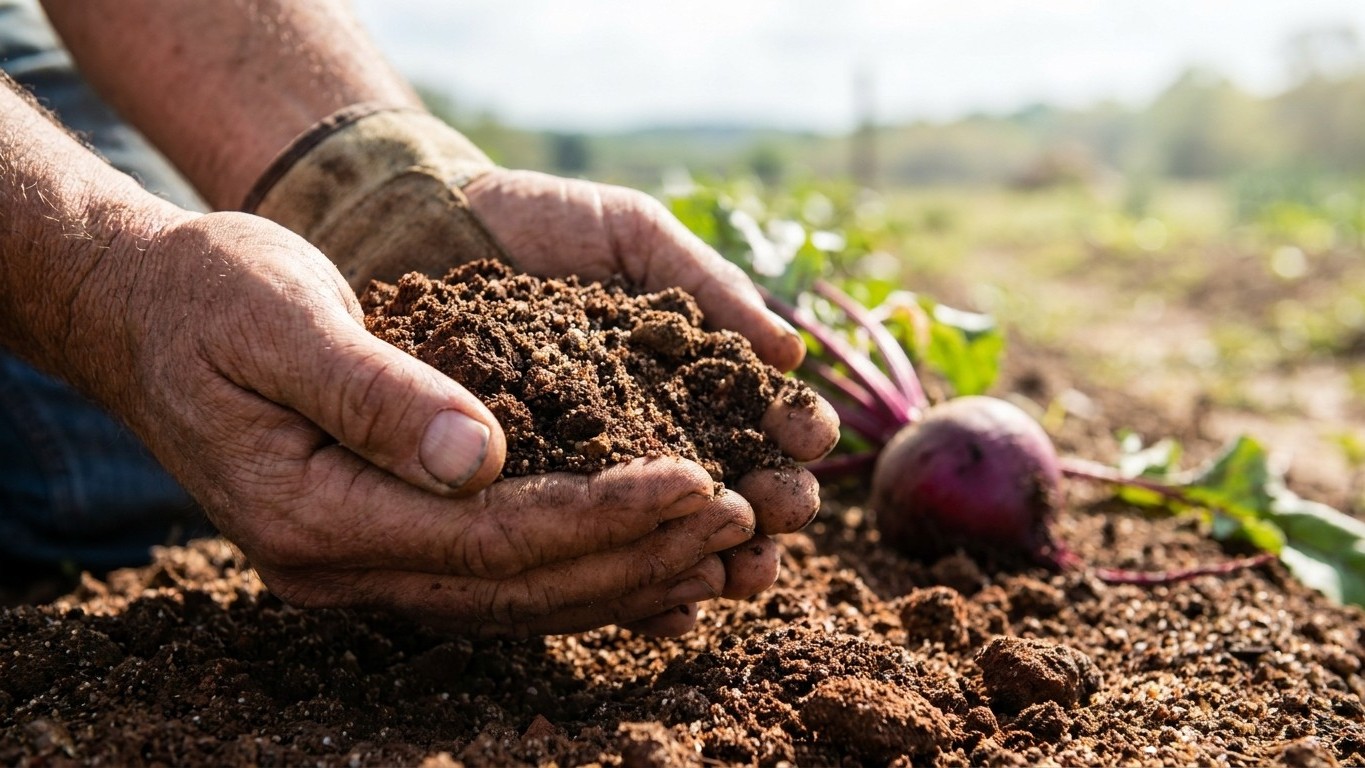

In Colorado, a beet root generally meets ground that’s better than its reputation: well-drained, slightly acid, with enough sand mixed in to let a taproot size up straight. The dirt usually isn’t the problem. What trips up beets here is timing and heat: a short window between sowing and the first real water stress, then summer sun that turns a root woody if it dries out at the wrong moment. The soil sets the stage. The weather writes the outcome.
The short answer
The soil USDA lists as representative of Colorado is the Seitz series, an Alfisol, which is the technical name for a forest soil of moderate fertility that holds onto nutrients reasonably well. Its surface horizon runs 42 percent sand, 21 percent clay and 37 percent silt, a loam-to-silt mix, with a pH around 5.6, slightly acid, and it drains well. For a beet, that texture is close to what the crop wants. Utah State University Extension describes beets as needing deep, sandy, well-drained soil rich in organic matter, and the Seitz series checks the sand and drainage boxes without much argument.
Where the number gets misleading
The organic matter figure attached to this series sits around 70 percent in the surface horizon as mapped, and that number needs a caveat before anyone gets excited. A figure that high means the mapped surface is a natural organic layer, something like forest litter or a peaty top layer, not the crumbly, worked topsoil of a cultivated garden bed. A backyard plot that’s been tilled, planted and amended for years will not carry anything close to that percentage, and it shouldn’t be read as a target. Utah State’s guidance is more useful here: no more than 1 inch of composted organic matter per 100 square feet worked into a bed. More than that, and beet roots tend to fork or grow hairy rather than smooth.
Heat is the other half of the equation
The Seitz series’ texture doesn’t say anything about temperature, and that’s where Colorado’s growing season does more damage than its ground does. Utah State’s research flags 85 F combined with water stress as the threshold where a beet root turns woody, and Front Range summers cross that mark on a regular basis. No day count above 90 F for a specific Colorado city is part of the dataset behind this page, so that figure isn’t stated here. What matters practically is the mechanism: heat alone doesn’t ruin a beet, heat paired with a dry spell does.
One more thing worth saying plainly: a state spans hundreds of soil series. The Seitz series is a representative starting point, not a description of any one garden. River bottoms, hillside plots and any yard where a builder scraped or filled the ground will differ from it, sometimes completely. A soil test remains the only way to know what a specific bed is actually working with.
The six weeks that decide it here
Beets get sown in place, directly into the ground, generally 2 to 3 weeks before the last spring frost. In Colorado, that last frost date runs from May 1 to May 11, based on NOAA’s 1991-2020 climate normals for a Denver-area station. That puts sowing somewhere in mid to late April, and it puts the first six weeks of a beet’s life, the window when it’s most vulnerable to drying out, squarely inside a Front Range spring.
What that spring tends to do
Colorado’s high-plains spring doesn’t do gentle drizzle. It swings. Warm, dry stretches with strong wind can pull moisture out of a seedbed fast, and those stretches often sit right next to cold snaps that bring the soil back down near freezing overnight. That combination, dry wind followed by a cold night followed by another dry stretch, is exactly the kind of instability that stresses a young beet plant before it’s built much of a root system at all.
Utah State’s research is specific about the consequence: water stress during those first six weeks is what pushes beets into premature flowering, known as bolting. Once a beet bolts, the plant redirects its energy into a seed stalk instead of the root, and the root itself typically turns tough and stringy. That’s a separate failure from the woodiness that heat causes later in the season, and it happens earlier and for a different reason. Given how dry and variable a Colorado spring tends to run, the bolting risk here sits mostly in that early window, before the plant has enough root mass to buffer a dry week on its own. Consistent moisture right after sowing matters more in this state than in a place with a wetter, steadier spring.
What goes wrong here
Layer Colorado’s climate onto the state’s representative soil and a handful of specific failures show up more often than others. Here’s where beets tend to fail in Colorado gardens, and what addresses each one.
- Bolting from a dry, windy spring. The six-week window after sowing lands in a season known for swinging fast between warm dry spells and cold nights. Water the bed consistently through that stretch rather than waiting for visible wilting, since the damage that triggers bolting happens before the plant shows stress.
- Woody roots from summer heat. Once temperatures climb past 85 F, any water stress on top of that heat toughens the root. Mulch to hold soil moisture longer between waterings, and water deeply rather than lightly and often as the root approaches harvest size.
- Forked or hairy roots in heavier ground. The Seitz series itself is a well-drained loam, but plenty of Colorado yards, particularly ones with fill dirt or compacted clay from construction, sit far denser than that. Loosen the bed to a full spade’s depth before sowing, and skip adding more than the recommended 1 inch of composted organic matter per 100 square feet, since overdoing it can cause the same forking problem it’s meant to prevent.
- Soil that doesn’t match the state benchmark at all. Alkaline soils are common across much of Colorado’s drier, lower-elevation ground, quite different from the Seitz series’ 5.6 pH. A garden’s actual pH can only be known through a soil test, not by assuming it matches the state’s representative soil, so testing before amending saves guesswork.
- Sowing timed to a calendar date instead of the frost window. Because the six-week vulnerable period starts at germination, sowing too early into cold, wet ground or too late into an already-hot stretch both narrow the safe window. Anchoring the sowing date to the local last-frost range, 2 to 3 weeks ahead of it, keeps that early period inside more predictable conditions.
Common questions
What’s the best soil pH for beets in Colorado?
The state’s representative soil, the Seitz series, runs around 5.6, slightly acid. That’s a benchmark, not a rule for every yard. Colorado gardens vary widely in pH, especially on drier, lower ground where alkaline soils are common, so a soil test of the actual bed is the only reliable way to know what’s being worked with.
When should I sow beet seeds in Colorado?
Generally 2 to 3 weeks before the last spring frost. For the Denver area, NOAA’s climate normals put that last frost between May 1 and May 11, which puts sowing in mid to late April for that location. Mountain towns and other elevations run shorter, later seasons and need their own local frost dates.
How long do beets take to mature from seed?
Beets are direct-sown, never transplanted, so the maturity clock starts at seeding. Depending on the variety, that typically runs in the 60- to 80-day range from the day seed goes into the ground.
Can beets handle Colorado’s clay soil?
Not as easily as they handle the state’s representative loam. Beets want deep, sandy, well-drained ground; heavier clay or compacted fill resists that and tends to produce forked or misshapen roots. Working the bed to a full spade’s depth and avoiding over-amending with organic matter helps close that gap, though a raised bed with a lighter mix is often the more direct fix on genuinely heavy clay.