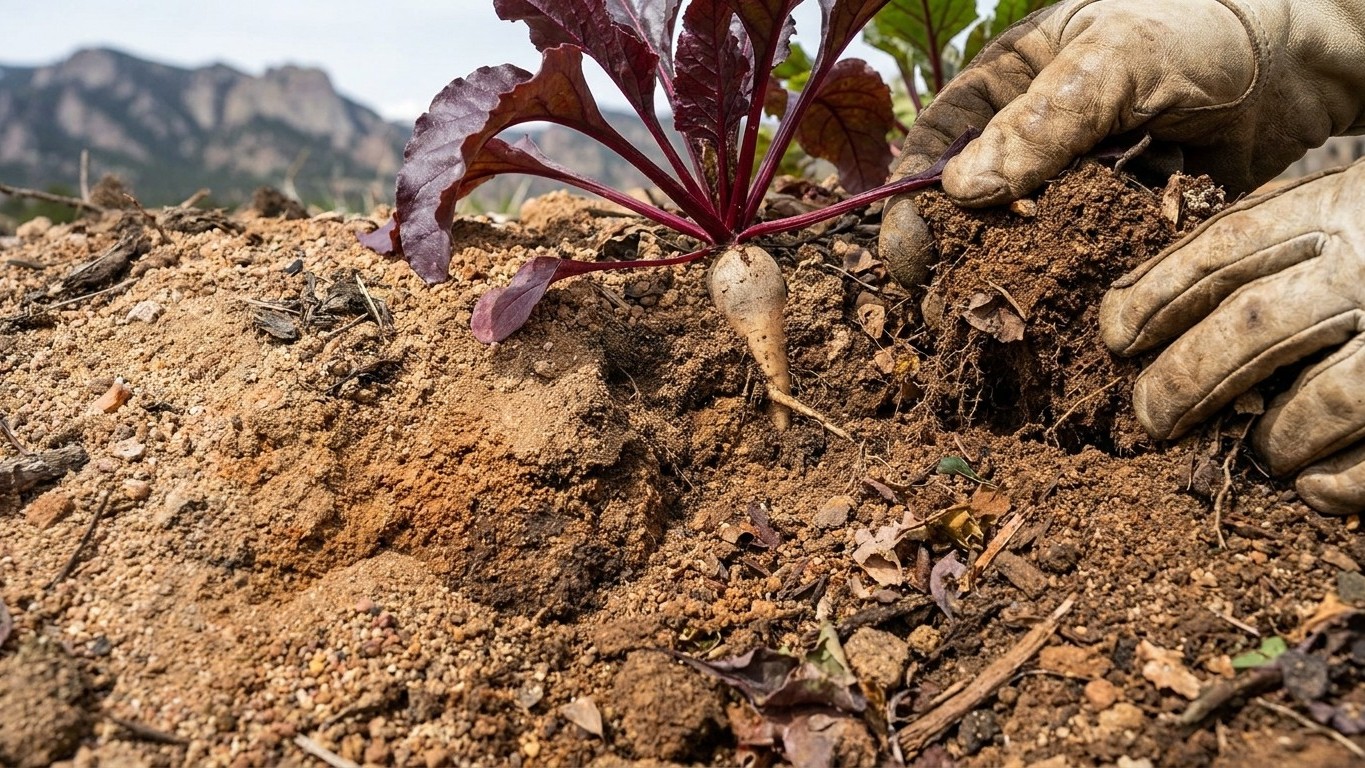

Colorado’s representative soil, the Seitz series, is a well-drained forest loam that runs slightly acid and low on nutrients storage compared to richer prairie ground. Beet Soil in Colorado can handle it, but only if you manage two separate risks: early-season dryness that pushes plants to bolt, and mid-summer heat that turns roots woody. Getting the timing right, see When to Sow Beets in Colorado, goes a long way toward avoiding both problems, though neither has the same fix.
The short answer
The Seitz series, the soil USDA lists as representative of Colorado, is an Alfisol built from a mix of 42 percent sand, 21 percent clay and 37 percent silt in its surface horizon, sitting right around pH 5.6 and classified well drained. For a beet, that texture is workable news: the sand fraction keeps water moving through rather than pooling around the taproot, and well-drained ground is exactly what Utah State University Extension recommends when it says beets want deep, sandy, well-drained soil rich in organic matter. The acidity is the part to watch. A surface pH near 5.6 sits on the acid side, and while that’s not automatically a dealbreaker, it means nutrients like calcium and boron, both of which beets pull on to build a solid root, may not be as available as they would be in neutral ground.
One number in the Seitz data needs a flag before anyone gets excited about it: the organic matter figure for this series’ surface horizon runs around 70 percent. That’s not a garden-bed reading. A number that high means the mapped surface is a natural organic layer, forest litter or a similar buildup, not a cultivated topsoil. Nobody’s raised beet bed will test anywhere near that, and treating it as a target would be a mistake. What the figure actually tells you is that the native ground here, before a shovel ever touched it, built up organic material naturally under tree cover, which is a reasonable argument for keeping compost habits going in a vegetable bed rather than skipping them.
On heat, the piece of data that would settle the woodiness question, how many days a year Denver or another reference city spends above 90°F, isn’t published in the sources behind this page, so it won’t be guessed at here. What is documented is the threshold that matters agronomically: Utah State University Extension puts the danger zone at 85°F combined with water stress, which is when beet roots start turning fibrous and tough. Colorado’s elevation keeps nighttime temperatures cooler than lowland states even during hot stretches, which takes some edge off sustained heat stress, but it doesn’t erase the risk on a string of dry, sunny days in July.
None of this is a verdict on any one backyard. Colorado spans hundreds of mapped soil series, from sandy river-bottom ground to heavy clay on old lakebeds to whatever mix a home builder left behind after grading a lot. The Seitz series is a statewide reference point, useful for guessing at general tendencies, not a stand-in for a soil test taken from an actual bed.
The six weeks that decide it here
Beets are sown directly in the ground, never transplanted, and the standard guidance is to get seed in 2 to 3 weeks before the last frost. NOAA’s 1991-2020 climate normals put Colorado’s last spring frost, based on 32°F freeze probabilities at station USW00003017, somewhere between May 1 and May 11. Count back from there and sowing lands in mid to late April for most Front Range gardens, which means the first six weeks of a beet’s life, the window Utah State identifies as the make-or-break period for bolting, run through late April into early June.
That stretch on Colorado’s plains has a reputation for swinging hard. Warm, dry, windy days can show up back-to-back with a late snow or a hard freeze, and soil moisture can disappear fast in low humidity even when the calendar says spring. That variability is exactly the setup Utah State University Extension warns about: water stress in the first six weeks after sowing is what triggers premature flowering, meaning the plant bolts and sends up a seed stalk instead of building a root worth eating. A beet doesn’t need a drought to bolt. It needs a handful of dry days at the wrong moment, right when the young plant is establishing itself, and Colorado’s spring pattern hands out exactly that kind of unevenness on a regular basis.
The practical takeaway is that this window deserves attention that a lot of gardeners give to July and skip in April. Wind alone can dry out the top inch of soil in a single afternoon on the plains, even when the air temperature isn’t particularly high, because low relative humidity pulls moisture out of exposed ground fast. Checking soil moisture by hand rather than trusting a glance at the sky matters more here than in a climate with steadier spring rain. And because mountain towns and the western slope run on entirely different frost schedules, sometimes with frost risk into July, anyone gardening outside the Front Range plains needs to treat the May 1 to May 11 window as a Denver-area reference, not a statewide rule.
What goes wrong here
- Bolting from an early dry spell. If the six weeks after sowing include a stretch of dry, windy days, plants read that stress as a signal to reproduce rather than build a root, and they send up a flower stalk instead. The fix is steady moisture through that window specifically, not just watering whenever it’s convenient; check soil an inch or two down every few days during April and May rather than relying on rainfall alone.
- Woody roots from summer heat combined with dry soil. Utah State University Extension is specific that this is a different failure from bolting: it happens later, when temperatures climb past 85°F and the plant is also short on water. The remedy is deep, consistent watering during hot stretches and mulch to hold soil moisture, since letting beets dry out on a 90-degree afternoon is what turns the root fibrous, not the heat by itself.
- Nutrient tie-up from acid soil. The Seitz series runs around pH 5.6, and ground on that acid side of neutral can lock up calcium and boron that beets need for solid root development. A soil test that comes back acidic is worth correcting with lime before planting rather than after a season of stunted roots.
- Forked or misshapen roots from compacted or rocky ground. Any bed that’s been graded, filled, or never deeply worked can force a taproot to split around obstructions. Loosening the bed a full 12 inches deep before sowing, and clearing rocks and clumps out of that zone, gives the root a straight path down.
- Overdoing the compost. Utah State University Extension caps organic matter amendment at 1 inch of composted material per 100 square feet. More than that can push soil too rich and unbalanced for root crops, encouraging leafy top growth at the expense of the root itself.
Checking this against your own county
The Seitz series and the May 1 to May 11 frost window describe a statewide reference point, not a specific backyard. The most useful next step is a county-level check through Colorado State University Extension, which can point to a soil test and local frost data specific to the county in question. Front Range gardeners, mountain-town growers, and anyone on the western slope are working with different growing seasons entirely, and a local extension office is the source built to sort that out rather than a statewide average.
Common questions
How long does it take to grow beets from seed in Colorado?
Beets are direct-sown, not transplanted, and the standard range runs 60 to 80 days from seeding to harvest. In Colorado, sowing 2 to 3 weeks ahead of the May 1 to May 11 last-frost window means most plantings land a harvest sometime in mid to late summer, depending on the variety and how the six-week establishment period goes.
Do beets need full sun in Colorado’s climate?
Utah State University Extension’s guidance centers on soil texture, drainage and moisture management rather than sun exposure specifics, so no sun requirement is stated in the sourced data here. General root-vegetable practice favors consistent sun, but readers should confirm particulars with Colorado State University Extension for their conditions.
Can I fix acidic soil before planting beets?
A soil test is the starting point, since the Seitz series reference value of pH 5.6 describes a statewide forest soil, not any individual garden. If a test comes back acidic, lime is the standard correction, but the amount depends on the actual reading, which only a test can provide.
Is bolting the same problem as woody roots?
No, and treating them as one issue is a common mistake. Bolting comes from water stress in the first six weeks after sowing and results in a flower stalk instead of a root. Woodiness comes later, when temperatures pass 85°F while the plant is also dry, and it toughens the root that’s already forming. They need different timing of attention: early-season moisture consistency for one, hot-weather deep watering for the other.