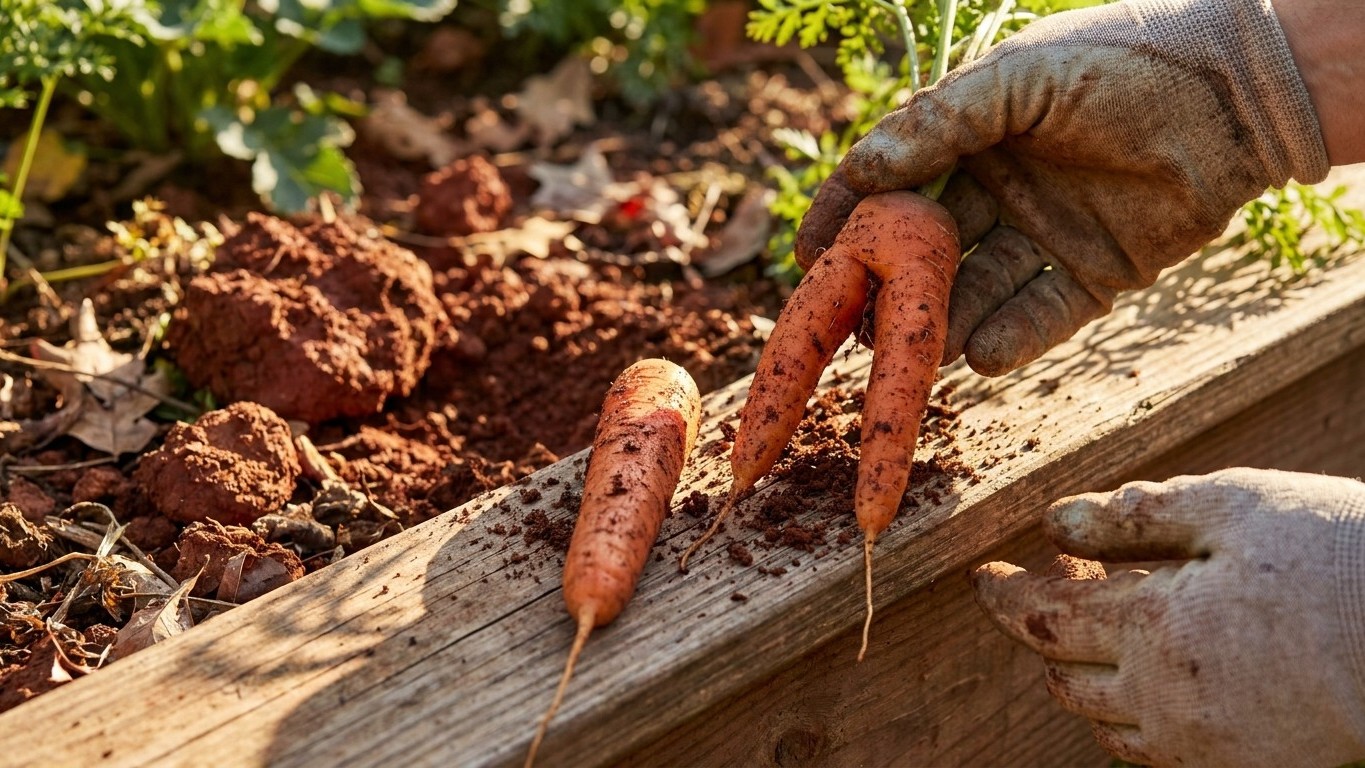

Florida’s official state soil, the Myakka series, is almost pure sand: 97 percent sand, 2 percent clay, 1 percent silt. That texture is close to the opposite of the heavy, rocky ground that makes a carrot fork, so on paper the forking risk from density alone is low. The catch is that Myakka carries a poorly drained rating, and Utah State University Extension is clear that carrots need well-drained ground, not just sandy ground. A raised bed or a heavily amended row usually settles what plain sand cannot.
The short answer
The soil named by state law as Florida’s official soil, the Myakka series, is classified as a Spodosol, a strongly leached, acid soil that historically formed under pine flatwoods across the state. USDA’s Soil Survey Geographic Database records the surface horizon at 97 percent sand, 2 percent clay and 1 percent silt, with a pH around 5.1, strongly acid, and organic matter near 2.0 percent. The series is rated poorly drained.
What the numbers mean for a carrot
Utah State University Extension names the two texture problems that make a carrot fork: heavy soil and rocky soil. A surface that runs 97 percent sand doesn’t match either description. There’s no clay pan for a taproot to push sideways against and no bed of gravel to split it in two. Judged on density and grit alone, ground built like Myakka carries little forking risk.
The complication is that sandy and poorly drained aren’t a contradiction here. The state soil’s own rating says water can sit low in the profile even while the surface feels loose and dry to the touch. Utah State’s guidance for carrots calls for soil that is deep, sandy, and well-drained, all at once, and it’s that last condition, drainage, that ground built like Myakka can fail even after the texture box is checked.
What fixes it
Utah State’s remedy for heavy soil, plenty of compost and double digging, still has a place here, just for a different reason. Working several inches of organic matter into the top of a sandy bed raises the organic-matter level well above the roughly 2.0 percent found in the native surface, and loosening that same layer lifts the root zone above whatever poorly drained ground sits underneath. A raised bed filled with a loosened, compost-rich mix sidesteps the drainage problem outright instead of trying to correct it in place, which matters more here than fighting density that mostly isn’t present.
None of this is a verdict on any one backyard. Florida is mapped across hundreds of soil series, and a state soil is a representative sample, not a survey of every lot. River bottoms tend to run heavier, hill country runs different again, and any yard where a builder scraped, graded, or trucked in fill dirt can carry nothing like Myakka underneath the sod. Treat the state soil as a place to start reading the ground, not a stand-in for testing it.
The test that settles it in your own garden
A soil survey describes what’s typical for a county, not what’s under one particular row of carrots. The only way to know whether a given bed will fork a carrot is to look at it directly, with a shovel and a bucket of water, before seed goes in the ground.
- Dig a test hole. Go down as deep as a full shovel blade, then a bit more. Carrots grow straight down before doing anything else; if the spade stalls on a hard layer, rock, or dense clay band well above where the root would reach, that’s the layer a carrot will hit too.
- Check for stones and debris. Sift through what comes out of the hole. Gravel, construction scraps, or old roots near the surface are enough on their own to fork or twist a taproot, no matter what the surrounding texture looks like.
- Feel the texture. Squeeze a handful of moist soil from the hole. Sand falls apart the moment you open your hand. Loam holds a loose shape and crumbles at a touch. Clay stays balled up, smooth and sticky, and keeps a thumbprint. The closer it sits to sand, the lower the forking risk from density; the closer to clay, the higher.
- Watch how water drains. Fill the hole with water and check on it through the day. Water that disappears quickly drains well. Water still sitting there later points to a poorly drained layer somewhere below, the same trait the state soil carries, and it calls for a raised bed rather than a fix worked into the existing ground.
- Repeat the test in more than one spot. A single hole only describes a single spot. Texture and drainage can shift across the same yard, especially anywhere fill dirt, an old foundation, or past landscaping disturbed the ground unevenly.
What goes wrong here
Sandy, poorly drained ground and Florida’s heat combine to cause a handful of specific, avoidable problems in a carrot row. None of them require a different variety, just a different approach to the bed itself.
Where sandy, poorly drained ground bites
- Forking in heavier pockets. Not every yard sits on pure sand like the mapped state soil. Anywhere the ground carries more clay, buried fill, or compaction than average, a root meets resistance and splits into forks. The fix is the one Utah State University Extension gives for heavy soil generally: work in plenty of compost and double dig the bed before sowing, breaking up the dense layer rather than leaving a root to fight through it.
- Poor germination during a hot spell. Carrot seed sits shallow, and a sandy surface layer like Myakka’s dries out fast under Florida heat, sometimes in a single day. Seed that dries before it sprouts simply fails. Keeping the top inch of the row damp with light, frequent watering, or covering it with a thin layer of mulch until seedlings appear, keeps the seed from drying out between waterings.
- Splitting from uneven water. Fast-draining sand swings between soaked and dry faster than heavier soil does, especially after a heavy afternoon rain followed by several dry days. That swing is exactly what splits a root that’s already sizing up below ground. A steady watering schedule, backed by mulch to slow evaporation, smooths out the swing instead of leaving the root to take up water in fits and starts.
- Waterlogged, rotting roots after heavy rain. A poorly drained rating means water can sit low in the soil profile even while the surface feels loose and gritty. A carrot left sitting in saturated ground for long stretches is more likely to rot than to fork. A raised bed filled with a loosened, well-drained mix sidesteps the standing water instead of trying to drain it away after the fact.
Common questions
Does sandy soil make carrots fork?
No. Utah State University Extension attributes forking to heavy or rocky soil, not to sand. Sandy soil is actually closer to what carrots prefer, provided it also carries enough organic matter and drains well, which is where a soil like Myakka can still fall short despite its texture.
Is Florida’s official state soil good for growing carrots as it is?
Not without amendment. The mapped surface of the Myakka series runs strongly acid, around pH 5.1, with organic matter near 2.0 percent, and it’s rated poorly drained despite being almost entirely sand. Building a bed on ground like this typically means adding compost to raise the organic matter and improve structure, and choosing a raised bed or worked-up mound to solve the drainage rating rather than the texture.
How long do carrots take from seeding to harvest?
Carrots are sown directly in the row rather than started elsewhere and transplanted, so the days to maturity are always counted from the seeding date, not from any transplant date. Utah State University Extension’s guidance on carrots in the garden puts that window at 70 to 100 days from seed to harvest, depending on the growing conditions the row provides along the way.
Should I test my own soil before planting carrots, even if I know the state soil?
Yes. The state soil describes a representative sample across hundreds of mapped series statewide, not the specific ground under a particular garden bed. Digging a test hole, checking for stones, feeling the texture, and watching how quickly water drains away tells a gardener far more about their own row than any statewide figure can.