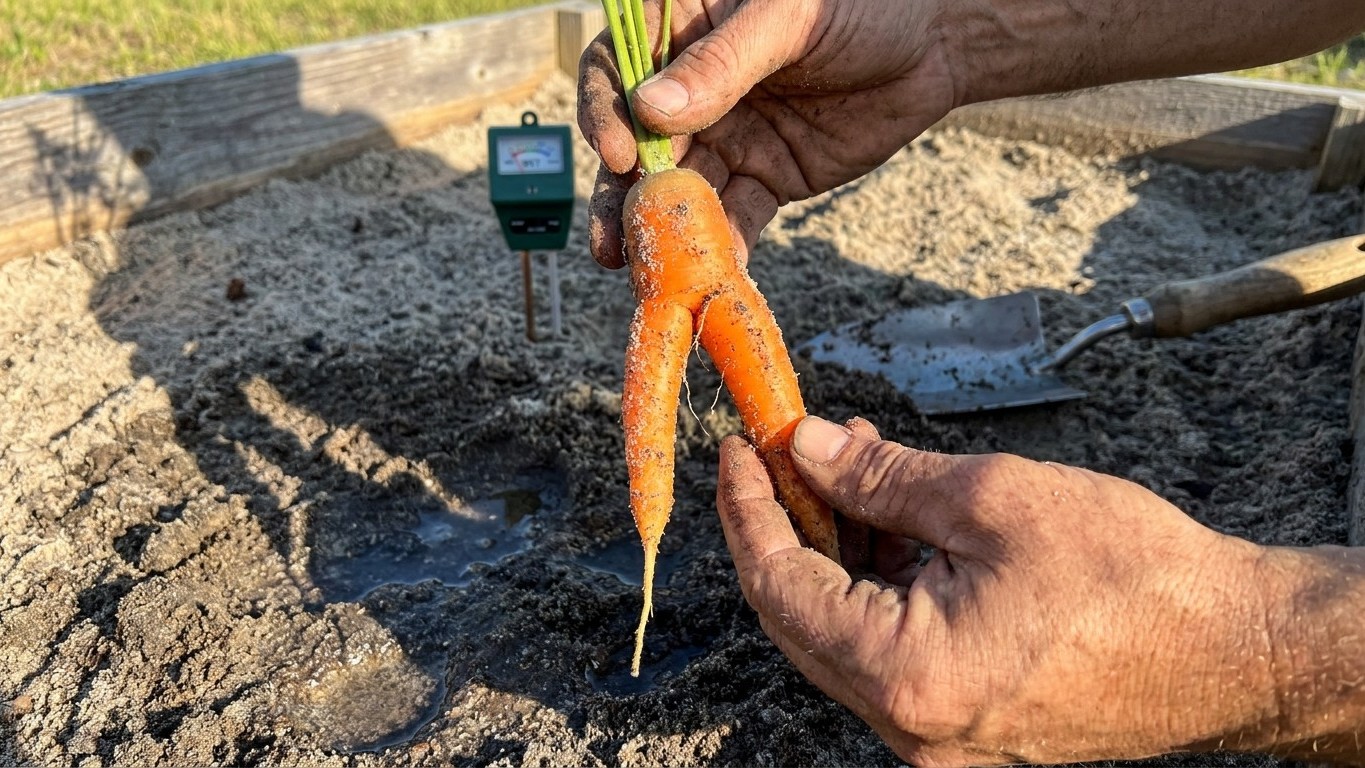

Florida’s official state soil is almost pure sand, which sounds like carrot heaven until you learn it’s also rated poorly drained. That combination, not clay, is what forks roots here. The fix depends entirely on what’s under your own feet, so dig before you decide anything.
The short answer
Florida’s state soil is the Myakka series, a Spodosol named the state’s official soil by Florida law back in 1989. Pull a sample from the surface horizon and the numbers read like this: 97 percent sand, 2 percent clay, 1 percent silt, organic matter around 2.0 percent, and a surface pH near 5.1, which is strongly acid. It’s also classed as poorly drained.
That last point is the twist. Utah State University Extension is clear that carrots want deep, sandy, well-drained soil rich in organic matter, and that heavy or rocky ground is what forks the root. On texture alone, Myakka passes with room to spare. Almost nothing else needs to be sifted or broken up to let a carrot root push straight down. But sand this fine, sitting in a soil rated poorly drained, tells a different story than a Midwest clay pan does, which raises the real question of Will Carrots Fork in Florida Soil? The problem in a lot of Florida ground isn’t a root hitting a rock or a wall of clay. It’s a root sitting in water it can’t shed fast enough, or growing through ground so short on organic matter (that 2.0 percent is thin) that it can’t hold a steady, even moisture level. Carrots don’t fork from a lack of structure the way they do in clay, but they do split and rot when moisture swings from soaked to dry and back, which is why knowing When to Sow Carrots in Florida matters just as much as the soil itself.
The fix looks different from the double-digging answer that heavy-soil gardeners reach for. Working in compost still matters, mainly to lift that organic matter figure and buffer the acidity, but the bigger move in poorly drained sandy ground is often a raised bed, which gets the root zone above standing water instead of trying to break through anything below it. If your dirt drains slowly, raise it. If it’s compacted or full of debris from grading or fill, double dig it. Those are two different diagnoses with two different tools, and Myakka’s numbers only point toward the first one.
None of this is a verdict on your yard. Florida carries hundreds of mapped soil series, from muck flats to old dune sand to compacted fill dirt trucked in during a subdivision build. Myakka is the state’s representative soil, not a stand-in for every backyard bed. Treat these numbers as the starting assumption you test against, not the answer you act on without digging first.
The test that settles it in your own garden
The only way to know what you’re actually working with is to go look at it. None of these steps need lab equipment, and none of them will hand you a number the facts here don’t already carry, but together they tell you whether you’re closer to Myakka’s sandy profile or to something a builder scraped and filled.
- Dig a hole at least a foot deep where you plan to sow. Note how easily the shovel goes in. Ground that resists at six or eight inches may have a compacted layer or old fill under a thin topsoil skin, and a carrot root will stop cold at that same depth.
- Look for stones, chunks of old concrete, or construction debris as you dig. Any of these will split or fork a root that runs into them on the way down.
- Grab a handful of moist soil from the hole and rub it between your fingers. Sand feels gritty and falls apart. Clay feels slick, sticky, and holds a shape when you squeeze it. Silt feels smooth, almost like flour. Most soil is a mix, and how it leans tells you how much organic matter and grit you may need to add.
- Fill the hole with water and time how long it takes to drain. Water that lingers for hours points toward the same poorly drained condition Myakka carries, and that’s your signal to raise the bed rather than dig it deeper.
- Repeat the dig in more than one spot in the yard. Soil can change completely within twenty feet, especially on lots that were graded or partly filled during construction.
When to sow here
Carrots are sown directly into the ground. There’s no seedling to transplant, and the standard 70 to 100 days to harvest counts from the day the seed goes into the soil, not from any later date. Timing that seeding date is where Florida’s split personality shows up.
NOAA’s climate normals for the Jacksonville station peg the local last spring freeze window at February 16 to March 7. That figure comes from thirty years of freeze-probability data, and even within that record three of the thirty years saw no freeze at all. This window applies to north Florida, where a freeze is still a real possibility. Central and south Florida run essentially frost-free, and there the whole calendar flips: instead of racing the last frost, gardeners in those regions are racing summer heat, and the main carrot season runs through the cooler winter months instead.
For a north Florida gardener working from that Jacksonville window, the arithmetic runs like this:
- Start with the last frost window, February 16 to March 7. Carrot seed goes in the ground 2 to 3 weeks before that date, not after it, since the crop tolerates cool soil far better than the heat that follows.
- Check soil Temperature before sowing. The ground needs to sit at 40 F at minimum for the seed to have any shot at germinating at all.
- Aim for the 55 to 65 F range if you can hit it. Germination is fastest and most even in that band, and seed sown well below or above it tends to sit in the ground doing nothing.
- Push the date earlier in a cold snap, later in a warm spell. The window isn’t a single fixed day. It moves with the year, and the NOAA range itself spans nearly three weeks for that reason.
Gardeners outside north Florida won’t find a comparable frost-based figure published here, since the NOAA data cited applies specifically to the Jacksonville station. In frost-free parts of the state, the safer approach is sowing carrots for a fall-through-winter harvest window instead of chasing a spring frost date that effectively doesn’t exist.
What goes wrong here
- Forking in compacted or debris-filled ground. Even sandy soil can pack down hard where fill dirt was trucked in or a driveway once stood. A root that hits resistance splits around it. Dig the test hole described above, and if the ground resists a shovel or holds rock and debris, build a raised bed instead of fighting what’s underneath.
- Poor germination during a heat spike. Carrot seed germinates best in the 55 to 65 F range, and a sudden warm stretch right after sowing can stall it out completely. Sow at the front edge of the recommended window rather than the back edge, and keep the seedbed lightly shaded and moist until seedlings show.
- Splitting roots from uneven watering. A root that grows in surging bursts, wet one week and bone-dry the next, tends to crack along its length as it swells unevenly. This is a common failure in sandy soil, which drains fast and dries out faster than it looks like it should. A steady watering schedule matters more here than the total amount of water applied.
- Stunted, pale roots in soil this acid and this thin on organic matter. A surface pH near 5.1 and organic matter around 2.0 percent, the values recorded for Myakka, don’t give a root much to work with. Working compost into the bed before sowing addresses both problems at once, feeding the soil and buffering the acidity.
Checking this against your own county
Myakka is Florida’s representative soil, not a survey of your particular county, and the frost data cited here comes from a single Jacksonville station. Neither one substitutes for a local read on your own conditions.
The University of Florida’s IFAS Extension network runs county offices across the state, and they’re the people equipped to answer questions this page can’t: what the local soil survey shows for your specific address, when the frost-free date actually lands in your county, and which local conditions matter for a carrot bed near you. Find your county’s office through the UF/IFAS Extension directory before you finalize a planting date or a soil amendment plan.
Common questions
Can carrots grow in Florida’s sandy soil?
Sandy soil is close to what carrots want, since Utah State University Extension identifies deep, sandy, well-drained ground as ideal for straight roots. The catch in Florida is that the state’s representative soil, Myakka, is sandy but rated poorly drained, so drainage needs attention even where texture is fine.
What actually causes forked carrots in Florida gardens?
Compacted ground, buried debris, or a dense fill layer under the topsoil are the usual causes, along with waterlogged beds in poorly drained soil. Loose, deep, well-drained ground with plenty of organic matter is what prevents it.
When should carrot seed go in the ground in north Florida?
Based on the Jacksonville frost window of February 16 to March 7, seed goes in 2 to 3 weeks before that range begins, once soil has warmed to at least 40 F. This is a seeding date, since carrots are sown directly and never transplanted.
Does the north Florida frost schedule apply statewide?
No. That window comes from a single Jacksonville-area station and describes north Florida conditions. Central and south Florida run essentially frost-free, and the growing calendar there shifts toward a fall-through-winter season instead of a spring-frost-driven one.