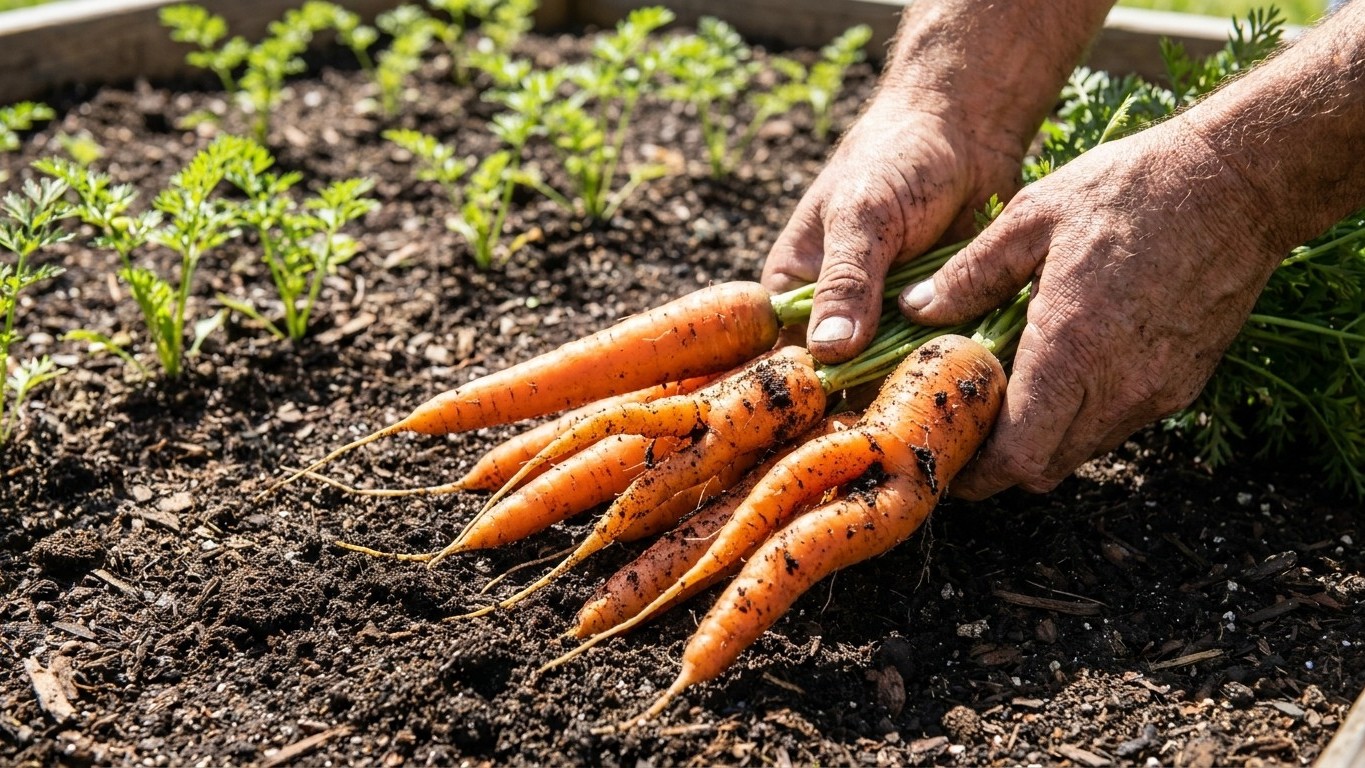

Florida’s carrot timing hinges less on a single frost date than on what’s under your boots. Carrots are direct-sown and need 70 to 100 days from seeding to harvest, never from a transplant date, and the state’s climate zones are too varied for one frost line to apply everywhere. The number that actually decides success statewide is soil: sandy, deep, well-drained ground carrots need, and Florida’s representative soil starts out working against that.
The short answer
Florida’s official state soil is the Myakka series, a Spodosol, the kind of soil that forms under conifers after centuries of leaching. USDA soil survey data puts the surface horizon at 97 percent sand, 2 percent clay and 1 percent silt, with organic matter around 2.0 percent and a surface pH near 5.1, which is strongly acid. The series is also classified as poorly drained, and it carries enough weight that the Florida legislature named it the official state soil.
That combination sounds like good news for carrots at first glance. Sand is exactly what root vegetables want, and Utah State University Extension is blunt about the alternative: carrots want deep, sandy, well-drained soil rich in organic matter, and heavy or rocky ground makes the taproot fork instead of growing straight down. Myakka’s sand fraction checks that box. But the “poorly drained” classification is the catch. A soil can be almost pure sand and still sit wet, if there’s a hardpan layer underneath holding water near the surface, which is common in Spodosols like this one. Carrots sunk into that kind of profile don’t fork from clay or rocks, they stall or rot at the tip because the root can’t push through a saturated zone, and the low organic matter (2.0 percent) means the loose surface sand doesn’t hold moisture or nutrients evenly once you start irrigating.
The fix looks the same as it would in heavy clay, just for a different reason: build up, don’t just dig down. A raised bed filled with a sand-compost mix drains past any perched water table and gives the root a full 10 to 12 inches of open profile with no hardpan to hit. Working several inches of compost into the top layer of an in-ground bed helps too, adding the organic matter this soil is short on and improving how evenly it holds water between waterings.
None of this describes your yard specifically. Florida spans hundreds of mapped soil series, from river-bottom muck to old citrus grove sand to whatever a builder trucked in and graded flat before your house went up. Myakka is the representative soil for the state as a whole, the one that shows up often enough in surveys to earn official status, not a verdict on the ground behind your particular fence line.
The test that settles it in your own garden
State-level survey data is a starting point, not a diagnosis. The only way to know what you’re actually planting into is to look at it yourself, and none of the steps below require lab equipment.
- Dig a test hole at least a foot deep. Use a shovel or post-hole digger in the exact spot you plan to plant, not just anywhere in the yard. Soil can change dramatically over a few feet, especially near a foundation, driveway, or old fill area.
- Check the depth and look for obstructions. Carrots need open, unbroken ground to grow long and straight. Note where you hit rock, buried construction debris, a compacted layer, or a hardpan that stops the shovel. Any of these near the surface will force the root to bend or fork.
- Feel the texture between your fingers. Grab a handful of moist soil and rub it. Gritty and loose means sandy. Slick, sticky, and able to hold a ribbon shape when squeezed means heavy clay. Something in between, that crumbles into loose clumps, is closer to the loam carrots prefer.
- Watch how water drains. Fill the test hole with water and time how long it takes to disappear. Water that vanishes within a few hours drains well. Water still standing the next day signals a poor-draining spot, whatever the texture felt like in your hand, and it points straight toward a raised bed.
Run this test in more than one spot in the garden if you have room to choose. The bed that passes all four checks, open to a foot or more, no obstructions near the surface, a texture that isn’t sticky clay, and water that drains within hours, is the one to plant carrots in. A spot that fails on drainage or hits an obstruction within a few inches is telling you to build a raised bed rather than fight the native ground.
What goes wrong here
- Forking in compacted or clay-heavy pockets. Even in a state whose representative soil runs sandy, individual yards carry patches of dense fill dirt, clay lenses, or compacted subsoil left over from construction. Utah State University Extension is direct on the cause: heavy or rocky soil makes the root fork. The remedy is the same one used for clay anywhere else: work in generous compost and double dig the bed to break up the compaction before seeding, or skip the fight entirely with a raised bed filled with loose, sand-compost mix.
- Poor germination during a hot, dry stretch. Carrot seed is small and sits near the surface, and a sandy soil like Myakka’s surface horizon dries out fast once the sun hits it. A crust can form on top or the seed bed can simply dry out before the seed sprouts. Keeping the surface consistently moist with light, frequent watering (not deep soaking) until germination is what carries seedlings through a hot spell.
- Splitting from uneven watering. Roots that go through a dry stretch and then get a heavy soak swell too fast on the inside and crack along the length of the root. This is a watering-schedule problem more than a soil problem, and it’s worth watching closely in sandy ground, which drains fast and dries out between waterings quicker than loam does. A steady, even watering routine rather than feast-or-famine irrigation prevents most splitting.
- Weak roots from low organic matter. Myakka’s surface horizon carries only about 2.0 percent organic matter, which is thin for feeding a root crop through a 70 to 100 day season. Mixing compost into the bed before sowing, rather than top-dressing later, gives the developing root steady nutrition and helps sandy soil hold moisture between waterings.
Common questions
Do I need to test my own soil, or is the state soil information enough?
Test your own bed. The Myakka series describes the soil that represents Florida overall, not the specific patch of ground in your yard. A state holds hundreds of distinct soil series, and builders regularly grade, fill, or strip topsoil before a house is finished, so what’s actually under your garden bed can look nothing like the state’s representative profile.
Is Florida’s sandy soil automatically good for carrots?
Sand alone helps, since Utah State University Extension notes carrots need deep, sandy, well-drained ground to grow straight. But Myakka’s classification as poorly drained means sand on its own doesn’t guarantee good drainage if a hardpan or perched water sits underneath. Check drainage directly with a water-fill test rather than assuming sand equals good drainage.
Should I count the 70 to 100 days from seeding or from transplanting?
From seeding, always. Carrots are sown directly into the ground and are never transplanted, so there’s no transplant date to count from. The 70 to 100 day window runs from the day the seed goes into the soil to harvest.
What’s the fastest fix for a bed that fails the drainage test?
Build a raised bed. Filling it with a loose mix of sand and compost sidesteps a hardpan or perched water table entirely, giving the root a clear, well-drained path down without needing to amend or break up the native ground underneath.