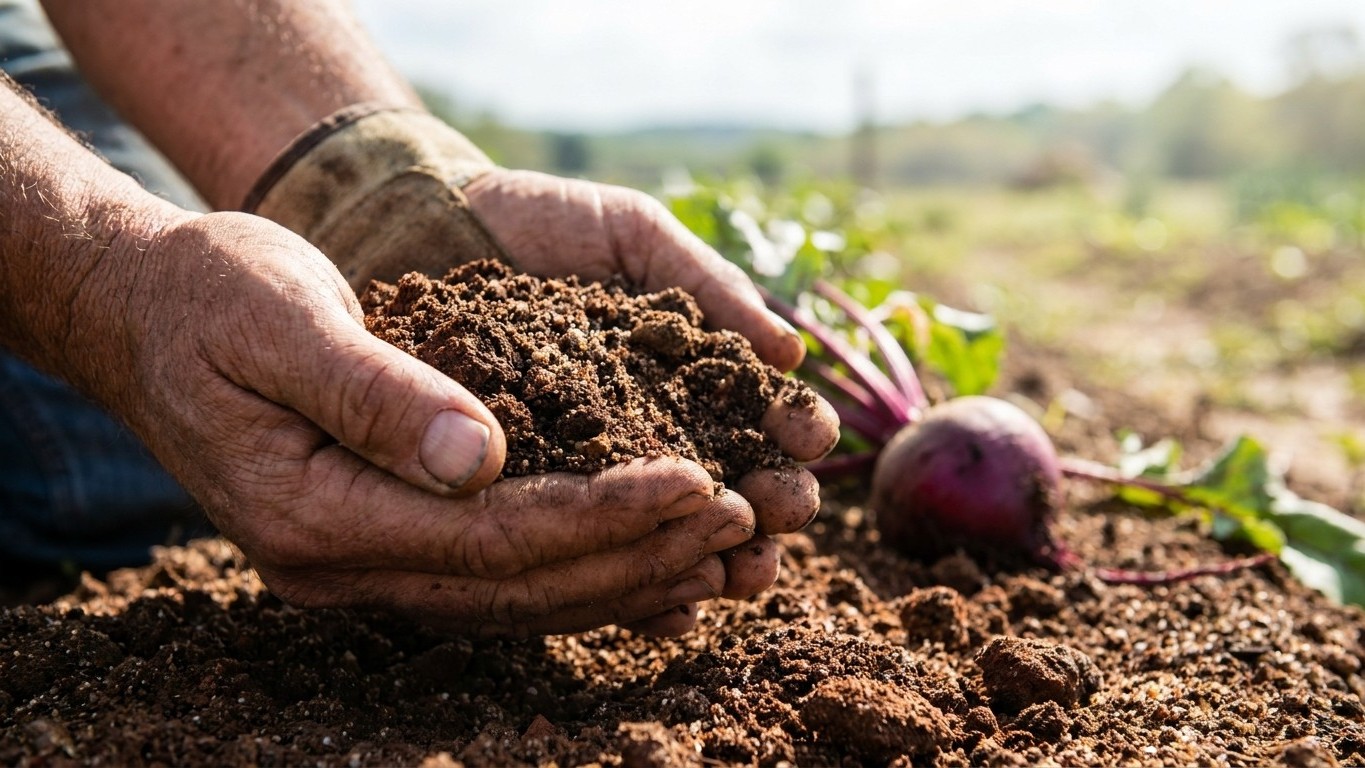

Hawaii’s representative soil, the Hilo series, is a volcanic-ash Andisol: light, porous, and better than almost any other soil type at holding onto both water and phosphorus. Its surface pH runs about 5.8, and the texture leans heavy on silt and clay rather than sand. For a beet, that mix cuts both ways: good drainage, but a taproot that has to push through more clay than it wants. There’s no frost season here to build a calendar around, so timing runs on rainfall and elevation instead.
The short answer
Pull up the soil survey for the Big Island and you land on the Hilo series, the soil USDA lists as representative of Hawaii under its State Soils program. It’s an Andisol, built from weathered volcanic ash, and it behaves differently than the sand, loam, or red clay a mainland gardener might know. The surface horizon runs 10 percent sand, 35 percent clay, and 55 percent silt, with organic matter around 9.0 percent and a classification of well drained. Surface pH sits at about 5.8, slightly on the acid side.
That’s the profile USDA uses to represent the state, not a reading from any one backyard. Hawaii holds hundreds of mapped soil series, and a garden a few miles inland, at a different elevation, or on reclaimed lava rock can look nothing like Hilo series ground. Treat these numbers as a starting point for how the region’s soil tends to behave, then confirm your own plot with a soil test.
Working with this soil, not against it
Utah State University Extension is clear about what beets actually want: deep, sandy, well-drained soil rich in organic matter. Hilo series soil delivers the drainage and the organic matter, but not the sand. Silt and clay together make up 90 percent of the surface horizon, and that much fine material can compact around a beet’s taproot, especially once foot traffic or irrigation pressure works it down. The well-drained rating helps offset some of that risk, since water doesn’t sit on the root and rot it, but it doesn’t fix the mechanical resistance clay-heavy, silt-heavy ground puts up against a root trying to swell straight down.
The fix isn’t more organic matter than the plant needs. USU Extension caps amendment at 1 inch of composted organic matter per 100 square feet; going past that in soil already sitting at 9.0 percent organic matter risks smothering drainage rather than improving it. A raised bed or deeply loosened row gives the root somewhere easier to go than fighting native silt and clay straight down.
On heat, the source data doesn’t publish a specific count of days above 90 F for a Hawaii reference station, so that figure isn’t given here. What is documented is the mechanism: heat above 85 F combined with water stress makes a beet root woody. Lowland Hawaii commonly runs at or near that threshold for long stretches, which keeps this risk live for most of a beet’s time in the ground, regardless of which month it’s sown.
The six weeks that decide it here
On the mainland, gardeners count backward from a last-frost date to time the first six weeks of a beet’s life, the window where water stress does the most damage. Hawaii doesn’t give you that anchor. NOAA’s climate normals for the reference station here show zero days per year at or below 32 F and no computable freeze percentile at all: there is no spring frost to count from in inhabited, low-elevation Hawaii. Freeze only happens on the high summits of Mauna Kea, Mauna Loa, and Haleakala, ground no one is planting beets on.
What actually shifts the risk
Without a frost date, the calendar that matters here runs on rainfall and geography instead. Windward slopes catch consistent moisture off the trade winds; leeward slopes sit drier and more exposed to sun for more of the year. Elevation adds another layer, with higher ground running cooler and often wetter than coastal lowland. None of that swings on a fixed spring season the way a continental climate does, it swings on which side of an island a garden sits on and how high up it is.
That geography is what decides where bolting risk lands. A beet sown on a dry leeward slope, or in a stretch where irrigation lapses during its first six weeks, hits the same premature-flowering trigger USU Extension describes for any beet under early water stress, just without a frost date to blame or plan around. A beet sown on a consistently wet windward slope faces less of that early-thirst risk, but the Hilo series’ clay-and-silt-heavy texture combined with heavy rain can leave the root zone saturated for longer stretches even at a “well drained” rating, since drainage class describes the soil profile, not how fast a heavy tropical downpour moves through it.
The practical takeaway: in Hawaii, the first six weeks are decided by exposure and irrigation discipline, not by a date on a calendar. Consistent watering through that window matters more here than it would somewhere with a predictable wet spring, precisely because there’s no seasonal rainfall pattern to rely on by default.
What goes wrong here
- Forked or stunted roots from clay-silt compaction: the Hilo series’ 35 percent clay and 55 percent silt surface can pack down around a taproot. Loosen the bed to a full spade depth before sowing, and skip extra compost beyond the 1-inch-per-100-square-foot cap USU Extension recommends, since more organic matter on already organic-rich ground can make compaction worse, not better.
- Bolting from early water stress on dry leeward ground: beets that go thirsty in their first six weeks after seeding flower prematurely instead of building a root. Set irrigation on a fixed schedule through that window rather than waiting for rain that a leeward slope may not reliably deliver.
- Woody roots from sustained heat: once temperatures climb past 85 F while the plant is also short on water, the root turns fibrous and tough. Mulch to keep soil temperature down and water deeply on a regular schedule rather than letting the bed dry out between waterings.
- Nutrient lockup from acidic surface pH: the Hilo series runs about 5.8 at the surface, slightly acid. Rather than lime on assumption, run a soil test on the actual garden bed, since a mapped series value isn’t the same as a reading from a worked, amended row.
- Waterlogged rows despite a “well drained” rating: heavy windward rainfall can still saturate a silt-and-clay-heavy bed for stretches longer than the taproot tolerates well. Raised beds or slightly mounded rows give excess water somewhere to go besides sitting against the root.
Common questions
Is there a frost date to time beet planting in Hawaii?
No. NOAA climate data for the reference station shows zero days per year at or below 32 F, with freeze restricted to the high volcanic summits. Lowland gardens never see it, so timing runs on rainfall, elevation, and windward versus leeward exposure instead of a frost calendar.
How many days after seeding do beets take to mature here?
Beets are sown directly in the ground, not transplanted, and the maturity window runs from that seeding date. Per Utah State University Extension, most beets reach harvest 60 to 80 days after seeding; nothing in Hawaii’s frost-free climate shortens or extends that window on its own, though sustained heat and water stress can affect root quality along the way.
Can I add compost to Hawaii’s volcanic soil for beets?
Yes, but sparingly. The Hilo series already carries about 9.0 percent organic matter at the surface. USU Extension caps amendment at 1 inch of composted organic matter per 100 square feet; adding more than that on soil already this rich risks compacting the root zone rather than loosening it.
Does the volcanic soil’s phosphorus retention help beets?
Andisols like the Hilo series are known for holding phosphorus unusually well, which is a genuine advantage for root crops that need steady nutrient access. It doesn’t offset the texture problem, though: 90 percent of the surface horizon is silt and clay, and that’s still the more immediate factor shaping whether a beet’s root grows straight or forks against compacted ground.