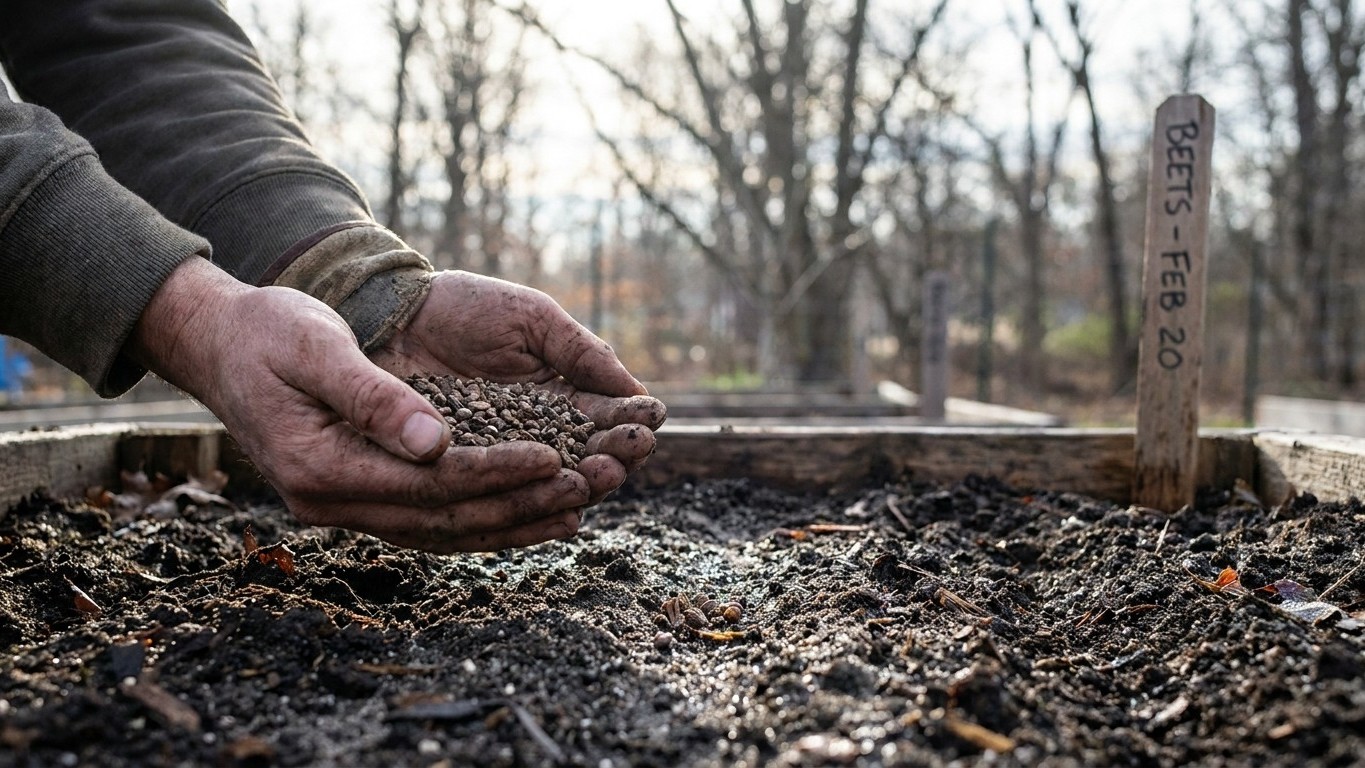

Beets in Hawaii go into the ground whenever the local rainfall pattern lets you keep the seedbed evenly moist for six straight weeks, because there’s no frost date to build a calendar around. That single fact, more than any month on paper, decides whether your roots bolt, turn woody, or size up the way they should.
The short answer
USDA’s representative soil for Hawaii is the Hilo series, an Andisol built from weathered volcanic ash. It’s light and porous in a way that lets it hold onto both water and phosphorus far better than most mineral soils, which sounds like good news for a root crop. The surface horizon runs slightly acid, about pH 5.8, and comes in heavy on fines: 10 percent sand, 35 percent clay, and 55 percent silt, with organic matter around 9.0 percent and a well-drained rating. That combination of high organic matter and good drainage checks two boxes Utah State University Extension lists as beet requirements. But beets also want a deep, sandy structure, and a soil that’s 90 percent clay and silt by weight isn’t sandy. Expect roots that fight the ground on the way down unless you loosen the bed or build it up.
The brief asked how many days a year a reference city here climbs past 90 F, and that figure simply isn’t part of the published data behind this page, so it won’t be guessed at. What can be said plainly: Hawaii has no frost season anywhere people garden. NOAA’s climate normals for the region show every freeze threshold as not computable, with zero days a year at or below 32 F. Frost exists only on the summits of Mauna Kea, Mauna Loa, and Haleakala, thousands of feet above any vegetable bed. That means the usual “count back from the last frost” logic doesn’t exist here at all. Timing instead rides on rainfall, elevation, and whether a garden sits windward (wetter, generally milder) or leeward (drier, generally hotter) of the island’s mountains.
None of this is a diagnosis of your particular yard. Hawaii, like every state, spans hundreds of mapped soil series, and the Hilo series is simply the one USDA lists as representative of the state as a whole. A garden carved from lava rock, filled with imported topsoil, or sitting in a low wet valley could behave nothing like the numbers above. Treat the Hilo figures as a sketch of what the region’s volcanic ground tends to do, not a report card on your bed. A soil test remains the only way to know your actual pH and texture before you commit a beet crop to it.
The six weeks that decide it here
Everywhere with a real winter, gardeners sow beets two to three weeks before the last frost so the first six critical weeks land in a predictable stretch of spring. Hawaii has no such anchor point. The six weeks after sowing here fall inside whatever rainfall regime happens to be running in your part of the island at the time, and that regime is set by geography more than by the calendar on the wall. A windward garden tends to get steadier, more frequent rain; a leeward garden tends to run drier and warmer for longer stretches. Without a published day-count for either pattern in the source data behind this page, the honest move is to judge your own site by what it’s actually doing that week, not by what month it is.
What matters agronomically is unchanged by geography: Utah State University Extension is specific that water stress in the first six weeks after sowing is what pushes beets into premature flowering, or bolting. A young beet that dries out even briefly during that window can lock in a decision to flower rather than to bulk up a root, and there’s no reversing that decision once it’s made. In a leeward, drier stretch, that risk sits squarely on the gardener’s shoulders, because rainfall alone likely won’t carry a bed through six consistent weeks. In a windward, wetter stretch, natural rainfall does more of the work, but even a well-drained Andisol like the Hilo series can sit soggy in a poorly graded bed, and beets don’t want to sit in standing water any more than they want to dry out.
The practical takeaway isn’t a date. It’s a habit: whatever six-week window you pick, plan to check soil moisture by hand rather than trust rainfall to show up on schedule, because in this state it’s geography, not season, that decides whether it will.
What goes wrong here
- Bolting from a dry stretch in the first six weeks. This hits leeward and drier gardens hardest, where rainfall can’t be counted on to carry seedlings through. The remedy is direct: irrigate on a fixed schedule rather than waiting for rain, and mulch lightly to slow evaporation from that porous volcanic-ash surface.
- Woody roots from heat layered on top of water stress. Utah State University Extension ties this specifically to temperatures above 85 F combined with a dry root zone, a separate failure from bolting and one that shows up later in the crop’s life, closer to the 60- to 80-day maturity window counted from seeding. The fix is consistent watering through any hot stretch and pulling roots promptly once they’ve sized up, rather than leaving them in the ground through prolonged heat.
- Roots fighting a silt-heavy, clay-heavy bed. At 35 percent clay and 55 percent silt, the Hilo series is far from the deep, sandy structure beets prefer. Loosen the bed a full spade’s depth before sowing, and work in composted organic matter, capped at 1 inch per 100 square feet, to open the texture without overloading a soil that already runs close to 9 percent organic matter on its own.
- Sowing by a frost calendar that doesn’t apply. Lowland Hawaii has no measurable frost season at all, so any planting chart built around a last-frost date is simply the wrong tool here. Replace it with a rainfall-and-irrigation plan specific to your windward or leeward exposure.
- Assuming your yard matches the state’s representative soil. The Hilo series describes a mapped surface horizon, not your worked garden bed. If your soil test comes back sandier, more acidic, or less organic than the figures above, adjust amendments to what your test says, not to what the state series says.
Common questions
Is there a frost-based planting calendar for beets in Hawaii?
No. NOAA’s climate normals for the region show zero days a year at or below 32 F, and every freeze threshold in the data is flagged not computable. Frost only occurs on the high summits, never where gardens grow. Any planting decision here should be built around rainfall and irrigation, not a frost date.
How long do beets take to mature once sown in Hawaii?
Beets are sown directly in place rather than transplanted, and the maturity window runs 60 to 80 days from that seeding date. Nothing in the source data ties a shorter or longer window specifically to Hawaii’s climate, so plan around the standard range and check roots by size rather than by a fixed day count.
Does Hawaii’s volcanic soil suit beets?
Partly. The Hilo series is well drained and rich in organic matter, both traits beets favor, but it’s heavier in clay and silt than the deep sandy soil Utah State University Extension recommends. Loosening the bed and adding modest amounts of compost helps close that gap, though a personal soil test is the only way to know how closely your own ground matches the state series.
Should I test my own soil before sowing beets here?
Yes. The Hilo series is USDA’s representative soil for the state as a whole, not a measurement of any individual garden. Hawaii’s soils range from raw lava fill to river-bottom deposits, and a test is the only way to know your real pH and texture before amending or timing a beet crop around figures that may not describe your yard at all.