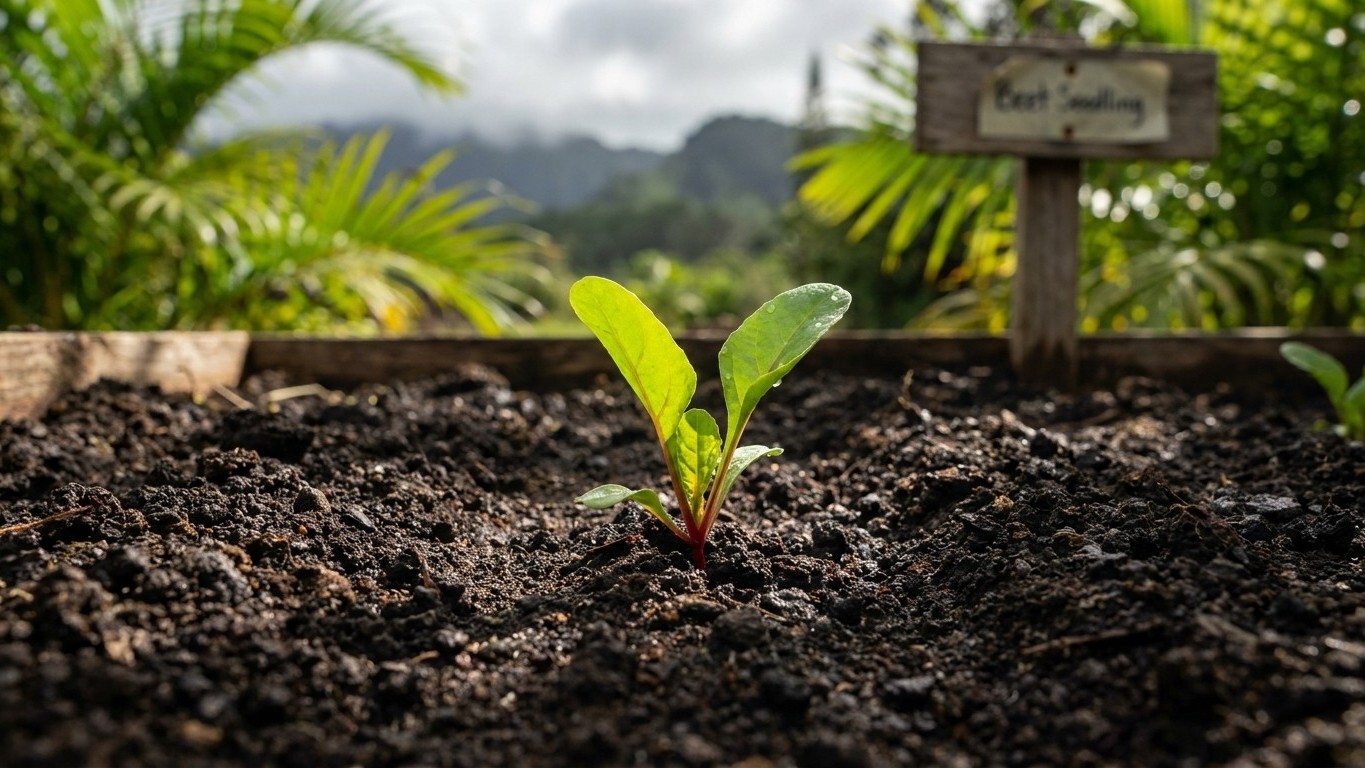

Beets in Hawaii do best in soil that drains fast and never dries out completely, which is a tricky combination in a state built from volcanic ash and heavy tropical rain. The real risk here isn’t frost, since lowland Hawaii essentially never freezes. It’s the six-week seedling window that goes bone-dry between rains, triggering premature flowering, and later heat that turns an otherwise fine root woody. Get the moisture rhythm right and the state’s ash soils do most of the rest of the work for you.
The short answer
The soil USDA lists as representative of Hawaii is the Hilo series, an Andisol, meaning it started as volcanic ash rather than weathered rock. That origin makes it light and porous, and unusually good at holding both water and phosphorus, two things a beet root genuinely needs. But “light and porous” doesn’t mean sandy. The Hilo series surface horizon runs about 10 percent sand, 35 percent clay and 55 percent silt, which is a heavy, silt-dominated soil by any measure. Surface pH sits around 5.8, mildly acid, and organic matter averages about 9.0 percent, both workable numbers for a root vegetable. Drainage is classed as well drained, which matters because beets sitting in saturated ground for days will rot or fork before they ever size up.
Utah State University Extension is blunt about what beets actually want: deep, sandy, well-drained soil rich in organic matter, amended with no more than 1 inch of composted organic matter per 100 square feet. Compare that ideal to the Hilo series and the mismatch is obvious, at least on the texture front. A silty, clay-heavy Andisol will hold moisture longer than a sandy loam, which can be a genuine advantage against the water stress that triggers bolting, but it also means a bed can stay soggy after heavy rain, and beet roots don’t like wet feet any more than they like drought.
Temperature is the other half of the equation, and here the published record is thin. No days-above-90-F figure for a reference Hawaii city appears in the data behind this page, so that number simply isn’t stated here rather than guessed at. What’s clear from the extension guidance is the mechanism: heat above 85 F combined with water stress is what makes a beet root woody, stringy and unpleasant to eat, independent of whatever triggered bolting earlier in the season. Timing your planting correctly is essential, so see When to Sow Beets in Hawaii for guidance on avoiding both stresses.
None of this describes every garden in the state. Hawaii spans hundreds of mapped soil series across its islands, from young lava-derived ash near active volcanic zones to older, more weathered clays on windward slopes and imported fill in lowland subdivisions. The Hilo series is the state’s representative soil in USDA’s records, not a stand-in for the dirt behind any one house. Treat the numbers above as a starting point for understanding Beet Soil in Hawaii, not a substitute for testing what the region’s ground tends to do, then confirm your own plot with a soil test before you plan the bed.
The six weeks that decide it here
Most beet-growing guides built for the mainland tell you to sow 2 to 3 weeks before the last spring frost, which anchors the whole calendar to a freeze date. That approach doesn’t apply in Hawaii. NOAA’s 30-year climate normals for the state’s reference station show no freeze occurring in inhabited areas at all, no measurable date at either the 32 F or 36 F threshold. Frost exists only on the summits of Mauna Kea, Mauna Loa and Haleakala, thousands of feet above any vegetable bed. A frost-based sowing calendar simply has nothing to attach to here.
What governs the calendar instead is rainfall, elevation and whether a garden sits on the windward or leeward side of an island. Windward slopes catch the trade winds and the moisture that rides in on them, often staying wet enough that the challenge is drainage rather than drought. Leeward gardens, in the rain shadow of the island’s mountains, tend to run drier and hotter, and that’s exactly the combination that stresses a young beet stand. Since beets are sown directly in place, never transplanted, that first six-week stretch from seed happens in whatever moisture pattern the local microclimate delivers that season, dry, wet, or swinging between the two depending on trade-wind strength and which side of the island the bed is on.
Utah State University Extension’s finding is specific: water stress during those first six weeks causes premature flowering, meaning bolting, in beets. It doesn’t say the plant will look unhappy or grow slowly. It says the plant will shift into reproductive mode and abandon the root you’re trying to grow. On a leeward Hawaii garden going through a dry stretch, an unwatered bed can hit that threshold quietly, well before any wilting is visible above ground. On a windward garden getting frequent showers, the six-week window is less likely to run dry, but a heavy clay-and-silt bed like the Hilo series can stay waterlogged instead, which brings its own set of root problems even if bolting isn’t one of them.
The practical takeaway is to track your own soil moisture through that seedling stage rather than relying on any statewide rainfall assumption, since windward and leeward conditions on the same island can differ enormously within a few miles.
What goes wrong here
- Bolting from a dry stretch in the first six weeks. This is the failure Utah State University Extension ties directly to early water stress, and it’s the one most likely to bite on leeward, drier gardens. The remedy is consistent moisture at the seedling stage, not occasional deep watering once symptoms show, since by the time the plant visibly struggles the flowering trigger has often already happened.
- Woody roots from heat plus drought later in the season. This is a separate mechanism from bolting: heat above 85 F combined with water stress toughens the root’s texture, per Utah State University Extension, even in plants that never flowered early. The fix is maintaining even soil moisture through the hotter stretch of the growing cycle, not just at the start.
- Waterlogging in the heavy, silt-and-clay Hilo-type soil after tropical downpours. A well-drained soil classification doesn’t prevent short-term saturation during a heavy rain event, and beet roots sitting in soggy ground can rot or split before they mature. Raised beds or added drainage material help beds that repeatedly puddle after rain.
- Over-amending an already organic-rich soil. With organic matter around 9.0 percent already present in the representative surface horizon, piling on more compost than the recommended 1 inch per 100 square feet risks nitrogen imbalance and excess leaf growth at the root’s expense. Test before adding, rather than assuming more organic matter is automatically better.
- Assuming the state soil describes your own bed. A garden on imported fill, old lava rock, or a different island’s soil series can behave nothing like the Hilo series numbers above. Skipping a soil test and planting on assumption is the single most common way gardeners here get blindsided by pH or drainage problems the state average never warned them about.
Checking this against your own county
Everything above describes the state’s representative soil and general climate mechanics, not the dirt in any one backyard. Hawaii’s soils shift dramatically from one valley or lava flow to the next, and rainfall on the windward side of an island can be several times what falls a few miles away on the leeward side. Before committing a bed to beets, get your own soil tested and ask about local rainfall patterns and any variety notes suited to your specific area.
The University of Hawaii’s College of Tropical Agriculture and Human Resources runs the state’s Cooperative Extension Service, and its office is the right first call for county-level soil testing, planting timing and local pest concerns. You can find contact details and services through the CTAHR Cooperative Extension Service.
Common questions
Can I sow beets year-round in Hawaii since there’s no frost?
There’s no freeze-based cutoff, since lowland Hawaii doesn’t experience frost according to NOAA’s climate normals. But that doesn’t mean every week is equally good for sowing. The first six weeks after seeding need reliable moisture to avoid bolting, so timing sowing around your local rainfall pattern, rather than a season name, matters more than any calendar date.
How long until beets are ready to harvest from seed in Hawaii?
The published guidance from Utah State University Extension doesn’t give a Hawaii-specific timeline, but beets in general are counted from the seeding date, not from a transplant, since they’re sown directly in place. No harvest-day figure specific to Hawaii’s climate is stated in the available data, so check with a local extension source for a number tailored to your elevation and rainfall.
Does the acidic pH of Hawaii’s volcanic soil hurt beets?
The Hilo series surface horizon runs about 5.8, mildly acid, which is within a workable range for many vegetables, though it’s worth testing your own soil rather than assuming that figure applies to your bed. Soil series vary enormously across the islands, and a pH reading from your own garden is the only way to know where you actually stand.
Should I add compost to Hawaii’s naturally organic-rich soil before planting beets?
Not automatically. The Hilo series already carries roughly 9.0 percent organic matter in its representative surface horizon, and Utah State University Extension caps recommended amendment at 1 inch of composted organic matter per 100 square feet. Adding more than that on an already rich soil risks pushing leafy growth at the expense of the root, so test first rather than compost by habit.