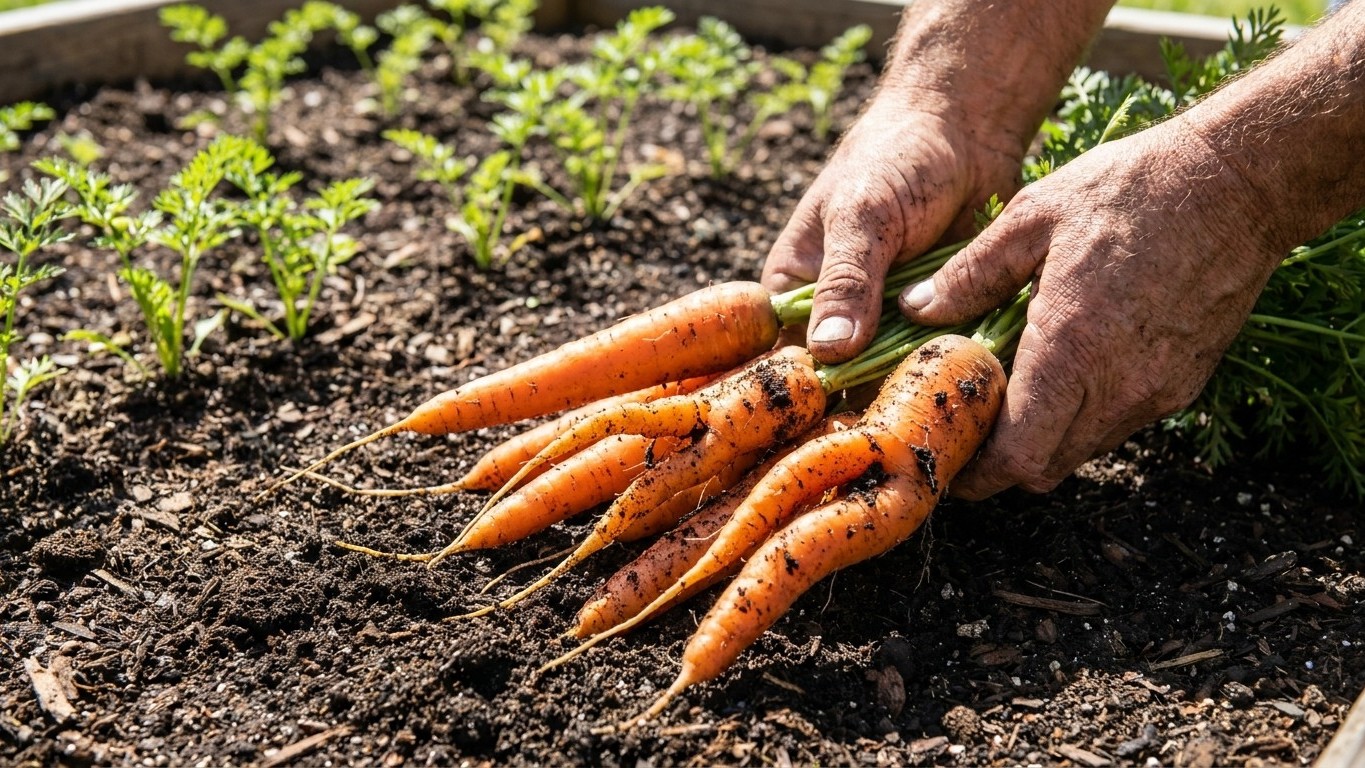

In most of Hawaii, there is no last frost date to count back from. Freezing temperatures only touch the summits of Mauna Kea and Mauna Loa, thousands of feet above where anyone keeps a vegetable bed. Carrot timing here runs on soil and moisture instead, and the state’s representative soil, the Hilo series, is heavy enough in clay and silt to fork a carrot root before it ever gets deep.
The short answer
The soil USDA lists as representative of Hawaii is the Hilo series, an Andisol built from weathered volcanic ash. That parent material makes it behave unlike most garden soils on the mainland: it’s light and porous in structure, and it holds onto water and phosphorus with unusual efficiency. But structure isn’t texture. Measured at the surface, the Hilo series runs 10 percent sand, 35 percent clay and 55 percent silt, which puts it squarely in heavy-soil territory by any standard USDA texture chart. The surface pH sits around 5.8, slightly acid, and organic matter measures about 9.0 percent, both figures drawn from the surface horizon of the series’ major mapped components. Drainage class is listed as well drained.
That combination, high clay and silt with good drainage, is a strange one, and it matters for carrots specifically. Utah State University Extension is direct on this point: carrots want deep, sandy, well-drained soil rich in organic matter, and heavy or rocky ground makes the root fork. A soil that’s 35 percent clay and 55 percent silt qualifies as heavy under that definition, even if volcanic ash keeps it draining well and holding moisture better than a typical clay would elsewhere. The forking risk is real here, and it doesn’t go away just because the soil happens to be well drained and unusually fertile.
The fix Utah State recommends for heavy ground is not a different carrot variety. It’s changing the bed. Working in plenty of compost loosens the structure and gives the taproot room to push straight down without meeting resistance. Double digging, turning the soil to a full spade’s depth and then again below that, breaks up compaction at depth where a carrot root actually needs the clearance. Where the native ground is too heavy to work that way, or where a hardpan sits close to the surface, a raised bed filled with a loose, sandy mix sidesteps the problem entirely and is often the faster route to straight roots.
None of this is a diagnosis for any one garden. Hawaii’s soil map runs to hundreds of distinct series across the islands, shaped by lava age, rainfall gradient and elevation that can shift dramatically within a few miles. The Hilo series is what USDA names as representative of the state as a whole, not a measurement of what’s under any particular yard. A garden built on fill dirt, a plot near a stream bottom, or a bed at higher elevation with different rainfall could all read very differently from the numbers above. Treat this section as the starting point for what the region’s ground tends to do, not the final word on yours.
The test that settles it in your own garden
The Hilo series numbers describe a mapped average, not the twelve or eighteen inches of dirt where your carrots will actually grow. Settling the question at home takes about twenty minutes and no lab equipment.
- Dig a test hole at least a foot deep. Use a spade or a soil probe in the spot you plan to plant. This is where you’ll find out fast whether there’s a hardpan, a layer of rock, or old fill material sitting closer to the surface than expected.
- Check the depth and look for stones. Carrots need clear, unobstructed depth to grow straight. Note where the soil changes color or resistance, and pull out any rocks or debris you find in the top foot. A shallow rocky layer is one of the most common causes of forked or stubby roots, regardless of what the texture reads like above it.
- Feel the texture between your fingers. Take a handful of moist soil from the hole and roll it. If it forms a long, slick ribbon without crumbling, that’s a clay-heavy soil, similar in behavior to what the Hilo series numbers describe. If it falls apart into loose crumbs and grit, it’s already closer to what carrots want.
- Watch how water drains. Fill the hole with water and let it soak in once, then fill it again and time how it disappears. Water that stands for hours signals compaction or a drainage problem worth addressing before seeding, regardless of what the surrounding soil map suggests.
Run through those four steps before you commit to a planting method. A bed that passes the ribbon test and drains at a steady pace can likely take carrots directly in the ground with a season of compost worked in. A bed that fails on stones, standing water, or a slick ribbon is telling you to build up rather than dig down.
What goes wrong here
Hawaii’s volcanic soil and its warm, variable rainfall pattern create a specific set of carrot problems, and each one has a fix that doesn’t require starting over.
- Forking in heavy, compacted ground. The clay and silt fraction in soils like the Hilo series resists a taproot pushing straight down, and the result is roots that split or twist around obstacles. Working in compost and double digging the bed before sowing gives the root a loosened column of soil to grow through; where the native ground is too heavy to fix that way, a raised bed filled with a lighter, sandier mix solves it outright.
- Poor germination during a hot, dry stretch. Carrot seed is slow to sprout under the best conditions, and a dry surface layer during a warm spell can stall germination for days or stop it entirely. Keeping the seedbed consistently moist with light, frequent watering, and covering it with a thin mulch or light shade cloth until seedlings emerge, keeps the surface from crusting over and drying out between waterings.
- Splitting from uneven watering. A stretch of dry weather followed by heavy rain, a common swing in Hawaii’s seasonal rainfall pattern, pushes a growing root to expand faster than its skin can stretch, and it cracks. A steady watering schedule, rather than letting the bed dry out and then soaking it, keeps root growth even. A layer of mulch over the bed helps buffer soil moisture between waterings and reduces how sharply conditions swing after a downpour.
Common questions
Do I need to worry about frost when sowing carrots in Hawaii?
At garden elevations across the islands, no. Frost in Hawaii is limited to the summit zones of Mauna Kea and Mauna Loa, well above where anyone is growing vegetables. Timing your sowing here comes down to soil temperature, moisture and bed preparation rather than a frost calendar.
How long does it take to grow carrots from seed in Hawaii?
Carrots are sown directly in the ground, not transplanted, so the growing period is counted from the seeding date. Utah State University Extension notes that carrots generally take 70 to 100 days from seeding to maturity, and that timeline runs the same whether the crop is grown in heavy native soil or a prepared raised bed.
Is the Hilo series soil good or bad for carrots?
It’s mixed. The volcanic-ash structure holds water and phosphorus unusually well, which benefits most vegetables. But the measured texture, 35 percent clay and 55 percent silt, is heavy enough to fork a carrot root without amendment. Compost, double digging, or a raised bed address that directly.
What if my garden’s soil doesn’t match the Hilo series numbers at all?
That’s expected in plenty of gardens. Hawaii’s soil map includes hundreds of distinct series, and elevation, rainfall and prior land use can all shift the ground far from the state’s representative figures. Running the dig-and-drain test on your own bed is the only way to know what you’re actually working with.