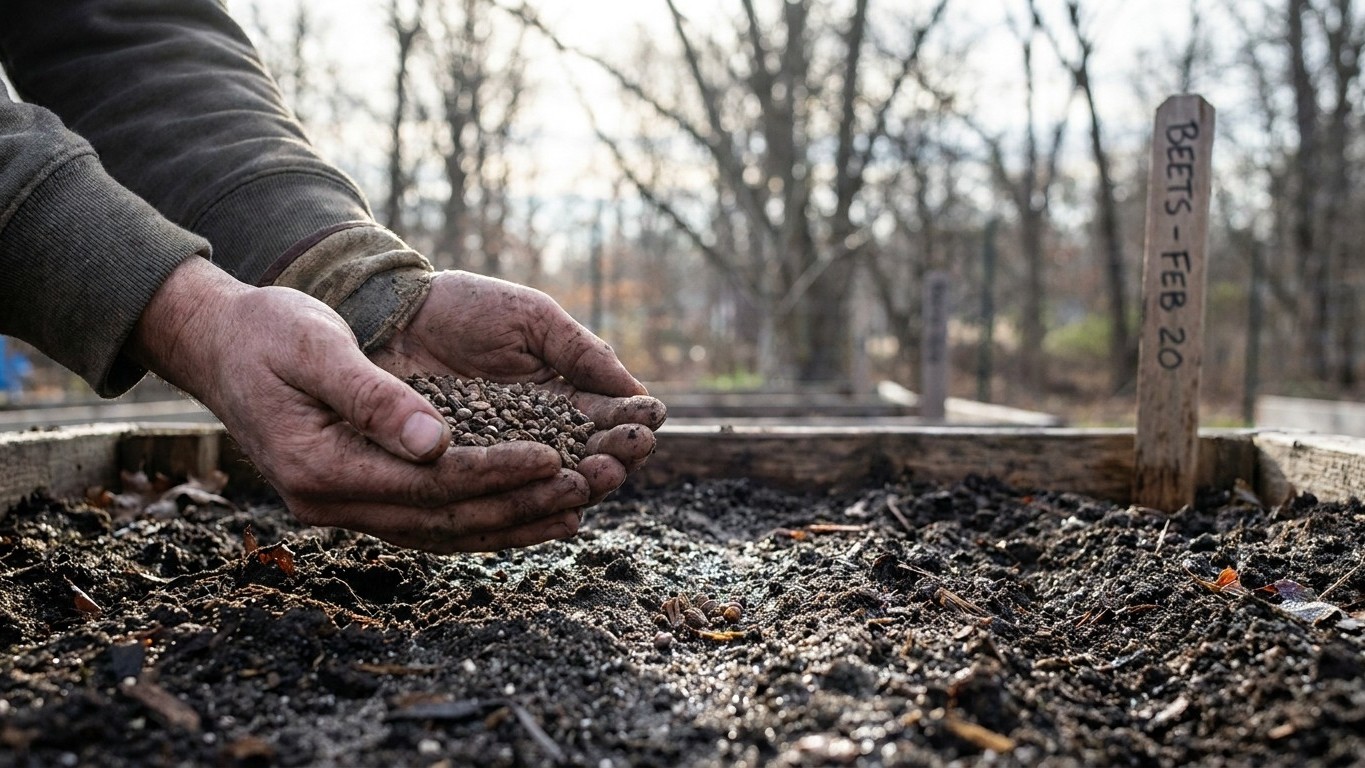

Beets go into Idaho ground two to three weeks before the last spring frost, which at the reference station falls somewhere between April 23 and May 7. That timing keeps the seedling’s most fragile stretch away from a hard freeze while still giving the root crop the cool weeks it needs before summer heat sets in. Everything past that starting point depends on what’s actually under the seed.
The short answer
Idaho’s representative soil, the Threebear series, is an Andisol built from volcanic ash. It runs 35 percent sand, 15 percent clay and 50 percent silt at the surface, which puts it in loam to silt loam territory rather than the dense clay that frustrates root vegetables elsewhere. It’s moderately well drained and unusually good at holding onto both water and phosphorus, a trait particular to ash-derived ground. That’s mostly good news for a beet, which wants deep, loose, well-drained soil and resents compaction around its taproot.
The catch is pH. Threebear surface soil runs around 5.0, strongly acid, while beets do best closer to neutral. Left unamended, that acidity ties up nutrients the plant needs to build a smooth, evenly colored root, and gardeners on ash-derived ground often see stunted or pale beets even when watering and spacing are done right. A soil test and some lime worked in ahead of sowing is the practical fix, and it matters more here than it would on a naturally neutral loam.
There’s also an organic-matter figure attached to this series, about 75 percent, but that number describes an undisturbed surface horizon as USDA mapped it, not a worked garden bed. A cultivated plot with that soil type won’t carry anything close to that reading once it’s been turned, and Utah State University Extension’s own guidance caps beet-bed amendment at roughly 1 inch of composted organic matter per 100 square feet, which is a far more useful target for a raised bed or tilled row than the mapped figure.
On the heat side, Utah State’s research flags 85 F combined with water stress as the point where a beet root turns woody instead of tender. Idaho summers include stretches well past that mark, but no day-count above 90 F for any specific city is published in the sources behind this page, so that number won’t appear here as a guess. What matters for sowing decisions is simpler: know that hot, dry stretches are coming, and plan the six weeks after seeding around avoiding them, not around a specific date on a calendar. And it’s worth saying plainly that Idaho spans hundreds of distinct soil series. Threebear is the one USDA lists as representative of the state, not a description of any one backyard. It’s a starting point for reading local conditions, not a substitute for testing the actual ground a beet will grow in.
The six weeks that decide it here
Sowing beets two to three weeks ahead of the April 23 to May 7 frost window means the first six weeks of growth land somewhere in mid-spring to early summer at lower elevations, and considerably later at the higher ground that makes up most of the state. That window is the one Utah State’s research points to directly: water stress during those first six weeks after seeding is what triggers premature flowering, or bolting, in beets. Once a plant bolts, the root stops bulking up and the crop is effectively over for the season, regardless of how well it’s watered afterward.
Idaho’s spring in this region tends to run in fits, cold mornings giving way to sudden warm stretches as snowmelt recedes, with dry spells that can show up with little warning once the ground starts to dry out. That variability is exactly the setup that makes bolting risk in this state a moving target rather than a fixed date. A gardener who sows right at the early edge of that two-to-three-week window, in late April in a low valley, may hit a cooler, wetter early season. One who sows into early May, or considerably later at higher elevation, is more likely to run into a dry stretch during those first critical six weeks, precisely when the seedling has the least reserve to draw on.
None of this is a reason to delay sowing further. Beets sown too late simply run into the season’s heat before the root has matured, trading a bolting risk for a woodiness risk instead. The practical response is to treat that six-week window after seeding as the period demanding the most consistent watering of the entire growing cycle, ash-derived soil’s decent water-holding capacity notwithstanding. A soil that drains moderately well can still dry out at the surface fast enough to stress a young beet, particularly once daytime temperatures climb.
- Acidic ash soil locking up nutrients: Threebear-type soil runs around pH 5.0, well below what beets prefer. The fix is a soil test before sowing and lime worked into the bed well ahead of planting, not after pale or stunted roots show up.
- Bolting from a dry stretch in the first six weeks: Idaho’s swing-prone spring can dry out fast after snowmelt. Keep the bed evenly moist through that window rather than watering in response to visible wilting, which usually arrives after the damage that triggers bolting has started.
- Surface soil drying while roots still sit in moisture: Andisols like this one can look dusty on top while holding water lower in the profile, tempting a gardener to over- or under-water based on a glance. Check moisture a couple of inches down before deciding to irrigate.
- Woody roots from late-season heat and water stress together: Once temperatures push past 85 F, any water stress on top of that heat is what toughens the root, according to Utah State’s research. This is a separate failure from bolting, tied to later heat rather than early dryness, and the fix is steady watering through the hot stretch rather than at the start of the season.
- Ignoring elevation when picking a sowing date: The April 23 to May 7 frost window applies to a low-valley station. Most of the state sits higher and colder, with a shorter, later season, so a date pulled straight from that range without adjusting for local elevation risks either frost damage or a root that never finishes before summer heat arrives.
Common questions
Do beets need lime before sowing in Idaho’s typical soil?
If the bed sits on ash-derived ground similar to the Threebear series, likely yes. A surface pH near 5.0 is well below what beets need to take up nutrients efficiently, and a soil test is the only reliable way to know how much lime a specific bed actually needs before sowing.
How long from sowing to harvest for beets grown in Idaho?
Beets are sown directly in place, not transplanted, and the standard maturity window runs from that seeding date. Timing the sowing date around the local last-frost window matters because the entire maturity clock starts from seed in the ground, not from a later transplant date.
What’s the difference between bolting and woody roots in beets?
Bolting happens early, when water stress in the first six weeks after sowing pushes the plant into premature flowering and stops root development. Woodiness happens later, when heat above 85 F combines with water stress to toughen a root that’s already forming. They’re two different failures with two different causes, not the same problem at different stages.
Does the last-frost window change much across Idaho?
The April 23 to May 7 range comes from a single low-valley station. Most of the state sits at higher elevation with colder, shorter seasons, so a gardener farther from that valley floor should expect a later frost-free window and adjust sowing dates accordingly rather than relying on that range directly.