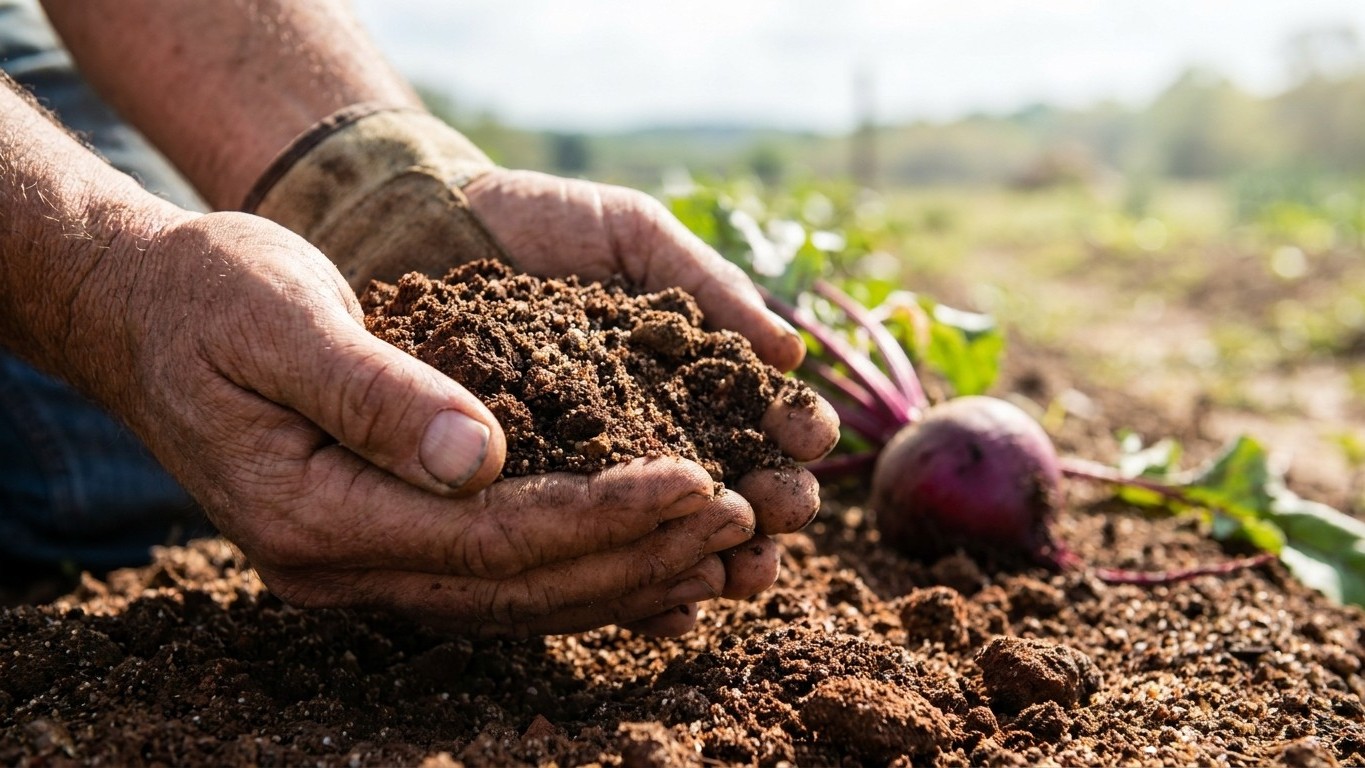

Kansas gardeners planting beets are working with the Harney series, the state’s official soil: a silty, well-drained prairie ground that holds moisture better than it drains excess heat stress. The real determining factors are the first six weeks after seeding and how long summer heat lingers past 85 degrees. Here’s what that soil, that spring, and that heat mean for a beet root headed underground.
The short answer
Kansas named the Harney series its official state soil, a Mollisol, the deep, dark prairie soil that built the Corn Belt. The surface horizon runs 9 percent sand, 24 percent clay, and 67 percent silt, a loam-to-silt texture with a near-neutral pH around 6.7 and organic matter near 2.0 percent. It’s classified as well drained. For a beet, that’s a mixed hand. The organic matter is respectable, the pH sits right where beets want it, and drainage is adequate, not soggy. But the texture leans silty rather than sandy, and beets specifically want deep, sandy, well-drained ground. A high silt content like Harney’s can crust after rain, sealing the surface and making it harder for a beet’s taproot to push straight down without forking or stalling.
On the heat side, the published guidance is clear about the mechanism, not about a specific Kansas day count: temperatures above 85 F combined with water stress make beet roots woody. What isn’t published here is how many days a year any particular Kansas city actually crosses that 85 F or the 90 F mark, so treat any number you see elsewhere on that point with caution. What matters practically is that Kansas summers are known for pushing well past that threshold for sustained stretches, which means the woodiness risk isn’t a one-off hot afternoon. It’s a cumulative bet against however long your beets sit in the ground during the hottest part of the year.
None of this is a diagnosis of your yard. Kansas spans hundreds of mapped soil series, and the Harney profile above describes the surface horizon of the state’s representative series as surveyed, not a worked garden bed. A property near a river bottom, in hill country, or on ground a builder graded and refilled can differ completely from these numbers, and organic matter above roughly 20 percent in a soil report signals a natural peat, muck, or leaf-litter layer, not a cultivated bed. A soil test from your own garden is the only way to know what you’re actually amending. Think of Harney as the regional starting assumption, not the final word on the bed outside your back door.
The six weeks that decide it here
Beets sown 2 to 3 weeks before the last spring frost put their first six weeks squarely inside the reference city’s frost window of April 4 to April 18, based on NOAA’s 1991-2020 climate normals for that airport station. That places early sowing dates around mid to late March for many Kansas gardeners, with the critical six-week window running from late March or early April into May. Suburban and rural gardens typically see their last frost later than the airport figure, often by a week or two, and more at higher elevation, so treat these dates as a regional anchor and check your own county’s typical last frost before committing seed to soil.
What that spring window usually brings in Kansas is variability more than any single pattern. The state sits in a transition zone where spring weather can swing from dry, wind-scoured stretches to sudden heavy rain within the same season, sometimes within the same week. That swing matters enormously for beets, because the published research on this crop is specific: water stress in the first six weeks after seeding is what triggers premature flowering, known as bolting. A bolted beet stops building a usable root and pours its energy into a seed stalk instead. The root you dig up afterward will be small, tough, or simply not worth eating.
The practical risk for Kansas gardeners sits less in any one predictable dry season and more in the unpredictability itself. A spring that starts wet and then shuts off for two or three weeks right after germination is the classic bolting setup, and Kansas springs are prone to exactly that kind of reversal. Consistent moisture during those first six weeks, not just moisture at planting, is what the crop actually needs. A soil that crusts easily, like the silty Harney surface tends to do, compounds the problem, because a hard crust sheds light rain instead of absorbing it, leaving the root zone dry even when it looks like it rained recently.
What goes wrong here
Between a silty state soil prone to surface crusting, a spring known for swinging between dry spells and heavy rain, and summer heat that regularly pushes past the 85 F woodiness threshold, Kansas beet beds tend to fail in a few predictable ways. Each has a specific fix rooted in the mechanism, not a generic “keep it watered” shrug.
- Bolting from an early dry spell. If the first six weeks after seeding include even a short stretch without rain or supplemental water, plants read that as stress and shift energy toward flowering instead of root growth. The fix is consistent soil moisture through that window specifically, checked by hand a couple inches down rather than assumed from a recent rainstorm.
- Surface crusting on the silty Harney texture. A 67 percent silt surface can seal over after a hard rain, blocking the light, frequent watering beets need right after germination. Breaking the crust gently with a rake tine, or mulching lightly, keeps water reaching the seed row instead of running off.
- Woodiness from summer heat plus late-season thirst. Once temperatures climb past 85 F, any water stress on top of that heat turns the root fibrous and tough. This is a separate failure from bolting; it happens later in the season, closer to harvest, and the remedy is steady watering through the hot stretch, not just at planting.
- Amending past what the soil needs. Harney’s organic matter already sits near 2.0 percent. Piling on more than roughly 1 inch of composted organic matter per 100 square feet, the ceiling the research points to, can throw off the balance rather than help it. Amend to that limit and stop.
- Sowing too shallow or too deep for a silt-heavy bed. A silty surface that crusts also makes it easy to misjudge planting depth; seed sown under a crust that later hardens can struggle to emerge at all, contributing to spotty stands that look like a fertility problem but are really a texture problem.
Common questions
How many days does it take for beets to mature in Kansas soil?
The published range for beets generally runs 60 to 80 days, counted from the day seed goes into the ground, since beets are sown in place rather than transplanted. Kansas’s Harney-type soil doesn’t change that count directly, but a spring dry spell or a crusted surface that delays even germination by a week effectively pushes the whole timeline back.
Does the Harney soil name mean my yard has that exact soil?
No. Harney is the state soil named under Kansas law, representing a common Mollisol profile mapped across the state, but it’s one series among hundreds. A soil test of your own bed is the only way to confirm your actual sand, silt, clay, and organic matter percentages.
What’s the difference between bolting and woodiness in beets?
Bolting happens early, triggered by water stress in the first six weeks after seeding, and it causes the plant to send up a flower stalk instead of building a root. Woodiness happens later, when temperatures exceed 85 F and the plant is also short on water, leaving the root fibrous and tough even if it never bolted. They’re two separate failures with two separate timing windows.
When should I sow beets relative to the last frost in Kansas?
The general guidance is 2 to 3 weeks before the last spring frost. For the NOAA reference station used here, that frost falls between April 4 and April 18, but suburban and rural gardens often see frost a week or two later than that airport figure, so confirm your own county’s typical date before setting a sowing calendar.