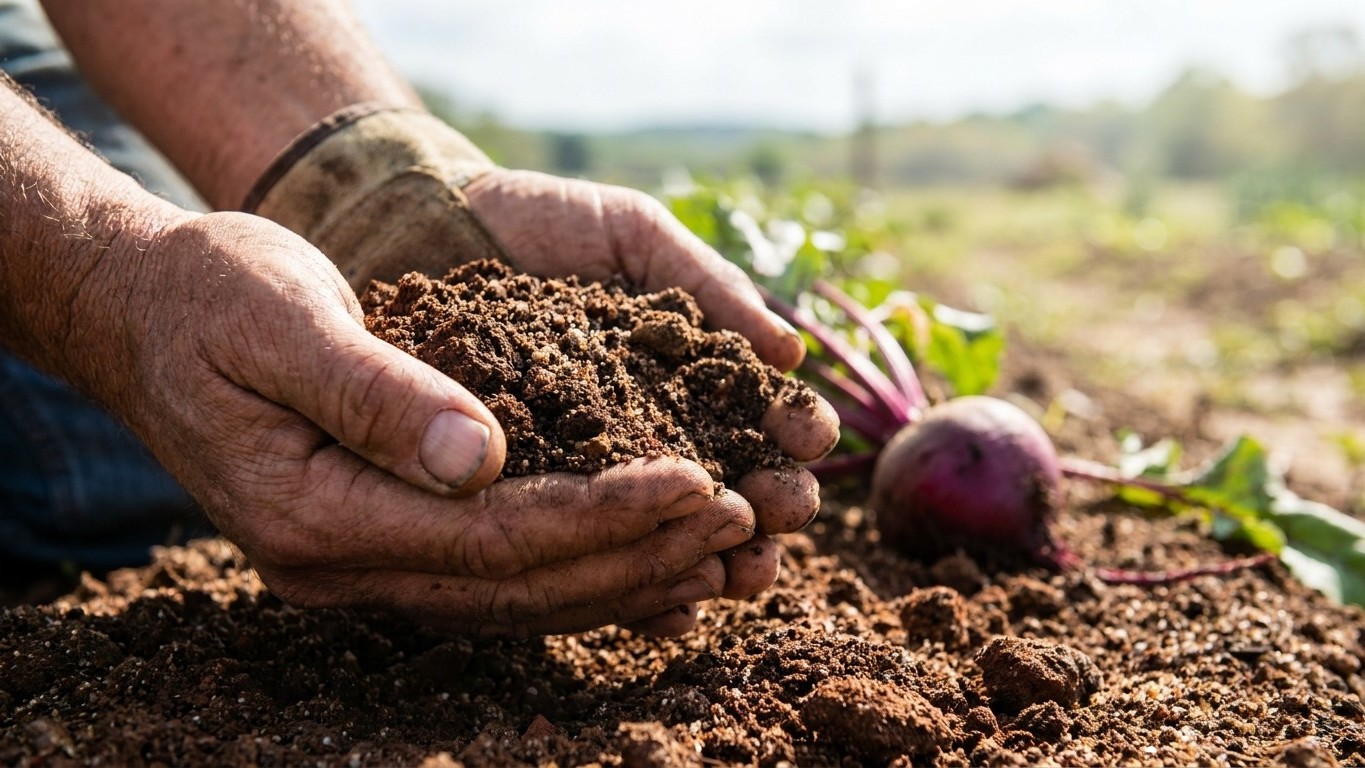

Maine’s official state soil, the Chesuncook series, is a sandy, strongly acid Spodosol that formed under stands of conifers, not the loose, dark loam a beet root actually wants. The state’s last spring frost typically falls between April 22 and May 1 near the coast, later the farther inland or north you go. That combination, sandy and acid on one hand, a cool and unpredictable spring on the other, shapes almost everything about growing a straight, tender beet in Maine ground.
The short answer
Pull a soil report for the Chesuncook series and the numbers tell a specific story: 35 percent sand, 12 percent clay, 53 percent silt, a surface pH around 5.1, and a drainage class of moderately well drained. That texture, heavy on silt and sand and light on clay, sits closer to what a beet root prefers than a dense clay pan would. Beets want deep, well-drained ground with plenty of organic matter worked in, not more than about 1 inch of composted material per 100 square feet, according to Utah State University Extension. A soil this sandy drains fast once it thaws, which cuts the risk of a waterlogged root ball but raises a different problem: it dries out just as fast.
The numbers under your boots
The organic matter figure recorded for this series, about 53.0 percent, looks enormous next to any worked garden bed. That number reflects a natural forest floor layer, needles, roots, decomposing litter under a stand of spruce or fir, not a cultivated row. Once that surface gets turned, tilled, and planted year after year, the organic content drops toward something far more ordinary. Nobody should read that figure and assume their raised bed already has more compost than it needs.
The pH reading of 5.1 is strongly acid, again as measured on the series’ natural surface horizon, not on any particular backyard. A state as large as Maine holds hundreds of distinct soil series, mapped county by county, and the ground under a coastal garden in Portland can differ completely from a hillside plot forty miles inland, or from a lot where a builder scraped and refilled the topsoil. Chesuncook is the representative baseline USDA settled on when Maine named an official state soil under state law, a useful starting point, not a verdict on any one yard. A soil test remains the only way to know what pH and texture you’re actually working with.
What it means for heat and woodiness
Utah State University Extension is specific on the heat side of the equation: temperatures above 85 F combined with water stress are what turn a beet root woody and tough. That’s a real risk in Maine, but a precise count of how many days a typical Maine summer spends above 90 F isn’t part of the dataset behind this page, so no such figure is published here. What is clear is that Maine summers, especially near the coast, don’t sustain extreme heat for long stretches the way inland regions farther south do. The bigger threat to a Maine beet crop isn’t sustained heat. It’s water stress arriving on top of whatever heat does show up, and that pairing is what growers need to watch for.
The six weeks that decide it here
Beets are sown directly in the ground, never transplanted, and the standard advice is to get seed in 2 to 3 weeks ahead of the last frost date. With a last frost window of April 22 to May 1 along the coast, that puts direct seeding somewhere in the first half of April for the mild end of the state, later for inland and northern gardens working with a colder spring calendar. The first six weeks after that sowing date, roughly early April into the back half of May for coastal growers, are the stretch that decides whether the root bolts before it ever fills out.
When the clock starts
That timing matters because Utah State University Extension is clear that water stress during those first six weeks is what pushes a beet plant into premature flowering, a failure distinct from the woodiness that comes later from heat. Bolting is a spring problem. Woodiness is a summer problem. Conflating the two, or assuming “just keep it watered” covers both, misses what’s actually happening at the root.
What Maine spring usually does
Maine’s spring is known for swinging hard between extremes: a saturated, slow-to-thaw start as snowmelt works through the ground, followed by a fast transition into drying winds and open sun once the thaw is done. On a sandy, moderately well drained soil like Chesuncook, that second half of the swing is the one to watch. Ground that sheds water quickly once it warms up can flip from soggy to parched inside a couple of weeks, right in the window when beet seedlings are most sensitive to running dry. The bolting risk in Maine sits less with the wet start of spring and more with how abruptly that wet ground stops staying wet. Gardeners who track soil moisture by feel rather than by calendar, checking a few inches down rather than assuming April rain means the job is done, catch that shift before it triggers a stress response in the plant.
What goes wrong here
- Bolting from an early dry spell. A sandy, fast-draining soil like the Chesuncook type can dry out within days of the spring rains tapering off, right inside the six-week window that decides flowering. The remedy is even, scheduled moisture through establishment, roughly an inch of water a week, checked by hand rather than assumed from rainfall totals.
- Woody roots from summer heat paired with dry soil. Once temperatures push past 85 F, a beet root under water stress toughens and loses the tenderness that makes it worth growing. The fix is deep watering ahead of and during any hot stretch, not a quick surface sprinkle that never reaches the root zone.
- A pH mismatch the gardener never checked. The state’s representative soil reads strongly acid at 5.1, and while that number belongs to a forested reference plot and not any one yard, plenty of Maine ground runs acidic. A soil test, and lime worked in if the results call for it, is the only reliable step here.
- Over-amending a bed that already looks rich. Seeing dark, organic-looking soil can tempt a gardener to pile on more compost than the crop needs. Utah State University Extension caps the recommendation at roughly 1 inch of composted organic matter per 100 square feet; more than that can work against root development rather than help it.
- Perched water in a “moderately well drained” spot. That drainage class means water can sit longer than a fully free-draining soil would allow, especially in a low corner of the yard. Raised beds or deep tillage before planting break up that perching and give roots somewhere to escape standing moisture.
Common questions
Is Maine’s soil naturally good for growing beets?
The state’s representative soil, the Chesuncook series, has a texture, low clay, high sand and silt, that leans in the right direction for beets, which want deep, well-drained ground. Its natural pH is strongly acid, though, and that reading comes from an undisturbed forest surface, not a cultivated bed, so a personal soil test still matters more than the state average.
When should I Sow Beets in Maine to avoid bolting?
Direct sow 2 to 3 weeks before the last frost date, which falls between April 22 and May 1 near the coast and later inland. Keeping soil moisture steady through the six weeks that follow is what actually prevents the premature flowering known as bolting, more than the exact sowing date alone.
Why do beets turn woody in Maine gardens?
Woodiness comes from heat above 85 F hitting a plant that’s already short on water, according to Utah State University Extension. It’s a separate failure from bolting, which happens earlier in the season from water stress alone, so the fix for one isn’t automatically the fix for the other.
Should I test my garden’s pH before planting beets?
Yes. The state’s reference soil runs strongly acid at a pH around 5.1, and while that figure describes a mapped forest surface rather than any specific backyard, it’s a reasonable sign that acidic ground is common across Maine. A soil test tells you what you’re actually working with, and whether lime is worth adding before seed goes in the ground.