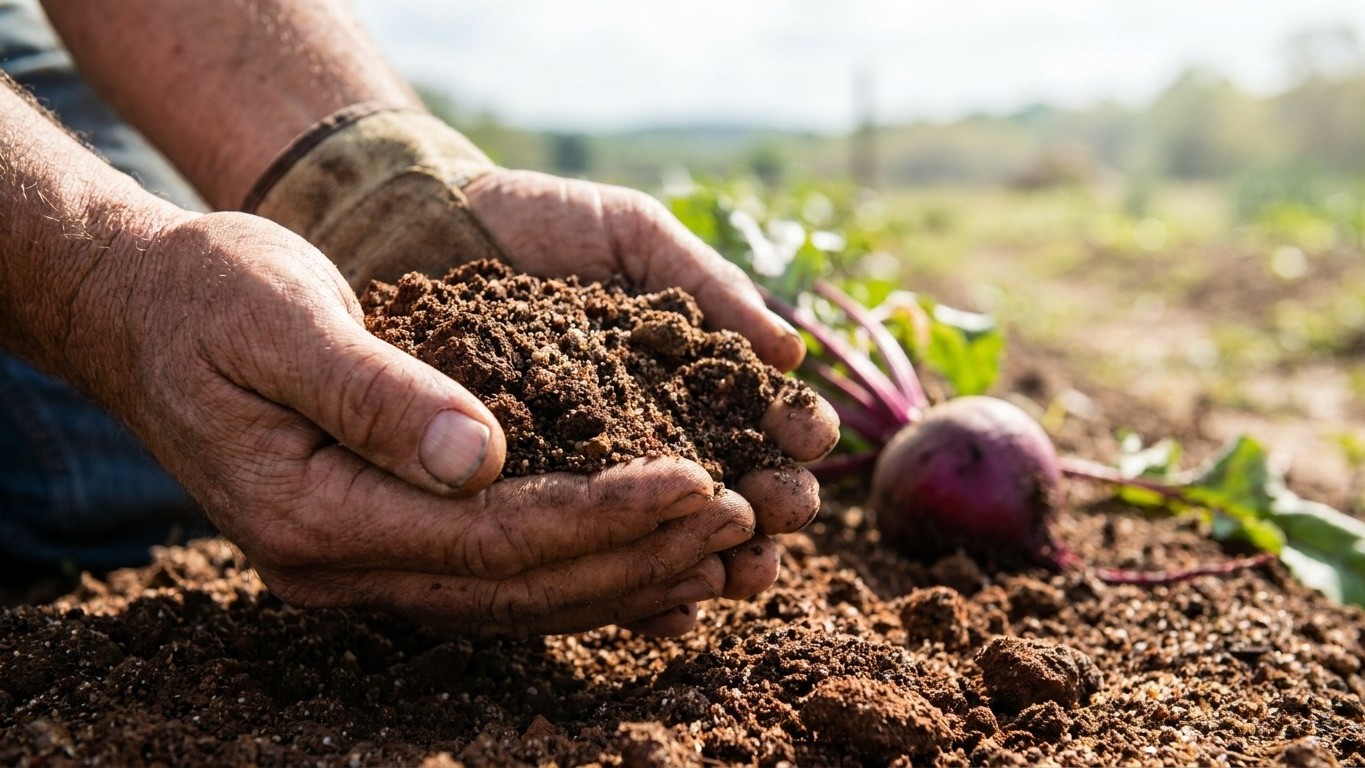

Beet roots pushing into Manitoba ground meet a dark, alkaline, loam-textured soil that drains slower than a beet would like, under a spring that swings from snowmelt to dry wind within weeks. The province’s dominant soil, a Chernozem, is naturally fertile and rich in organic matter, which beets appreciate, but it runs imperfectly drained and alkaline, both working against what beets actually want: deep, sandy, quick-draining ground. That mismatch, more than any single number, decides how the row turns out.
The short answer
Across the agricultural regions of Manitoba, the most common soil order found in mapped surface horizons is Chernozem, covering 41 percent of the sampled ground, with Gleysolic soils the next most frequent. Where a Chernozem profile shows up, the median surface reading runs alkaline, about pH 7.6, with a loam texture built from roughly 45 percent sand, 24 percent clay and 31 percent silt, an organic matter content near 5.5 percent, and a drainage class described as imperfect. That’s according to the Canadian Soil Information Service, which compiled measurements from 2,535 mapped soil components across the province.
Set that against what a beet root actually wants. Utah State University Extension describes the ideal beet bed as deep, sandy and well-drained, rich in organic matter but not over-amended, capping compost at 1 inch per 100 square feet. Manitoba’s dominant soil clears one bar and misses two. The organic matter figure, 5.5 percent, is generous by garden standards and needs little if any additional compost worked in before sowing. But the texture is a loam, not a sand, and the drainage class is imperfect rather than free-draining, which means water tends to sit in the root zone longer than a beet’s taproot prefers. Add an alkaline pH of 7.6 and micronutrients like boron, which beets pull on more than most root vegetables, become harder for the plant to access even when they’re present in the ground.
On the heat side, the Utah State guidance is specific: temperatures above 85 F combined with water stress are what turn a beet root woody. That’s a documented threshold. What isn’t published on this page is a count of how many days a given Manitoba location spends above 90 F in a typical year, so no such figure is offered here, and none should be assumed from a nearby state’s climate table. Manitoba summers do produce stretches of heat, but without a sourced day-count for a reference station, the honest answer is that this piece can name the woodiness threshold without quantifying how often local conditions cross it.
None of this describes one garden. Manitoba’s agricultural land spans hundreds of individual soil series, and a Chernozem profile is a starting point for reading the region, not a stand-in for a soil test from a particular yard. River bottoms, drained wetland, and any plot a builder has graded or filled can sit far outside these medians.
The six weeks that decide it here
Beet seed sown 2 to 3 weeks ahead of the last frost lands its first six weeks of growth squarely inside Manitoba’s spring, and that spring has a well-known character. The average last spring frost at Winnipeg Richardson International Airport falls on May 23, according to Environment and Climate Change Canada’s 1981-2010 climate normals. Sowing 2 to 3 weeks before that mean date puts seed in the ground in early May, right as the province is shifting out of snowmelt and into the dry, windy stretch that defines a prairie spring. That transition matters more than the calendar date by itself.
A mean frost date is not a safety line. It marks the midpoint of a range, which means that in roughly half of all years, the last frost falls later than May 23, sometimes well into the following weeks. Anyone sowing on the calendar rather than watching the ground and the forecast is gambling on the favorable half of that distribution. A late cold snap during the first six weeks after seeding hits young beet seedlings at their most bolting-prone stage.
Layer the soil onto that timing. Manitoba’s dominant Chernozem is imperfectly drained and holds moisture through the topsoil after snowmelt, which can leave a seed bed cold and slow to warm in the first days after sowing. Once that early wetness burns off, the same continental spring that brought the cold snap tends to swing toward wind and low humidity, and a loam surface with 45 percent sand can dry out at the top faster than the deeper profile suggests. That combination, wet-and-cold at planting followed by a quick dry-out, is what makes the first six weeks the period to watch. Utah State University Extension is explicit that water stress during this early window, not later in the season, is what pushes a beet plant into premature flowering. Heat stress arrives on its own separate timeline, later in the season, and produces a different failure entirely: a woody root rather than a bolted plant. Treating the two as one problem, solved by “keep it watered,” misses which stress is doing the damage and when.
What goes wrong here
- Bolting after a cool, dry start. Seed sown in early May, ahead of a frost date that only marks a 50/50 midpoint, can sit through a cold, slow-draining spell in Manitoba’s imperfectly drained Chernozem and then dry out fast once prairie wind sets in. That early water stress, per Utah State University Extension, is what triggers premature flowering. The remedy is even, light moisture through the first six weeks after seeding rather than a single soak, and watching the ten-day forecast instead of the calendar before sowing.
- Woody roots from mid-summer heat. Once beets are established, heat above 85 F combined with water stress toughens the root’s texture, an entirely separate failure from bolting. Deep, less frequent watering that keeps the loam profile evenly moist through summer heat, rather than letting the topsoil swing between soaked and dry, is the documented fix.
- Boron lockout from alkaline pH. A median surface pH near 7.6 can tie up boron and other micronutrients beets rely on, even when the soil’s organic matter supply, around 5.5 percent here, looks generous on paper. A soil test that reports pH and micronutrient availability, not just texture, is the only way to know whether this is happening on a given plot.
- Forked or hairy roots from a heavy loam. The province’s typical 24 percent clay content resists the straight, easy push a beet taproot wants compared to the sandy soil Utah State University Extension describes as ideal. Working the bed deeply and removing stones and clay clumps before sowing, rather than relying on the ground as it sits after tillage, gives the root a clearer path down.
- Over-amending a soil that’s already rich. Because Manitoba’s dominant soil already carries roughly 5.5 percent organic matter, piling on more compost past the 1-inch-per-100-square-feet limit Utah State University Extension recommends risks pushing leafy top growth at the expense of the root, not solving a fertility problem that may not exist on this ground.
Common questions
Does Manitoba’s alkaline soil mean beets won’t grow at all?
No. Beets tolerate a range of pH conditions reasonably well; the issue with a median surface pH of 7.6 is reduced availability of certain micronutrients, particularly boron, not an outright barrier to growth. A soil test is the way to confirm whether a specific plot needs correction.
Should I sow beets earlier to avoid the heat-related woodiness problem?
Sowing earlier changes exposure to the bolting risk described above, tied to the first six weeks after seeding, not to the later heat-and-water-stress woodiness problem, which is a separate mechanism entirely. Adjusting sowing date addresses one failure, not the other.
How many days does it take beets to mature from seed in Manitoba?
Beets are direct-seeded, and their maturity window is counted from the day of seeding, not from a transplant date. This page does not carry a Manitoba-specific day-count from a cited source, so gardeners should rely on the seed packet’s stated days to maturity alongside local frost timing.
Is the Chernozem soil described here what’s actually in my yard?
Not necessarily. It’s the most frequently mapped soil order across Manitoba’s agricultural surface, drawn from over 2,500 sampled components, but it’s a provincial median, not a survey of individual properties. A local soil test remains the only way to know the texture, pH, and drainage sitting under a particular garden bed.