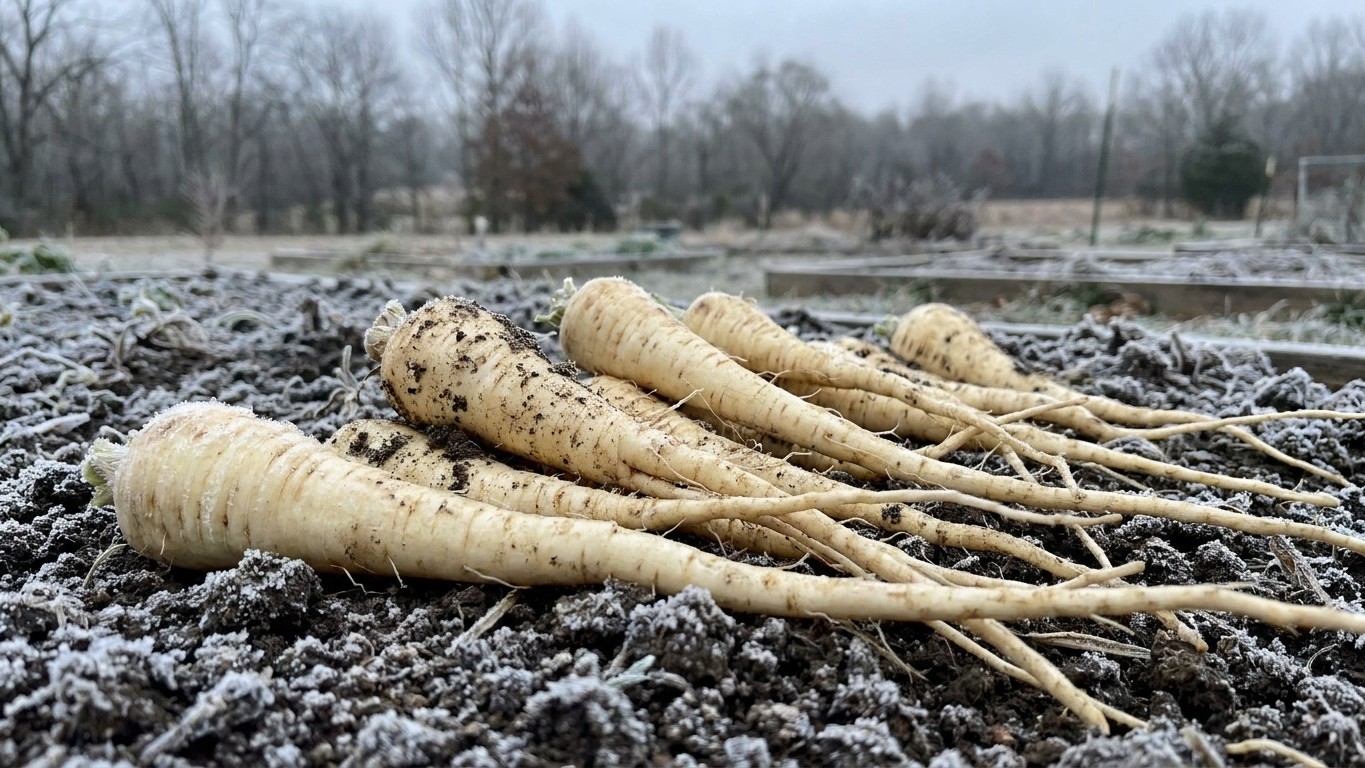

Whether parsnips sweeten in Nevada depends almost entirely on which part of the state you’re standing in. In the low desert around Las Vegas, winters run too mild, on average, to deliver the sustained cold that turns starchy parsnip roots sugary. Farther north and at elevation, in places like Reno, Carson City, and the mountain valleys, real frost is common, and the classic sweetness is far more likely, though no single figure covers the whole state.
The short answer
The question that decides everything here isn’t the hardiness zone printed on a seed packet. It’s simpler and more specific: does this particular patch of ground get several weeks of genuinely frosty weather each winter? That’s the mechanism that converts stored starch into sugar inside a parsnip root, and it’s a different question from whether the plant can survive the winter at all.
For the Las Vegas area, the only Nevada figure in the federal climate record shows a mean minimum temperature of 39.6 degrees Fahrenheit for the coldest month of the year, based on the 1991-2020 NOAA NCEI Climate Normals. That’s an average of daily lows, not a record cold snap, and it sits nearly eight degrees above freezing. A month where the typical overnight low doesn’t even reach 32 degrees is not a month of sustained frost. It’s a mild desert winter that happens to dip cool at night.
That distinction matters more for parsnips than for almost any other root vegetable. A parsnip left in ground that never really freezes will still grow into a full-sized, harvestable root. It just won’t develop the nutty sweetness gardeners associate with the crop, because that sweetness is a direct chemical response to cold exposure, not a byproduct of the growing season length or the soil type. In the Las Vegas Valley and similar low-elevation desert pockets, expect a good parsnip, not necessarily a sweet one.
The picture almost certainly looks different in the rest of the state, and this is where a Nevada gardener has to do some local homework rather than lean on a statewide answer. Reno sits at roughly 4,500 feet, Carson City higher still, and the Sierra foothills and high desert valleys scattered across central and northern Nevada see winters that are colder, longer, and far more consistent than anything the Las Vegas figure describes. No published NOAA normal in the facts available here covers those stations directly, so the honest answer is that gardeners in those regions should expect meaningfully more frost exposure than the desert floor, and likely a sweeter parsnip as a result, but the exact number isn’t something this page can responsibly invent.
The practical takeaway: if you garden in the low desert, treat sweetness as a bonus rather than a guarantee, and consider that the crop will still be perfectly edible and worth growing for its texture and mild flavor. If you garden at elevation anywhere else in Nevada, the odds tilt in your favor, but check your own local frost pattern before counting on it.
Does the season fit?
Parsnips are sown directly in place, not transplanted, and Utah State University Extension puts the full run at 100 to 120 days from seeding to harvest, with sowing recommended 2 to 3 weeks before the last frost. That’s a long commitment for a root crop, and it means the arithmetic has to start well before spring officially arrives.
- Start the clock at seeding, not at germination. Parsnip seed is notoriously slow, taking 14 to 21 days just to sprout. Gardeners who don’t account for this often assume the bed failed and re-sow, which resets the whole 100 to 120 day count and can push harvest into weather nobody planned for.
- Add the full 100 to 120 days after that germination window. In practice, that means budgeting close to four months from the day seed goes into the ground to the day you’re pulling roots.
- Compare that total to your local frost calendar. The only precise frost dates in the federal record for this state come from the Las Vegas airport station: a last spring frost falling between January 7 and February 1, and a first fall frost between December 8 and December 23. Those numbers describe an urban desert heat island and are not a usable planting guide for Nevada as a whole. Reno, Carson City, and anywhere with real elevation freeze months earlier in fall and thaw months later in spring.
- Recognize the mismatch this creates for a statewide answer. Because Nevada spans low desert basins and high mountain valleys, the growing season length swings by months depending on where you are, not by weeks. A window that fits comfortably in one county can run short in another just a few hours’ drive away.
- Treat the local extension office as the actual frost calendar. Rather than borrowing a desert-floor frost date and hoping it applies, Nevada gardeners need a number specific to their own elevation and valley, which only local sources can supply.
In the Las Vegas Valley specifically, the long frost-free stretch means the season fits with room to spare, since a mild winter poses no risk of an early freeze cutting off root development. The tradeoff, as covered above, is that the same mild winter is exactly what limits sweetening.
What goes wrong here
- Forked roots from heavy or stony ground. Parsnip roots push straight down and split around any obstruction, whether that’s compacted clay, embedded rock, or a hardpan layer common in desert soils. Utah State University Extension recommends deep sandy soil, and where the native ground is heavy, double digging the bed before sowing gives the root a clear path down instead of a fork.
- Forked roots from overwatering. This is a separate cause from soil texture, and it’s easy to miss. Inconsistent or excessive watering encourages the root to branch as it searches for a steadier moisture supply. The fix is even, moderate watering through the growing season rather than heavy soaks followed by dry spells, which is a common pattern in desert irrigation habits.
- A season that runs out before the root finishes. Because germination alone eats 14 to 21 days, and the full crop needs 100 to 120 days after that, a late sowing date or an early hard freeze in a high-elevation garden can leave roots undersized. Sowing on time, and confirming the local frost window with a county extension office before committing to a planting date, prevents this.
- A winter too mild to sweeten. In the Las Vegas area’s climate, a fully mature, healthy-looking parsnip can still taste flat if the region simply doesn’t deliver several sustained frosty weeks. There’s no soil fix for this since it’s a climate limitation, not a growing mistake. Gardeners in mild winters can leave roots in the ground through whatever cold does arrive and harvest as late as practical, but shouldn’t expect the intense sweetness that a harder winter produces elsewhere in the state.
One safety note before you harvest
Parsnips carry a hazard that most garden pages never mention. According to the North Carolina Extension Gardener Plant Toolbox, “All parts of this plant contain furocoumarins which can make skin sensitive to light causing burns so be sure to wear gloves, long sleeves and long pants when dealing with it.”
The mechanism behind that warning is what makes it easy to get caught off guard. The sap alone doesn’t burn skin. It’s sap combined with sunlight that does, through a reaction called phytophotodermatitis. That’s why the burn tends to show up after a bright afternoon spent pulling tops or digging roots, and why it can take hours to appear rather than stinging right away like a chemical splash would. Because sunlight is the trigger, washing your hands after the fact doesn’t undo the exposure that already happened while skin was wet with sap and sitting in direct light. The real protection is preventing skin contact in the first place, which is exactly why gloves, long sleeves, and long pants matter more here than they might for other root vegetables. And since the warning covers all parts of the plant, not just the leafy tops, the same caution applies whether you’re handling foliage, the crown, or the root itself while it’s fresh out of the ground.
Checking this against your own county
Nevada’s climate range, from the Las Vegas basin to Sierra-adjacent valleys, means a statewide frost date or a single sweetening forecast can’t responsibly apply to every garden. The University of Nevada, Reno Extension is the state’s land-grant extension service and the right place to confirm actual frost timing, elevation-specific planting windows, and local soil conditions for a parsnip bed. Their office network covers counties across the state and can point to data specific to your valley rather than the Las Vegas airport figures cited above. Checking with them before committing seed to ground is the difference between guessing at a 100 to 120 day season and knowing it.
Common questions
Can I speed up sweetening if my winter is mild?
There’s no published shortcut for this. Sweetening comes from sustained cold exposure in the ground, and a mild desert winter simply doesn’t supply that regardless of how the crop is watered, fertilized, or timed.
Should I leave parsnips in the ground all winter?
In climates with real sustained frost, leaving roots in place through the cold weeks is standard practice, since that’s what triggers the starch-to-sugar conversion. In milder Nevada winters, extended time in the ground won’t hurt the root but also won’t produce the same sweetening effect.
Why did my parsnips fork even though my soil looks fine?
Check your watering pattern before blaming the soil. Forking has two separate causes: rocky or compacted ground, and inconsistent or heavy watering. A soil that looks loose on the surface can still be watered erratically enough to cause the same split-root problem as a stony bed.
Do I need to wash parsnip sap off my skin right away?
Washing doesn’t prevent the reaction described by NC State Extension, because the burn results from sap plus sunlight exposure, not sap alone. The more reliable protection is wearing gloves, long sleeves, and long pants before handling the plant, not treating skin afterward.