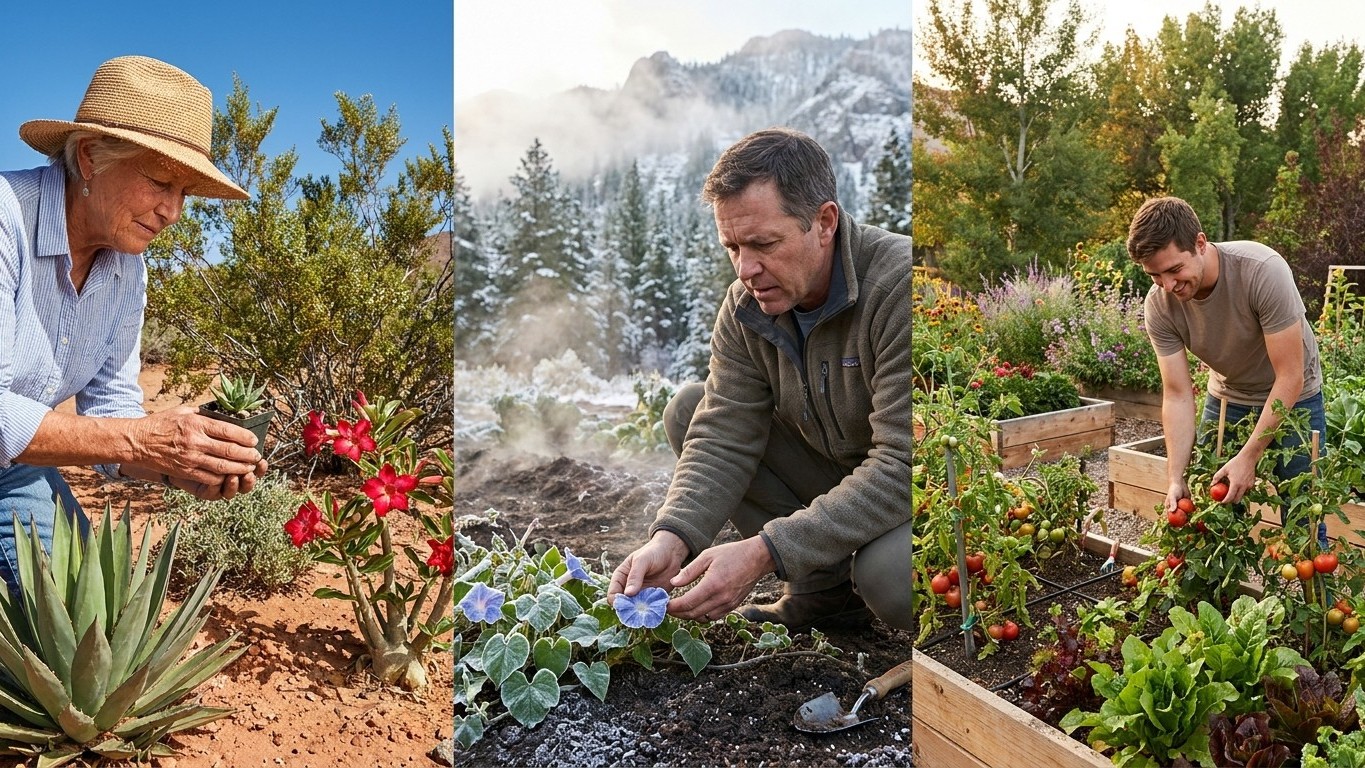

Nevada’s growing season isn’t one thing. It’s at least three: a low desert that barely freezes, high mountain valleys that freeze hard and often, and a long stretch of everything in between. The USDA hardiness zones here run from 4a to 10a, which means the actual answer to “when do I plant” depends entirely on which Nevada you’re standing in.
How long your season really is

Start with the numbers. The USDA Plant Hardiness Zone Map (2023 edition, built on 1991-2020 normals) places Nevada anywhere from zone 4a to zone 10a. That system is built on a single variable: the average annual extreme minimum winter temperature. It tells you whether a perennial survives the coldest night of the year, nothing about your actual planting window.
For that, look at frost dates. At the reference weather station for this data, Las Vegas, NOAA’s 1991-2020 climate normals put the average last spring frost between January 7 and February 1, and the average first fall frost between December 8 and December 23. Do the math and you get a frost-free window stretching from roughly 310 days to well over 350 days a year, essentially year-round gardening.
Here’s the catch: that number is a desert urban-heat-island extreme, not a Nevada figure. Las Vegas sits in zone 10a. A gardener in zone 4a, up in a mountain valley or a place like Elko, is working with a completely different calendar, one where frost can show up months earlier in fall and linger months later in spring. A frost-free window that’s near-continuous in the low desert can shrink to well under 100 days at elevation.
That gap matters because it decides what you can attempt. Long-season crops, the ones that need 90 to 120-plus frost-free days to reach harvest, are a reasonable default in the low desert, which is part of why Growing Potatoes in Nevada looks so different depending on elevation, and it’s also why Growing Pumpkins in Nevada is best attempted with a clear read on your local frost dates, and why knowing When to Carve a Pumpkin in Nevada depends so heavily on when your first fall frost actually lands. It’s also why Growing Sweet Corn in Nevada tends to work best where that long fros, while a long-lived perennial like Growing Asparagus in Nevada can still thrive in colder zones once it’s establishedt-free stretch is reliable. Shorter-season and cold-tolerant crops fare better at elevation, which is exactly why Growing Carrots in Nevada remains a viable option even in zone 4a, why Growing Parsnips in Nevada can actually work better in a mountain valley than in the low desert, why Growing Spinach in Nevada thrives on that same cool, short-season logic, and why Growing Beets in Nevada holds up across nearly the entire elevation range, while long-season crops are a gamble every single year, not a plan you build a garden around. And one more thing worth saying plainly: frost dates are averages, not guarantees. By definition, half of all years run colder or later than that average. Treat the date as a midpoint, not a safe line to plant on.
What the summer does to a garden here
Heat isn’t automatically good news for a vegetable garden, and Nevada’s low desert makes that obvious. At the Las Vegas reference station, the average is 131.3 days a year above 90F. That’s roughly four and a half months where the thermometer regularly clears the threshold that shuts a garden down rather than speeds it up.
Above roughly 90F, tomatoes stop setting fruit. The flowers drop, pollen goes sterile, and the plant just marks time until temperatures ease. Peppers behave the same way, which is why anyone Growing Peppers in Nevada needs to plan around that heat window rather than against it. Lettuce and other cool-season greens bolt, running straight to seed and turning bitter. Spinach, peas, broccoli, the whole cool-weather lineup, simply becomes impossible to grow through the middle of a desert summer.
The practical result is that a low-desert Nevada garden doesn’t run on one long season. It runs on two shoulder seasons, spring and fall, bracketing a dead middle where only the toughest heat-tolerant crops (or nothing at all) makes sense. Plan around that gap rather than fighting it.
Winter tells a different story. The average daily minimum for the coldest month at the same reference station is 39.6F, mild enough that hard freezes are the exception rather than the rule in the low desert. Compare that to higher elevations across the state, where that same coldest-month minimum drops well below freezing, and you can see why a single statewide gardening calendar falls apart fast. In the mountains, summer’s heat load is lighter, which flips the season shape: cool crops can hold on longer, but the reliable stretch of warmth that heat-lovers need may never fully arrive.
What tends to go wrong in Nevada
University of Nevada, Reno Extension keeps a running list of the insects home gardeners actually report, and a handful show up again and again. Squash bugs tend to arrive as vine crops fill out in early to midsummer, feeding on stems until whole squash and pumpkin plants wilt and collapse seemingly overnight. Aphids are more of a season-long nuisance, clustering on new growth from spring through fall, curling leaves and leaving behind sticky honeydew that invites sooty mold.
Hornworms show up mid to late summer on tomatoes and peppers, and they’re easy to miss until the damage is done: a plant stripped of foliage almost overnight, because these caterpillars are surprisingly well camouflaged against the stem. Mormon crickets, meanwhile, are more of a northern Nevada phenomenon, appearing in spring and early summer in years when populations spike, capable of stripping vegetation across large areas rather than nibbling a single garden bed.
UNR’s page also names aphids’ cousins the shield bugs (what most gardeners just call stink bugs), plus cabbage moth, earwigs, elm leaf beetle, and Japanese beetle. If something’s chewing on your plants and it isn’t on this short list, the right move is a photo and a call to your county extension office, not a guess at a treatment.
Where to check before you plant
Everything above is a state-level average, and Nevada is not an average kind of state. It spans several degrees of latitude and crosses hardiness zones from 4a to 10a within its own borders. A number that describes the desert reference station tells you almost nothing reliable about a mountain valley three hours away, and the reverse is just as true.
That’s exactly what a land-grant extension service exists to fix. University of Nevada, Reno Extension publishes region-specific guidance, pest alerts, and planting timing built around local conditions rather than a single statewide date. Beyond the state site, your own county extension office is the better call for a planting calendar that actually matches your elevation and microclimate.
The gap between “close enough” and “wrong” here isn’t small. A calendar built around the desert reference station can be off by weeks in one direction near the state’s edges, and by months once elevation gets involved. Before you commit seed money or transplants to a specific date, a five-minute call or a look at your county’s extension page is the cheapest insurance a Nevada gardener can buy.
What to Plant Next, Crop by Crop
The same numbers that shape a planting calendar also decide what’s worth putting in the ground. Winter cold isn’t a threat to everything — growing garlic in Nevada turns out to be a case where the state’s long stretch below 40°F is a gift rather than a gamble, even down in the low desert around Las Vegas. Summer heat cuts the other way, and it’s the reason a straightforward cool-season lawn can’t just be seeded and left alone here; Nevada lawn care lays out what to plant and when to feed it once you’ve counted up how many 90°F days you’re actually dealing with. And elevation splits the state in two for anyone chasing a summer harvest — growing tomatoes in Nevada walks through why a Las Vegas garden under 2,000 feet is playing a completely different season than one in Carson City or Elko, frost-wise, six hours up the road. Read them together and the pattern behind this hub’s numbers gets a lot less abstract.