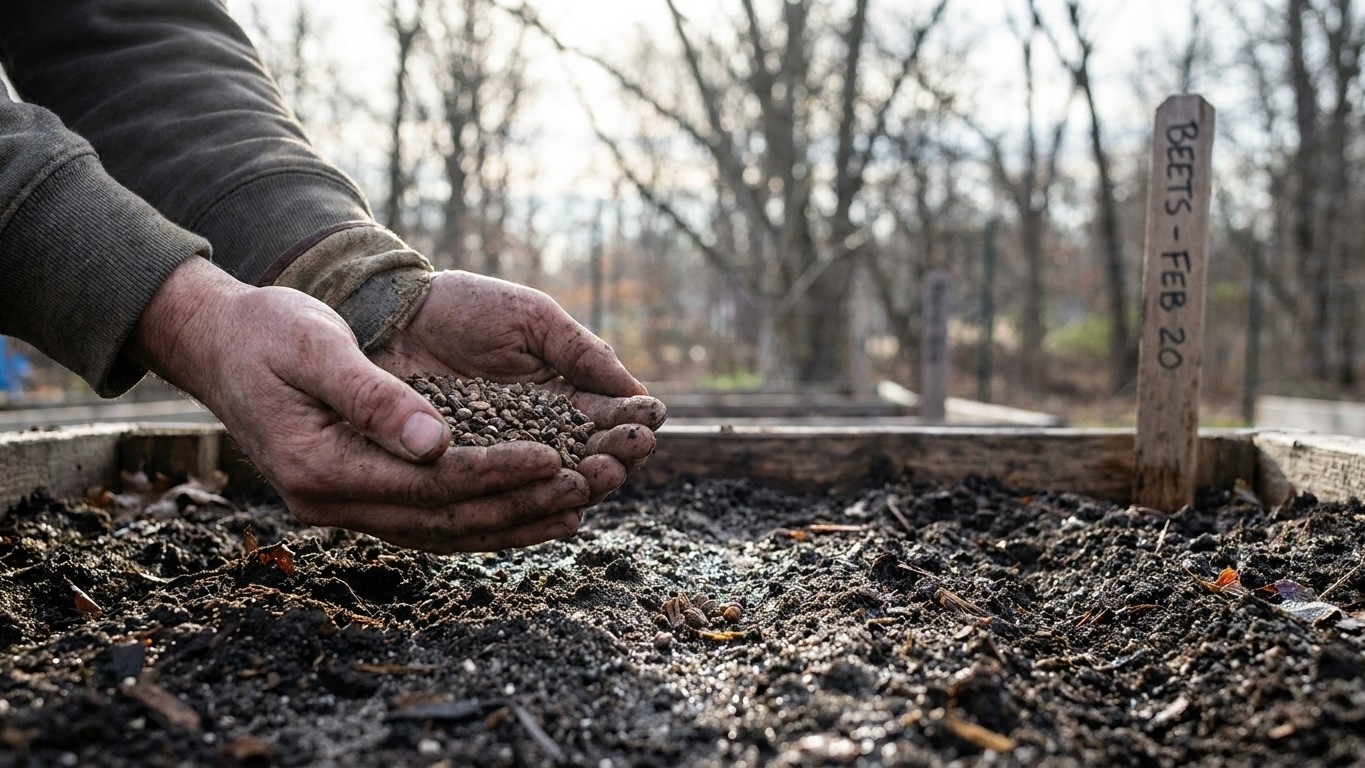

Sow beet seed directly in the ground two to three weeks before Mississippi’s last spring frost, which the reference weather station places between March 6 and March 22. That puts most spring sowing dates in the second half of February through the first days of March, depending on your county. Beets don’t transplant well, so seed goes straight into the bed where it grows to harvest in 60 to 80 days.
The short answer
Mississippi’s official state soil is the Natchez series, an Inceptisol, a young soil that hasn’t had time to build strong horizons. Surface samples run slightly acid at about pH 6.2, and the texture leans heavily toward silt: 5 percent sand, 13 percent clay, 82 percent silt, with organic matter around 1.8 percent. It’s classed as well drained. That combination matters for a root crop like beets, which do best in deep, sandy, well-drained ground carrying plenty of organic matter. A silt-dominant soil like Natchez holds moisture longer than a sandy bed and can compact into a dense mat if it’s worked wet, so a gardener starting from soil resembling this series usually needs to loosen it and mix in composted organic matter, capped at 1 inch per 100 square feet, rather than treating it as beet-ready straight out of the ground.
None of that describes every yard in the state. Mississippi spans hundreds of mapped soil series, and river-bottom ground, hill-country clay, and anything a builder has cut, filled, or compacted will behave nothing like the Natchez profile. Treat these numbers as a signal of what the region’s ground tends to do, hold water, run slightly acid, resist a shovel when wet, and then pull a real soil test from your own bed before you plant.
Heat is the second half of the equation. Beet roots turn woody when temperatures climb past 85 degrees Fahrenheit while the plant is also short on water. Mississippi’s growing season runs long and hot, and a beet sown too late will spend its final weeks of root development in exactly that combination of heat and thirst. The exact count of days each year the reference city spends above 90 degrees isn’t published in the source data behind this page, so that specific figure can’t be stated here. What can be said is that the risk window opens as spring gives way to summer, which is precisely why the sowing date sits so early in the calendar rather than any time convenient once the soil warms.
The six weeks that decide it here
Counting back from a last frost of March 6 to March 22, a spring sowing two to three weeks ahead of that lands roughly between mid-February and the first days of March, again shifting later the farther a garden sits from the reference weather station. Suburban and rural spots typically see their own last frost later than an airport station reports, sometimes by one to two weeks, so a garden outside town should lean toward the back end of that window rather than the front.
The first six weeks after sowing are when beets are most exposed to water stress, and that stretch falls squarely inside a Mississippi spring known for swinging weather more than steady weather. Cold fronts move through the state in late winter and early spring, dropping rain in bursts and then clearing into stretches of dry, breezy days before the next system arrives. That pattern, wet spell followed by dry spell rather than a slow steady soak, is what puts bolting risk on the table here. A beet seedling that dries out during germination or in its first true-leaf stage reads that stress as a signal to flower early rather than build a root, and once it bolts there’s no walking it back.
That risk sits at the front end of the season, distinct from the woodiness risk at the back end. Early water stress triggers premature flowering. Later heat combined with dry soil toughens the root that’s already forming. Both come from the same root cause, uneven moisture, but they show up as different failures at different points in the 60- to 80-day count from seeding, which is why watering habits need to stay consistent through the entire run rather than easing off once seedlings look established.
What goes wrong here
- Seedlings bolt before they size up. This traces back to dry spells during the first six weeks after sowing, the period a Mississippi spring is most likely to deliver in bursts rather than steadily. Water on a regular schedule through germination and early growth, and add a light mulch layer to slow surface drying between rain events.
- Roots come out woody and stringy. Heat above 85 degrees Fahrenheit paired with dry soil toughens the root late in its development. Sow early enough in the window given above that the bulk of root sizing happens before the hottest stretch of the season arrives, and don’t let the bed dry out once temperatures climb.
- Seeds fail to sprout evenly, or the surface crusts over. A silt-heavy soil like the Natchez series can seal into a hard crust after a rain, and beet seed is too small to push through it. Keep the top inch of the seedbed loose and lightly mulched, and avoid walking on the bed while it’s wet.
- Beds drain slower than expected after heavy rain. Even a soil mapped as well drained can sit wet longer than a beet root wants if the bed hasn’t been loosened below the surface. Work organic matter into the top several inches before sowing rather than relying on the native structure alone.
- Organic matter is piled on too heavily. More isn’t better here. Stick to the 1-inch-per-100-square-foot ceiling; overdoing compost or amendment in silt-heavy ground can leave the bed holding more moisture than a beet root wants, feeding right back into the woodiness problem above.
Common questions
What’s the real sowing window for spring beets in Mississippi?
Based on the reference station’s last frost falling between March 6 and March 22, sowing two to three weeks ahead puts most gardens somewhere from mid-February into early March. Gardens outside town, where the last frost often runs one to two weeks later, should shift toward the later end of that range.
Does the state soil mean I need to change how I prep my bed?
If your ground resembles the Natchez series, silt-heavy, slightly acid, well drained but slow to loosen, then yes: work in a modest amount of composted organic matter and break up the surface so beet seed can push through without crusting. But that’s a starting assumption, not a guarantee. Pull your own soil test before deciding how much to amend.
Can I sow a fall crop instead, or in addition?
Beets take 60 to 80 days from seeding to harvest, so a fall crop means counting back from your first fall frost. The source data behind this page doesn’t publish a first-fall-frost date for the reference city, so that count-back has to run off your own local frost history rather than a figure stated here.
Why do my beet roots turn tough even when I water regularly?
Woodiness comes specifically from heat above 85 degrees Fahrenheit combined with water stress, not from heat alone. If watering has been consistent but temperatures spiked during root sizing, the plant may still toughen up. Sowing early enough that most of the root development happens before the hottest stretch of the season is the more reliable fix than watering harder once the heat has already set in.