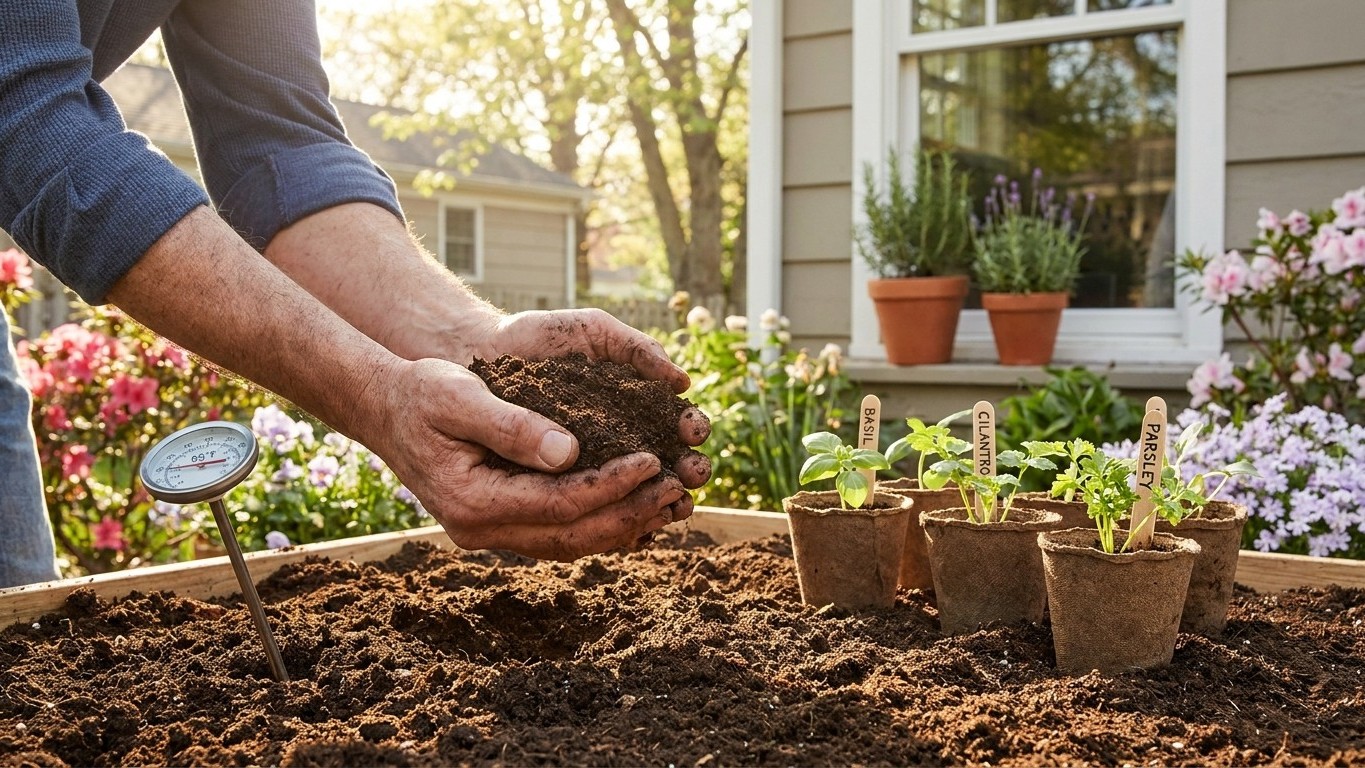

In most of Mississippi, herbs go into the ground once the soil itself has warmed, typically from late March through April depending on where you garden. That single fact matters more than the calendar: the real question is not “when is it safe to plant” but “how long does this state’s mix of frost dates, heat, and mild winters let a herb bed actually work.”
When the soil is warm enough in Mississippi
At Jackson’s reference weather station, the last spring frost falls somewhere between March 6 and March 22, based on NOAA’s 1991-2020 Climate Normals for the 30-70% freeze probability band. That is a wide window on purpose: frost dates are a probability, not a promise, and a garden in the Delta or up in the hill country can see its last freeze a week or two later than the airport station that generates this data.
Frost is a proxy for something gardeners actually need, which is warm soil. Air temperature can climb into the 60s on a sunny March afternoon while the ground four inches down is still cold and slow. Herb roots, especially the warm-season kinds, sit in that cold soil and simply stall rather than grow. That is why the smart move in Mississippi is to treat the frost-date window as the earliest possible starting line, then wait for the soil itself to catch up before setting out anything tender.
Two different clocks for two types of herbs
Cool-season herbs, the kind that tolerate a light frost and actually sulk in real heat, can go in weeks before that last frost date. Warm-season herbs, the kind that come from Mediterranean or tropical stock and hate cold, wet soil, need to wait until the frost risk has genuinely passed and the ground has had a few warm days in a row.
- Cool-season types: leafy herbs that bolt in hot weather, tolerant of a light freeze
- Warm-season types: herbs that stop growing below roughly 50°F soil and resent wet, cold roots
Some herbs carry a long medicinal reputation in folk use. This page does not evaluate any of those claims, culinary use only. And none of this is a guide to identifying a garden herb from a wild look-alike; several dangerous plants resemble common kitchen herbs closely enough that guessing is not worth the risk. If you are ever unsure what is growing in a bed, treat it as unidentified rather than edible.
How long the season lasts here
Between the last spring frost (March 6 to March 22, Jackson reference station) and the first fall frost (November 7 to November 22, same source), Mississippi’s frost-free window runs roughly seven to seven and a half months, depending on where in that date range your own garden falls. Using the more conservative bookends, a late last frost of March 22 and an early first frost of November 7, that is still about 230 days without freezing weather. That is a long season by national standards, and it changes what is worth planting and how.
A window that long allows more than one round of herbs in the same bed. A quick-growing cool-season crop planted in March can be finished and cleared by early summer, leaving time to put in a warm-season herb for the back half of the season, and in many parts of the state there is still enough fall window left after that for another cool-season sowing once the worst summer heat breaks. That kind of staggered planting, known as succession sowing, is exactly the strategy worth applying here, and this site’s succession sowing guide walks through how to time those overlapping windows so a bed is never sitting empty.
Contrast that with a short-season state where the frost-free window barely covers 100 days. There, the first sowing is often the only sowing, and gardeners lean hard on transplants with well-developed root systems just to get a harvest in before frost returns. Mississippi’s long window removes that pressure. It also means the transplant-versus-direct-seed decision matters less here than it does further north: with months of good growing weather ahead, a herb that gets off to a slightly slow start from direct-sown seed still has time to catch up.
The one caution worth repeating: these dates come from a single reference station. Low-lying or rural gardens away from the urban heat pocket of a city station often see frost arrive earlier in fall and linger later in spring, sometimes by one to two weeks. Treat the window as a starting estimate, and watch your own county’s actual frost history before committing tender plants outdoors.
Heat and water in Mississippi
For herbs, Mississippi’s defining feature is not really its summer, hot and humid as that season is across the state. It is the winter, and specifically how mild that winter tends to be. The coldest month at the Jackson reference station has a mean daily minimum of 36.6°F, which barely dips below freezing on an average night. Paired with a USDA Plant Hardiness Zone rating of 7b to 9a for the state, that single figure reorganizes the whole question of what belongs in a Mississippi herb bed.
In colder states, the growing conversation revolves around summer: how many days the thermometer clears 90°F, how the plants cope with heat stress. In Mississippi, that conversation flips. The winter minimum decides which herbs can live outdoors year-round as permanent plants, and which need to come inside or get replaced every year. A herb that is hardy only down into the 20s might survive most Mississippi winters outright in the milder zone 9a pockets near the coast, while struggling in a colder 7b winter further inland. That range, 7b to 9a, is wide enough that a plant treated as a reliable perennial in one part of the state may need a pot and a window ledge in another.
This page does not have a specific count of days above 90°F or a summer rainfall figure for this reference station, and rather than guess at a number, it is worth being direct about that gap: what matters more for herbs than the heat count is what that heat comes paired with, which in Mississippi is humidity. Warm, damp air sitting on herb foliage all summer is a setup for fungal disease and slow, uneven ripening rather than the crisp dry heat that some Mediterranean herbs actually prefer. A bed that gets full sun but poor airflow will often show more mildew and leaf spot here than one placed where breeze can move through the foliage, even at the same temperature.
Put together, the practical Mississippi herb calculus is less “can it take the heat” and more “can it take a mild, wet winter outdoors, and can it shed moisture fast enough in summer to avoid disease.” Those two questions, one about the coldest month and one about airflow, do more to decide a herb bed’s layout here than the frost dates alone.
Which herbs suit Mississippi
None of this points to a single named variety, and that is deliberate. Variety trials, the kind that test specific cultivars against Mississippi’s actual humidity and winter swings, are run locally by land-grant researchers, not by a general climate page. The Mississippi State University Extension Service publishes that kind of tested, region-specific variety guidance, and it is the right next stop for anyone choosing exact plants rather than plant types.
What this page can responsibly say is about type, not cultivar. Given the roughly seven-month frost-free window described above, herb types that establish and produce quickly have an advantage, since they can be sown once and still finish well before fall frost, or sown a second time after an early clearing. Given the mild coldest-month minimum and the 7b-9a hardiness range, herb types described as hardy through at least the upper end of that range are the candidates worth treating as permanent plantings rather than annuals, though gardeners in the colder inland counties should lean toward the more conservative end of any hardiness claim.
Given the humid summer air described above, disease resistance becomes the first filter rather than an afterthought. Herb types bred or selected for resistance to common fungal issues, and placed with real airflow around the base of the plant, hold up through a Mississippi summer far better than the same type crowded into a still, shady corner. Raised beds, wider plant spacing than a seed packet might suggest for a drier climate, and morning sun with some afternoon relief all address that same humidity problem without changing what is planted.
None of these herb types carry any medicinal recommendation on this page, whatever reputation a given herb might have elsewhere; the scope here is culinary and garden performance only. And as with any herb bed, if a plant appears in the yard that was not deliberately planted, it should be treated as unknown rather than assumed to be a safe look-alike. For the specific varieties that Mississippi trials have actually shown to perform, the state extension service listed above remains the source built for that answer.