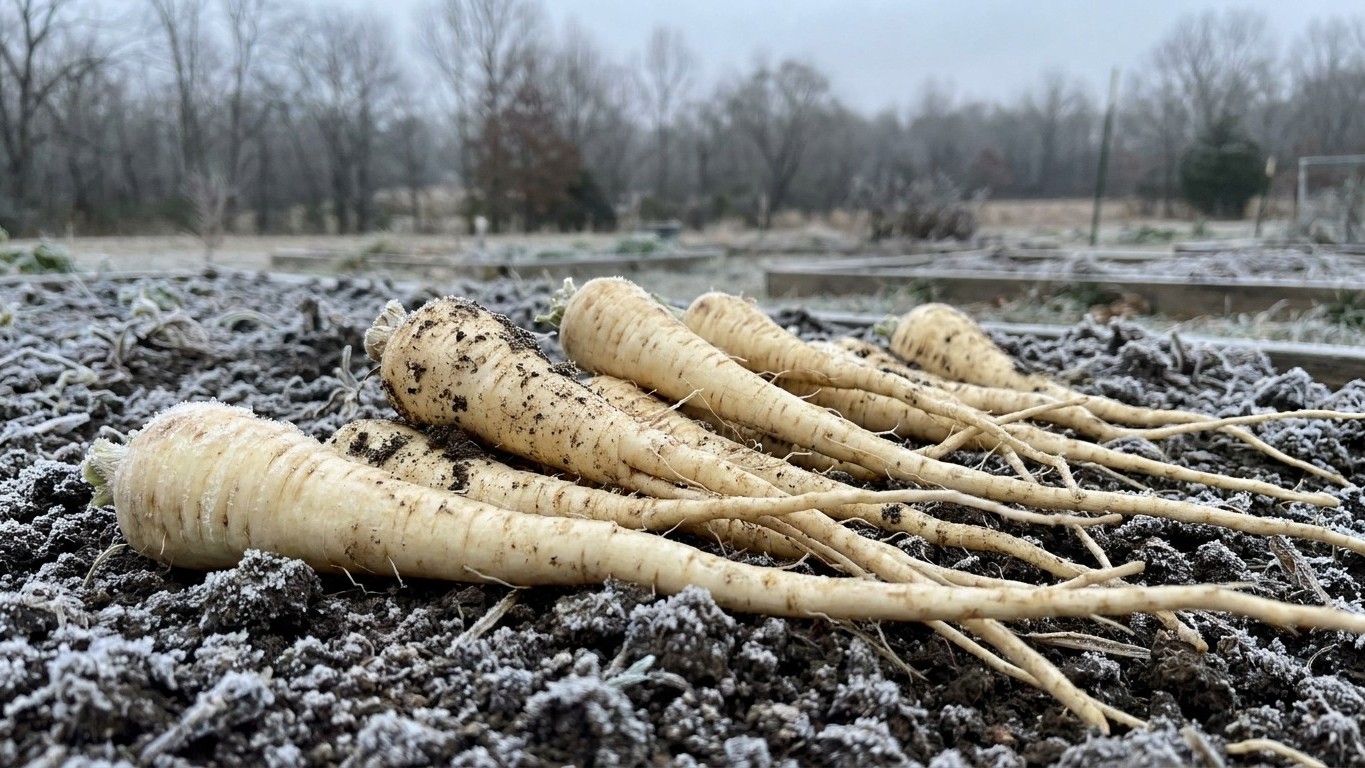

Yes, on the numbers: New Jersey delivers several genuinely frosty weeks most winters, and that’s the mechanism that turns a starchy parsnip into a sweet one. The reference station at Newark puts the coldest month’s mean daily minimum at 25.5°F, which is cold enough, long enough, to do the job. Whether any single garden gets there depends more on timing and soil than on climate.
The short answer
Frost exposure, not hardiness zone, is the number that matters for sweetness. A hardiness zone tells you whether a perennial survives winter where you live. It says nothing about whether a biennial root vegetable sitting in cold ground for weeks converts its stored starch into sugar. That conversion needs sustained exposure to near-freezing and below-freezing temperatures, night after night, for an extended stretch. NOAA’s 1991-2020 Climate Normals for the Newark station put the mean daily minimum for the coldest month at 25.5°F. That’s not a record low or a one-night dip. It’s the average low across the entire coldest month, which means most nights in that stretch dip well below freezing, and many days never climb far above it either.
That kind of sustained cold is exactly what Utah State University Extension describes when it says parsnips “taste best after several weeks of cool, frosty weather, which converts stored starch to sugar.” A mean minimum of 25.5°F across a full month isn’t a marginal case. It’s a solid, repeated freeze-thaw cycle running through the heart of winter, which is the condition the enzyme conversion needs. A garden in coastal South Carolina or inland Florida, where the coldest month’s mean minimum sits closer to 40°F, would struggle to hit that threshold at all, and the parsnips there would grow fine roots that never really sweeten. New Jersey isn’t in that camp.
So the frost exposure question resolves cleanly here. The state’s winter climate, at least at the reference station, gives parsnips the sustained cold they need. That leaves two other questions still open, and they matter just as much as the climate does. Does the growing season actually leave enough days for the root to reach a mature size before that cold arrives? And does the soil in the specific bed avoid the kind of resistance that forks a taproot before it ever gets the chance to sweeten? Climate answers the sweetening question. Season length and soil answer whether there’s a good root there to sweeten in the first place. Both get worked out below.
Does the season fit?
Parsnips are sown directly into the garden bed, never transplanted, and the clock for the 100 to 120 days to maturity starts on the day the seed goes into the ground, not on the day it germinates. Lining up Newark’s frost dates against that timeline shows how the season plays out.
- Last spring frost: Newark’s 1991-2020 data puts the window at March 29 to April 6. That’s the pivot point for the sowing date.
- Recommended sowing date: Utah State’s guidance is to sow 2 to 3 weeks before that last frost, which lands the sowing window at roughly March 8 to March 23 for this reference station.
- Germination: parsnip seed is notoriously slow, taking 14 to 21 days to come up. Seedlings from an early-March sowing might not show above the soil until late March or into April. Don’t dig up the bed in the meantime thinking the seed failed; that delay is normal.
- Root maturity: counting 100 to 120 days forward from the March 8 to March 23 sowing date puts full root size somewhere between mid-June and mid-August.
- First fall frost: Newark’s data puts this at November 4 to November 16, roughly three to four months after the roots reach maturity size.
- The fit: that gap, ten weeks or more between a mature root and the first frost, is the margin that makes New Jersey a comfortable fit rather than a tight one. There’s no pressure to rush the harvest. The roots can sit in the ground, full-sized, waiting for the cold to arrive and do its sweetening work, rather than getting caught half-grown when the season runs out.
That’s a season that fits with room to spare, which matters because parsnips reward patience: the longer they sit through cold weather before you pull them, within reason, the sweeter they get.
What goes wrong here
- Forked roots from heavy or stony ground. A parsnip taproot pushes straight down, and anything it meets, a rock, a clay lens, compacted subsoil, splits it into two or three legs instead of one clean root. Utah State’s fix is direct: work deep sandy soil if you have it, and double dig heavier soil before sowing, loosening it a full spade’s depth or more so the root has a clear path down.
- Forked roots from overwatering. This is a separate cause from soil texture, and it happens even in a well-prepared bed. Excess moisture, especially uneven watering that soaks the bed then lets it dry hard, encourages the root to branch rather than run straight. Water on a steady, moderate schedule instead, and let the top inch of soil dry slightly between waterings.
- A season that runs out. New Jersey’s frost window gives a comfortable margin, but only if the sowing happens on time. Sow too late, into May or June, and the 100 to 120 day clock pushes root maturity dangerously close to, or past, the first fall frost, leaving small or unfinished roots. Sow within the March window tied to your local last frost date and this isn’t a problem here.
- A winter too mild to sweeten. This is less likely given Newark’s cold month numbers, but a warm microclimate, a sheltered urban bed, heavy mulch applied too early, or an unusually mild winter, can shortchange the frost exposure the roots need. If a batch tastes flat and starchy rather than sweet, hold off mulching until after several hard freezes, and leave the roots in the ground longer before harvesting.
The safety warning most parsnip pages skip
Parsnips carry a risk that has nothing to do with taste or soil. NC State Extension’s Plant Toolbox states it plainly: “All parts of this plant contain furocoumarins which can make skin sensitive to light causing burns so be sure to wear gloves, long sleeves and long pants when dealing with it.” That’s all parts, the roots, the foliage, the sap wherever it touches skin, not just the leafy tops.
The mechanism is what makes this catch people off guard. The burn isn’t caused by the sap alone. It needs sap on the skin and sunlight hitting that same skin. That combination is exactly what happens on a bright afternoon spent pulling tops or digging a harvest, hands and forearms exposed, sap rubbing on wet or broken skin, sun doing the rest. The reaction doesn’t flare up immediately either; it typically shows hours after the exposure, well after the gardening is done and the sap has been forgotten. Because sunlight is the trigger, washing the skin afterward doesn’t undo the exposure that already happened in direct light. That’s why the real protection is covering up before you touch the plant at all, gloves, long sleeves, long pants, rather than relying on cleanup after the fact.
Checking this against your own county
Newark’s frost dates and the coldest month’s mean minimum come from one airport weather station, and gardens elsewhere in the state, especially inland, at higher elevation, or away from the moderating effect of the coast, typically see the last spring frost later and the first fall frost earlier, sometimes by a week or two. That shifts the sowing window and shortens the growing season a bit compared to the numbers above.
For frost dates, soil test recommendations, and planting timing specific to your own county, contact Rutgers New Jersey Agricultural Experiment Station Cooperative Extension at njaes.rutgers.edu. Their county offices track local conditions far than a single statewide reference figure can, and that local read is worth confirming before you commit a bed’s worth of seed to a March sowing date.
Common questions
Can I harvest parsnips before the first frost if I’m impatient?
You can, but the roots won’t have gone through the cold exposure that converts starch to sugar. They’ll be edible and fully grown if sown on schedule, just starchier and less sweet than roots left in the ground through several frosts.
Do parsnips need to be dug up before winter ends?
No. Parsnips tolerate freezing soil well and are often left in place and harvested through late fall and into winter as needed, provided the ground isn’t frozen solid enough to block digging.
Why did my parsnip seed seem to fail?
Check the timeline before assuming failure. Germination takes 14 to 21 days, which is slow compared to most garden seed, and an impatient re-sowing of a bed that simply hasn’t sprouted yet is a common, avoidable mistake.
Is the skin reaction from parsnip sap the same as poison ivy?
No. Poison ivy triggers an immune reaction to plant oil regardless of light. The parsnip reaction, described by NC State Extension, requires sap on the skin combined with sunlight exposure; without the light, the sap alone doesn’t cause the same burn.