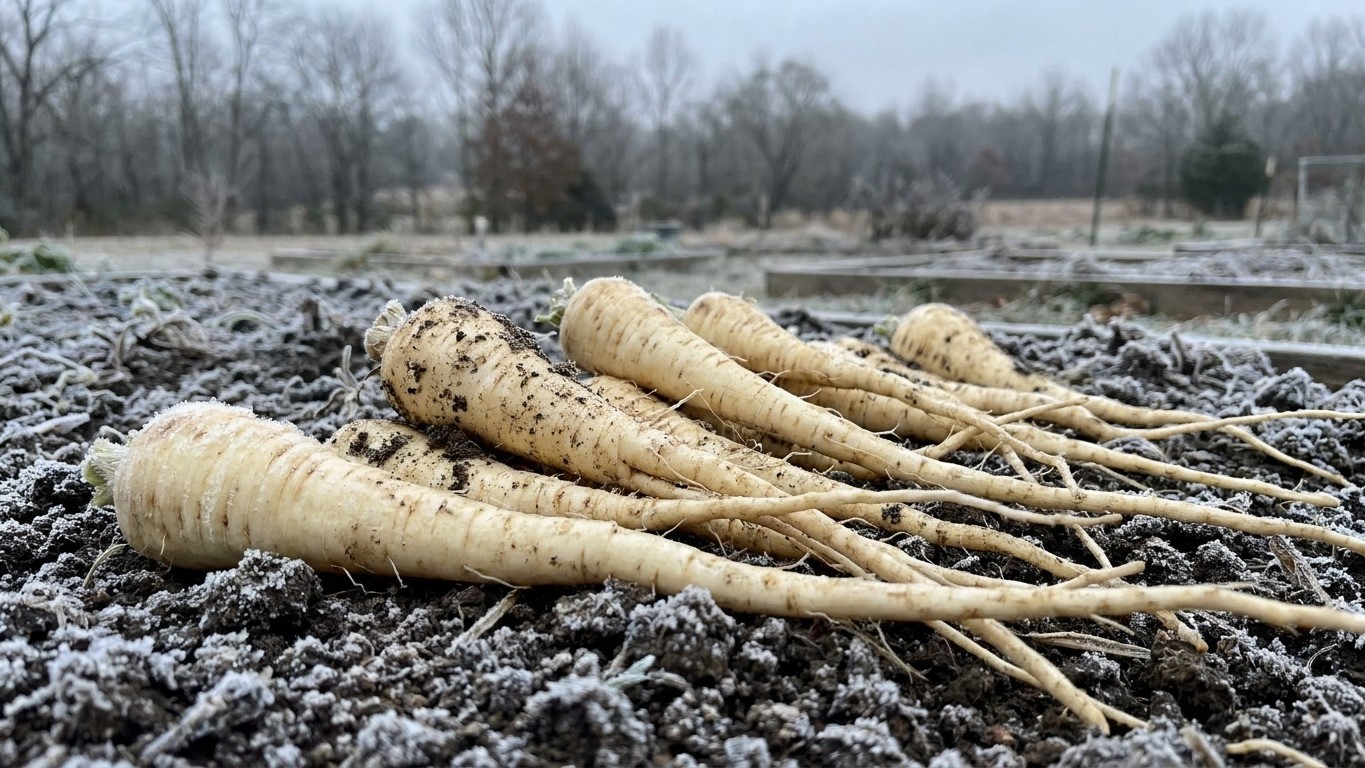

Yes, in most of New York, parsnips left in the ground through a run of hard frosts will sweeten. New York’s winters bring the frosty weeks parsnips need to convert starch to sugar, but how many weeks and how reliably depends on where in the state you garden, not on the state’s general reputation for cold.
The short answer
The question that actually decides this isn’t “is New York cold?” It’s: does this specific location deliver several weeks of frost before you dig the roots? Sweetening in parsnips is a frost-exposure event, not a hardiness-zone event, and those are two different things that get confused constantly.
At the reference station used for New York City, NOAA’s 1991-2020 Climate Normals put the mean daily minimum for the coldest month at 27.9°F. That’s not a record low and not a monthly average, it’s the typical low temperature you’d expect on an ordinary cold night in that coldest month. A number like that, sitting comfortably below freezing night after night, tells you the region gets real, sustained frost exposure rather than the occasional light dip that barely touches 32°F.
For a parsnip sitting in the ground, that matters more than any zone map. A hardiness zone tells you whether a perennial plant’s roots or crown will survive winter where it’s planted. It says nothing about whether an annual root vegetable, harvested and eaten in the same season it grew, will develop the sugar content gardeners actually want. Utah State University Extension is direct about this: parsnips taste best after several weeks of cool, frosty weather, because that cold converts stored starch into sugar. No frost exposure, no conversion, no matter how mild or severe the winter is labeled on a map.
So with a coldest-month mean minimum sitting at 27.9°F, and with frost arriving reliably rather than as a rare event, New York’s climate data supports genuine sweetening, not just growth. A parsnip grown here and left in the ground through the frost window should come out sweeter than one pulled the day after the first light freeze. The caveat worth holding onto: that 27.9°F figure comes from the New York City reference station. Upstate New York and the Adirondacks run colder and frostier earlier in fall, later in spring, which if anything gives those areas more frost exposure, not less. The state as a whole isn’t uniform, but nowhere in it is the winter so mild that sweetening fails to happen, provided the roots stay in the ground long enough to catch it.
Does the season fit?
Parsnips need 100 to 120 days from the day they’re seeded, and they’re sown directly in place rather than transplanted, so the clock starts at seeding, not at any later thinning or true-leaf stage. Working out whether that fits New York’s frost calendar means walking through the arithmetic step by step.
- Find the sowing window. The recommended timing is 2 to 3 weeks before the last spring frost. For the New York City reference station, that last spring frost falls between March 23 and April 3, which puts the seeding window in the first half of March.
- Account for germination before counting growth. Parsnip seed is notoriously slow to sprout, taking 14 to 21 days to germinate. That’s three full weeks where the row can look like bare dirt. Digging it up and re-sowing during that stretch is the single most common way gardeners waste a season before it even starts.
- Run the 100 to 120 day clock from seeding. Starting in early to mid March, the minimum maturity window (100 days) lands in late June, and the fuller window (120 days) lands in mid July. Either point is well within a New York growing season.
- Compare that to the first fall frost. The New York City reference station’s first fall frost falls between November 14 and November 27. Counting forward from an early-to-mid-March sowing date to mid-to-late November covers roughly 250 days, far beyond the 100 to 120 needed just to reach maturity.
- Read the fit. There’s not just enough time to mature the root, there’s an entire extra season’s worth of margin to leave it in the ground afterward, catching the frosty weeks that actually build the sugar. In New York, the season doesn’t just fit, it leaves room to spare.
That margin is worth noticing because it means timing pressure isn’t the risk here the way it is in shorter-season regions. The risk, if there is one, is elsewhere.
What goes wrong here
- Forked roots from heavy or stony ground. Parsnips push a single taproot straight down, and anything that splits its path, compacted clay, rocks, hardpan, splits the root into forks. Utah State University Extension recommends deep sandy soil, and where the native ground is heavy, double digging it before sowing so the root has clear passage.
- Forked roots from overwatering. This is a separate cause from soil texture, not a variation of it. Excess or uneven watering encourages the root to branch as it searches for a stable moisture level. The fix is consistent, moderate watering rather than heavy soaking followed by dry spells.
- A season that runs out before the root matures. This shows up when gardeners sow late, often after impatiently digging up the row during the 14 to 21 day germination window and re-seeding, which pushes the whole 100 to 120 day clock back further than the frost calendar can absorb. Sowing on time and leaving the row alone during germination avoids it.
- A winter too mild, locally, to finish the sweetening. Even where the regional data shows solid frost exposure, a sheltered microclimate (a warm wall, a low spot that drains cold air away, an unusually mild stretch) can leave a root fully grown but under-sweetened. The remedy is patience: leave mature roots in the ground through as much of the frost window as storage conditions allow rather than harvesting at the first opportunity.
Parsnips carry a hazard almost no garden page mentions. According to the North Carolina Extension Gardener Plant Toolbox, “All parts of this plant contain furocoumarins which can make skin sensitive to light causing burns so be sure to wear gloves, long sleeves and long pants when dealing with it.” That’s the whole warning, word for word, and it covers the entire plant, not just the foliage.
The mechanism is what makes this surprising rather than a vague caution. Furocoumarins don’t burn skin on their own. The reaction needs sap on the skin and sunlight on top of it, a photochemical burn rather than a simple contact irritation. That’s why the injury shows up specifically on a bright day of harvest or of pulling tops, why it doesn’t appear immediately but hours later once the skin has been exposed to sun, and why the protective step is covering up beforehand rather than washing the sap off afterward. Gloves, long sleeves, and long pants during the actual handling are the protection the source describes. There’s no mention of a treatment, a typical duration, or a severity scale, because that’s simply not part of what’s documented here, and it’s worth taking the warning at face value rather than assuming it’s minor.
Checking this against your own county
The frost figures here come from one reference station in New York City, and that’s a dense urban site that runs milder than most of the state around it. If you garden upstate, in the Adirondacks, or anywhere away from that immediate area, your own frost dates will likely differ, often by weeks in each direction.
The most reliable way to confirm local timing is to contact Cornell Cooperative Extension directly, since it maintains county-level offices with soil and frost data specific to your area. That local office can tell you what the sowing window and first fall frost actually look like where you garden, rather than relying on a single downstate station as a stand-in for the whole state.
Common questions
Can I transplant parsnip seedlings instead of sowing them in place?
No source here supports that approach. Parsnips are sown directly where they’ll grow, and the 100 to 120 day maturity clock is counted from that seeding date, not from any later transplant.
Why hasn’t anything sprouted three weeks after sowing?
That’s normal. Parsnip germination runs 14 to 21 days, sometimes filling the whole window before anything visible appears. Digging up the row to check or re-sow during that stretch is a common way to lose the season’s timing.
Does a colder hardiness zone guarantee sweeter parsnips?
No. Sweetening comes from actual frost exposure in the ground, not from the zone number assigned to a region. A location can carry a cold zone rating and still fail to deliver enough sustained frost exposure in a given spot, particularly in a sheltered microclimate.
Is it the leaves or the whole plant that cause skin burns?
All parts of the plant, according to the North Carolina Extension Gardener Plant Toolbox. The warning isn’t limited to foliage, so the same precautions apply when handling roots and stems as well.