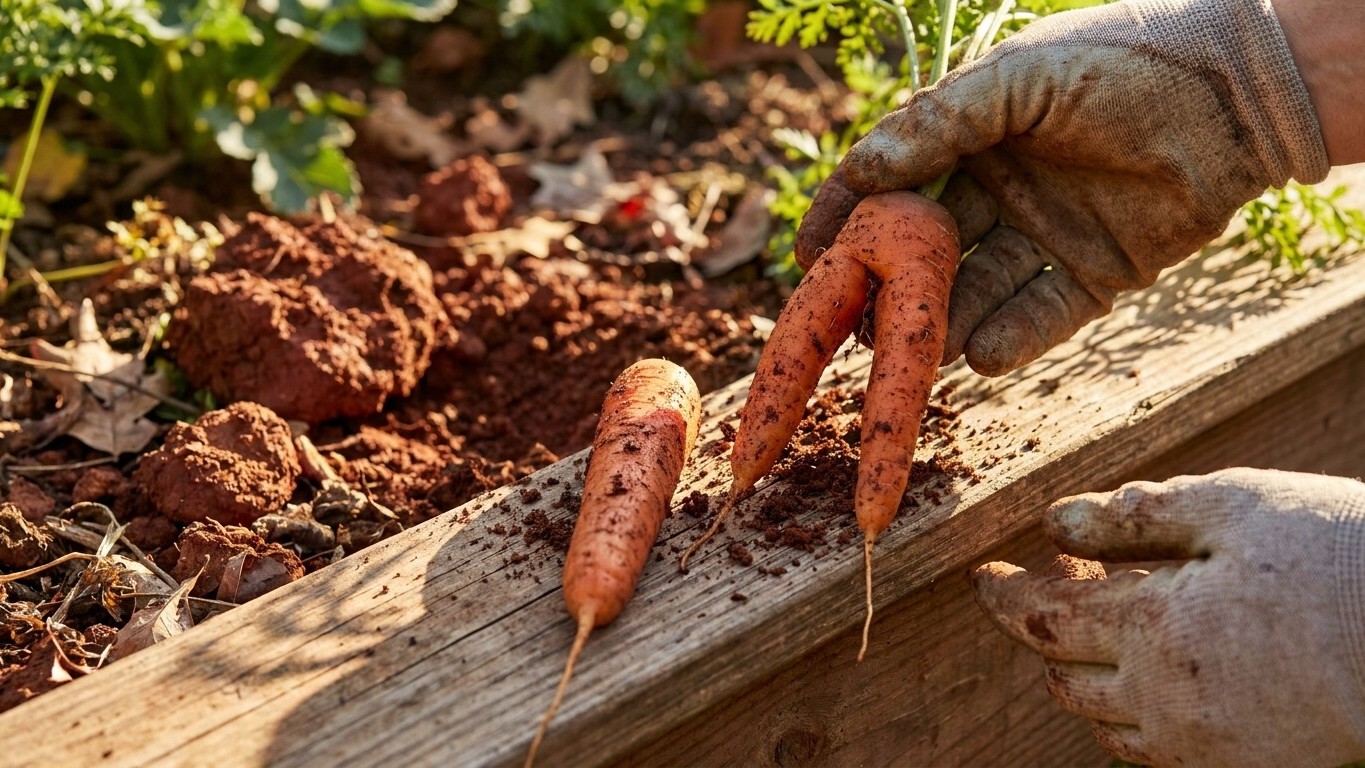

Nevada’s state soil, the sandy Orovada series, is well drained and light enough that carrots planted in it are unlikely to fork from clay alone. But that’s a statewide average, not your backyard. Whether your carrots come out straight or twisted depends on the dirt under your own boots, and the only way to know is to dig into it.
The short answer
The Orovada series is Nevada’s official state soil, named by state law and tracked by the USDA’s National Cooperative Soil Survey. It belongs to the Aridisol order, the soil group typical of dry, high-desert country, and it often runs alkaline with salts sitting near the surface. In the surface horizon, USDA’s Soil Data Access records the makeup as 66 percent sand, 8 percent clay and 26 percent silt, with organic matter around 1.4 percent and a pH near 7.5. Drainage class: well drained.
Set that against what a carrot actually wants. Utah State University Extension puts it plainly: carrots need deep, sandy, well-drained soil rich in organic matter, and heavy or rocky ground makes the root fork as it pushes past obstacles instead of growing straight down. On texture alone, Orovada leans in the carrot’s favor. Sand dominates, clay is a minor player at 8 percent, and the drainage class is well drained rather than the poorly drained, compacted profile that typically splits a taproot around a clump of clay or a buried rock.
Where this soil falls short is organic matter. At roughly 1.4 percent, it’s thin compared with the rich, loose growing medium carrots prefer, and that thinness shows up as soil that dries fast, crusts on top, and doesn’t hold the steady moisture a straight root needs. The fix Utah State University Extension gives for difficult ground still applies here even though the clay isn’t the main problem: work in plenty of compost and double dig the bed to loosen it a full spade’s depth, breaking up any buried rock or hardpan layer along the way. A raised bed filled with a loose, compost-rich mix sidesteps the issue almost entirely, which matters in areas where the native ground has been graded, filled, or otherwise disturbed by construction.
| Property | Orovada series (surface) | What carrots want |
|---|---|---|
| Sand | 66% | Sandy, loose texture |
| Clay | 8% | Low clay, to avoid forking |
| Silt | 26% | Moderate is fine |
| Organic matter | about 1.4% | Rich, well amended |
| Drainage | Well drained | Well drained |
None of this is a verdict on any one garden. Nevada spans hundreds of mapped soil series, from river-bottom ground to hill country to whatever a bulldozer left behind on a new lot, and Orovada is simply the one the state picked as representative. Treat the numbers above as a starting point for what the region’s ground tends to do, not a measurement of the dirt you’re about to plant in.
The test that settles it in your own garden
State-level soil data can’t tell you what’s six inches under your own tomato bed. A short hands-on check will.
- Dig a test hole in the bed you plan to use, going down at least as deep as you expect the carrot roots to reach. Note what you hit: solid rock, a hardpan layer, or just soil the whole way.
- Look at what comes out of the hole. Pull out any stones, gravel, or chunks of hard clay you find, since those are exactly what forces a root to fork or split as it grows around them.
- Grab a handful of moist soil from a few inches down and squeeze it. Sandy soil falls apart and feels grainy. Clay-heavy soil holds together in a slick ribbon when you press it between your fingers. Most garden soil lands somewhere between the two.
- Run a simple jar test if you want more detail: shake soil with water in a clear jar, let it settle, and watch sand drop first, silt next, and clay last, forming visible layers you can measure against each other.
- Fill the test hole with water and watch how it drains. Water that sits for a long stretch points to compacted or clay-heavy ground; water that vanishes almost immediately points to soil so sandy it may struggle to hold moisture evenly.
Run through these steps before you commit to a bed location, because the fix for heavy, slow-draining soil (compost and double digging, or a raised bed) is a different fix than the one for soil that drains too fast and needs more organic matter and mulch to hold moisture.
What goes wrong here
- Forking in heavy or rocky ground. Wherever clay pockets, buried rock, or a hardpan layer sit under the surface, a carrot root splits or bends around the obstruction instead of growing straight. Utah State University Extension’s remedy is direct: work in plenty of compost and double dig the bed a full spade’s depth, or skip the problem altogether with a raised bed filled with loose, sandy soil.
- Poor germination during a hot, dry spell. Carrot seed is small and sits near the surface, and Nevada’s dry climate combined with a thin organic-matter surface layer lets that top inch of soil crust over and dry out fast. Keeping the seedbed consistently moist until the seedlings emerge, and mulching lightly over the row, keeps that crust from forming in the first place.
- Splitting from uneven watering. A root that grows in a dry stretch and then gets hit with a heavy soak swells too fast and cracks open along its length. A steady watering schedule, rather than long dry spells followed by a flood, keeps growth even from seed to harvest.
- Slow, stunted growth in thin soil. Low organic matter means fewer nutrients and less moisture-holding capacity right where the root needs it most. Digging compost into the bed before sowing addresses both problems at once, which is why it’s the first fix worth trying regardless of what your texture test turns up.
Common questions
Does Nevada’s official state soil mean my garden won’t need amending?
No. The Orovada figures represent the surface horizon of one mapped series chosen to stand for the state, not a measurement of any particular yard. Fill dirt, river-bottom ground, and disturbed building lots can all differ completely from it, so the test above is what actually tells you where you stand.
How much compost should I dig in before planting carrots?
Utah State University Extension calls for plenty of compost worked into heavy soil along with double digging, but doesn’t publish an exact quantity, and none is given here. A local county extension office can point you toward an amount suited to what your own texture test turns up.
Can a raised bed replace double digging entirely?
Yes. A raised bed filled with a loose, sandy, well-drained mix removes most of the clay, rock, and compaction problems that cause forking in the first place, without the labor of double digging an existing bed.
How long until carrots are ready to harvest?
Carrots are sown directly in the ground rather than transplanted, so the growing period runs from seeding, typically 70 to 100 days, straight through to harvest. The exact number depends on the variety planted and the conditions through the season, details this page’s source doesn’t break down further.