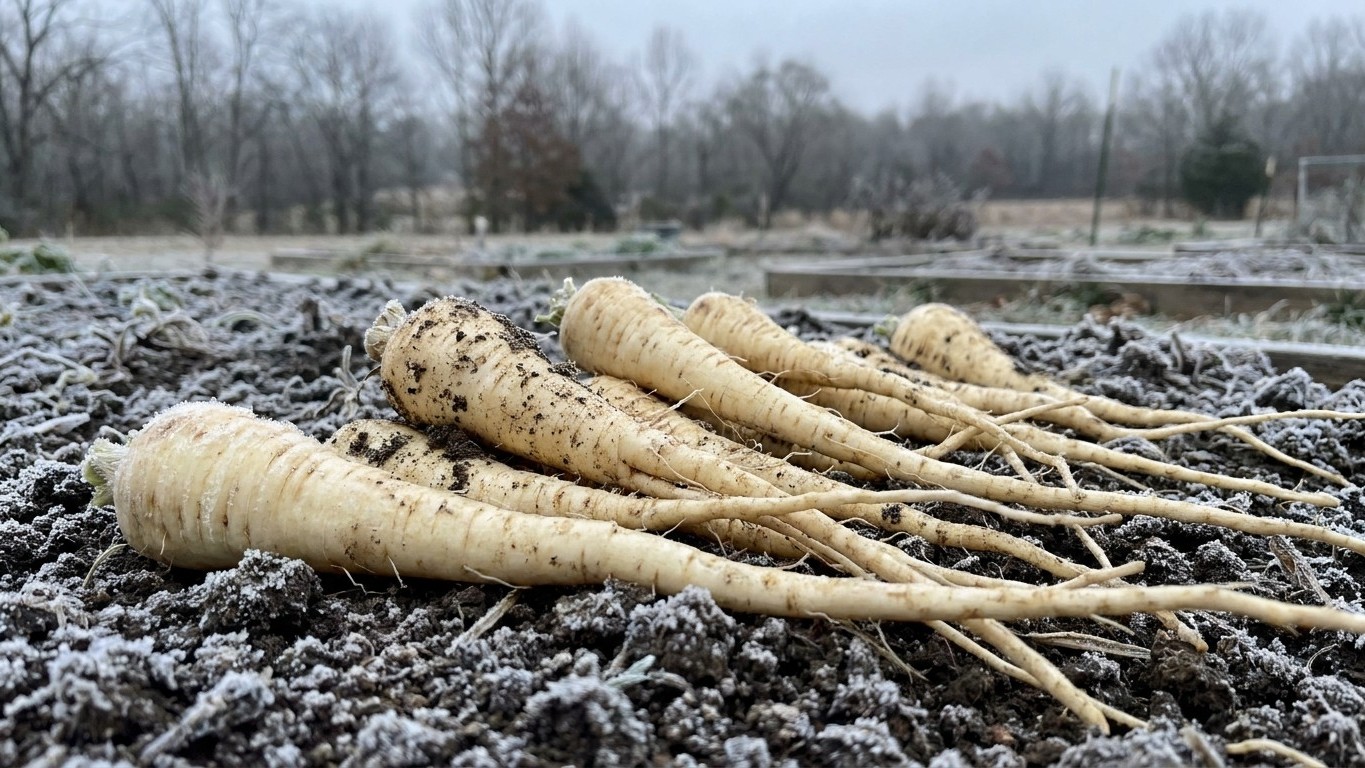

Parsnips grown in Newfoundland and Labrador do more than survive the season here, they sweeten properly. The province’s cold snap after the growing season converts stored root starch into sugar, and that’s the difference between a parsnip that’s just edible and one that actually tastes good roasted. Whether your own plot gets there depends less on a zone map and more on one specific number: how cold the coldest month really runs.
The short answer
The question that decides this isn’t which hardiness zone Newfoundland and Labrador sits in. It’s whether the ground here gets cold enough, for long enough, once the parsnip roots have already reached size. Hardiness zones tell you what a plant can survive. They say nothing about whether a root crop gets the sustained frost exposure it needs to turn starch into sugar. Those are two different questions, and mixing them up is the single most common mistake on parsnip advice pages.
At the reference station in St. John’s, the mean daily minimum for the coldest month comes in at 16.4°F, according to Environment and Climate Change Canada’s Canadian Climate Normals for 1981-2010. That’s not a record low pulled from one unusually harsh winter. It’s the average minimum temperature you’d expect on a typical day in the coldest month, year after year. A number that cold, sustained over an entire month, means the ground and anything left in it goes through weeks of genuine, repeated frost, not a single light nip followed by a warm spell.
That matters because Utah State University Extension is specific about the mechanism: parsnips taste best after several weeks of cool, frosty weather, because the cold converts the root’s stored starch into sugar. One overnight dip below freezing doesn’t do it. It takes sustained exposure, week after week, for that chemical conversion to run its course. A mild-winter region can grow a parsnip that’s perfectly fine to eat, sized right and firm, that never becomes genuinely sweet, simply because it never gets cold enough for long enough.
Newfoundland and Labrador doesn’t have that problem. A coldest-month mean minimum of 16.4°F is well below freezing, sustained across an entire month rather than a single event, and that kind of cold reaches roots left in the ground through fall and into early winter. The verdict for this territory is straightforward: parsnips grown here, given a season that lets them mature before the ground locks up hard, will sweeten. The cold is not marginal. It’s the kind of cold this crop is built for.
Labrador’s interior runs colder still than the St. John’s station used here, so if anything the sweetening effect is even more assured further inland and north. The one place this answer softens is in sheltered coastal microclimates, small maritime pockets where sea influence keeps winter milder than the regional average. Those spots are the exception, not the rule, for the province as a whole.
Does the season fit?
Frost exposure is only half the story. The crop also has to reach full size before the ground shuts down, and that’s a matter of counting days backward and forward from two known dates: the average last spring frost and the average first fall frost, both recorded at the ST JOHN’S A station.
- Parsnips go straight into the ground where they’ll grow, no transplanting, and germination alone runs 14 to 21 days before you’ll even see a seedling. Sow too shallow or let the bed dry out during that stretch and nothing comes up, which is why patience matters more than it does with faster germinators like radishes.
- Utah State University Extension recommends sowing 2 to 3 weeks before the last expected frost. With the mean last spring frost at St. John’s falling on May 30, that puts the sowing window somewhere around May 9 to May 16 for most of the Avalon Peninsula and comparable districts.
- From that sowing date, the crop needs 100 to 120 days to reach full size. Counting forward from mid-May, maturity lands somewhere between mid-August and mid-September, depending on the season’s warmth and exactly when the seed went in.
- The mean first fall frost at St. John’s is October 17. That leaves roughly five to nine weeks of buffer between the crop reaching maturity and the average date the first frost shows up, room to spare rather than a photo finish.
- Because parsnips are meant to stay in the ground through that early frost and beyond, rather than being pulled the moment they’re full size, the gap between maturity and the average first frost is exactly the window where the sweetening conversion starts. The crop doesn’t need to race the frost. It needs to sit through it.
Both frost dates are means from a 1981-2010 dataset, not guarantees. In roughly half of all years the last spring frost arrives later than May 30, and the first fall frost can arrive earlier than October 17 in some years too. Treat both dates as the midpoint of a window, not a safe line, especially if your garden sits inland or at elevation, where frost tends to run later in spring and earlier in fall than the coastal station suggests. Given all that, the season here fits comfortably for most of the province, with real margin on both ends rather than a tight squeeze.
What goes wrong here
- Forked roots from heavy or stony ground. A lot of Newfoundland and Labrador soil runs thin, rocky, or clay-heavy, and a parsnip root pushing down through a stone or a compacted layer will split rather than grow straight. Utah State University Extension’s fix is to work in deep sandy soil where possible, and where the ground is heavy, to double dig the bed to loosen and aerate well below the depth the root will reach.
- Forked roots from overwatering. This is a separate cause from soil texture, not the same problem in different clothing. Too much water, especially inconsistent heavy watering after a dry stretch, encourages the root to branch instead of driving straight down. The remedy is steady, moderate moisture rather than a flood-and-drought cycle, particularly once the root system is established.
- A season that runs out before maturity. Sow too late, whether from a delayed spring or simply starting the bed after the recommended window, and the 100 to 120 day clock can bump right up against the first fall frost with no buffer left. The fix is sowing as close to the May 9-16 window as your own local conditions allow, and choosing the earliest reasonable sowing date rather than the latest safe one.
- Winter too mild to sweeten. This is the failure that hits milder regions hardest, and it’s genuinely not the risk here given a coldest-month mean minimum of 16.4°F. The one exception worth flagging is a sheltered coastal microclimate with unusually strong sea moderation, where a gardener might get a crop that grows well but tastes flatter than expected in an unusually mild winter. For most of the province, this simply isn’t the failure mode to worry about.
Parsnips carry a warning that most garden pages skip entirely, and it’s worth taking seriously before you go pulling tops or hauling a harvest basket into the sun. North Carolina Extension Gardener Plant Toolbox states it plainly: “All parts of this plant contain furocoumarins which can make skin sensitive to light causing burns so be sure to wear gloves, long sleeves and long pants when dealing with it.” That’s the foliage, the root, the sap, all of it, not just the leafy tops people usually think of as the risky part.
What makes this genuinely surprising is the mechanism behind it. The burn doesn’t come from the sap alone. It comes from sap on the skin combined with sunlight. That’s why the reaction tends to show up on a bright day of harvest or of clearing away the tops, and why it often doesn’t appear until hours later, once the skin has been exposed to light. It also explains why the protection that actually works is clothing worn during the work, gloves, long sleeves, long pants, rather than washing your hands afterward once the sun’s already done its part. Plan around the sun, not the soap, and you’ve covered the real risk.
Checking this against your own county
Everything above comes from a single reference station and a provincial average, and Newfoundland and Labrador is not one uniform climate. Coastal districts, inland valleys, and Labrador’s interior can each run weeks apart from St. John’s on both ends of the frost calendar. Before you commit a full bed to parsnips, it’s worth checking those local dates against what’s published for your own area.
Newfoundland and Labrador’s Department of Fisheries, Forestry and Agriculture publishes growing guidance for the province and is the right first stop for local frost dates and soil advice specific to your district. Use it to confirm your local last and first frost dates before locking in a sowing date.
Common questions
Can I harvest parsnips before the first frost if I’m impatient?
You can, and they’ll still be edible, but they won’t have gone through the starch-to-sugar conversion yet. The sweetness this crop is known for comes specifically from several weeks of frost exposure after the root has matured, so pulling early trades flavor for convenience.
Do I need to cover parsnips once frost arrives?
No, and covering them would work against the point. The frost is doing the work of sweetening the root. A layer of mulch can help keep the ground workable for harvesting later in the season, but the crop itself doesn’t need protection from the cold once it’s mature.
Why did my parsnip seeds seem to fail?
Germination for this crop runs 14 to 21 days, noticeably slower than most garden vegetables. It’s easy to assume the bed failed and re-sow too soon, disturbing seeds that simply hadn’t come up yet. Give it the full three weeks before deciding anything went wrong.
Is a raised bed worth it for parsnips in rocky ground?
If your native soil is shallow, stony, or heavy clay, a raised bed filled with deep, sandy loam solves the forking problem at the source rather than fighting it season after season, which lines up with Utah State University Extension’s recommendation to work in deep sandy soil wherever possible.