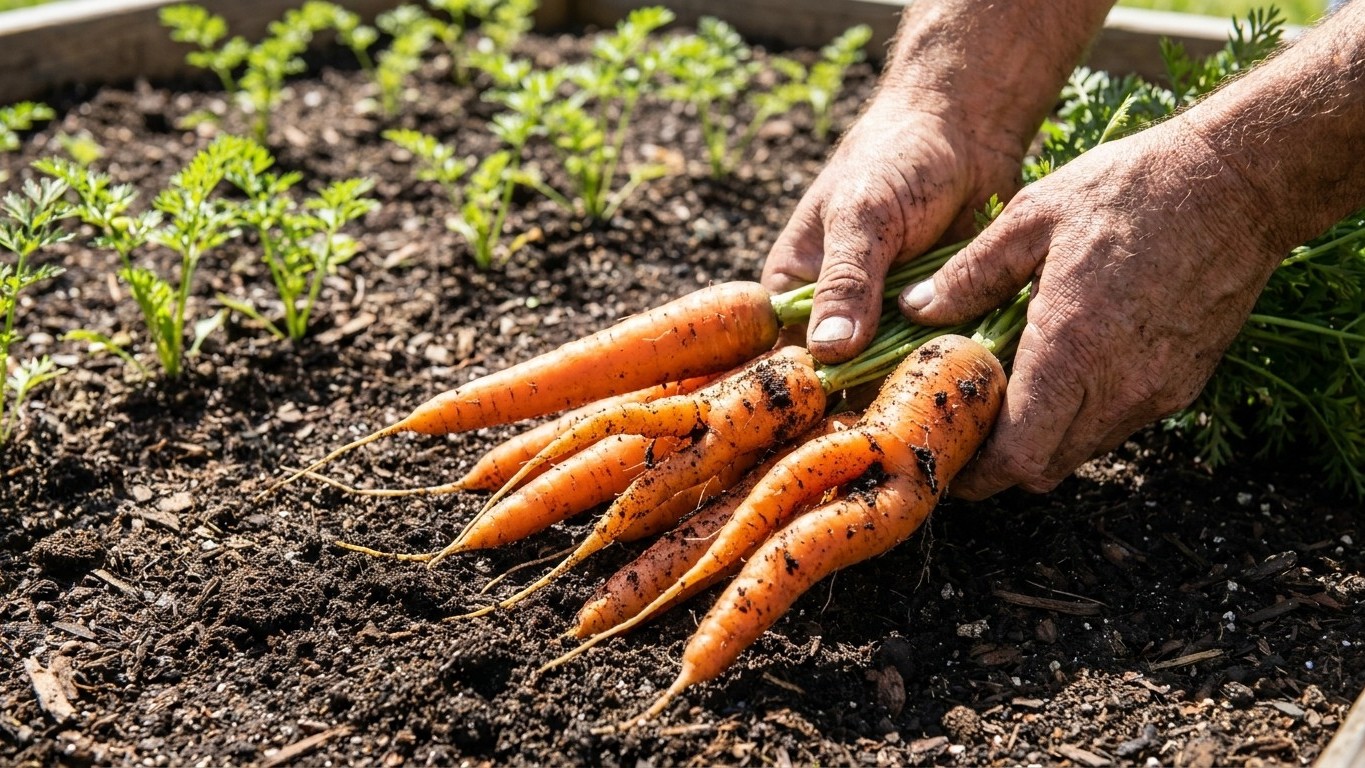

Counting back from the last frost only answers half the question in New Brunswick. Carrots go into the ground as seed, never as a transplant, and need 70 to 100 days from sowing to reach harvest size, according to Utah State University Extension. Get that math right on the calendar and still end up with stubby, forked roots if the bed underneath is heavy, acid ground. What follows looks at what New Brunswick soil typically does to a carrot row, and how to check your own bed before seed goes in.
The short answer
Across New Brunswick’s mapped agricultural soils, the single most common soil order is Podzol, covering 46 percent of the surface sampled, with Gleysolic soils close behind. Podzols form under the province’s conifer stands, where centuries of rain have leached calcium and other bases out of the topsoil and left it strongly acid, a median surface pH near 4.7 across the 418 soil components measured. The texture on top runs loam to silt: about 47 percent sand, 37 percent silt, and 16 percent clay, with organic matter sitting around 3.4 percent. Drainage across this median profile is classed well drained. (Agriculture and Agri-Food Canada, Canadian Soil Information Service, Soil Name Table and Soil Layer Table v2)
Will a carrot fork in this ground?
Carrots want deep, sandy, well-drained soil loaded with organic matter, according to Utah State University Extension. On paper, New Brunswick’s median profile leans closer to that ideal than you might expect from a province known for spruce bogs and rocky pasture: sand is the largest fraction, drainage is rated well drained, and the organic matter share is respectable. That combination tends to let a taproot push straight down without much resistance. Where a plot leans toward the clay side of that mix, though, or sits on Gleysolic ground rather than the better-drained Podzol majority, water sits longer near the surface, and the same seed can produce a root that splits into two or three forks instead of one clean carrot.
Why this number isn’t your number
None of this describes any single backyard. New Brunswick’s agricultural land is mapped into hundreds of distinct soil series, and the 418 components behind this median run from sandy river terraces to heavy, poorly drained lowland clay. A homeowner ten minutes outside town, or a lot a builder graded and refilled, can sit on something the provincial median doesn’t resemble at all. Treat the figures above as what the region’s soil tends to do, acid, sandy loam, decent drainage, not as a stand-in for a real soil test. If your own dig turns up compacted clay or a stone layer, the fix Utah State University Extension gives for heavy or rocky ground applies here too: work in plenty of compost and double dig the bed before sowing, or build a raised bed deep enough that the taproot never has to meet the native soil at all.
The test that settles it in your own garden
The soil map gives a starting point; a shovel gives the answer. Before committing a row to carrots, walk through the same checks a soil scientist would run on any new bed, in this order.
- Dig a hole to the depth of your shovel blade where the row will go. Note whether the blade meets loose ground the whole way down or hits something firmer, a hardpan, dense clay, or a shelf of stone. A carrot needs that whole depth open and loose, not just the top few inches of topsoil.
- Look at what comes out of the hole. Pull a handful from the bottom of the cut and check it for stones and rock fragments. Any bed with more than a scattering of stones will deflect a taproot sideways or split it, no matter how good the topsoil looks.
- Roll a moist handful between your fingers. Soil that forms a ribbon and holds its shape is heavier, clay-leaning ground. Soil that falls apart and feels grainy is sandier and drains faster, closer to what a carrot wants.
- Fill the hole with water and watch how it drains. Water that disappears steadily says the bed is well drained. Water that sits for hours, or pools on the surface after a normal rain, means the same waterlogging that produces forked or stunted roots in heavy provincial clay is happening in your own yard.
- Repeat the dig in more than one spot. A single test pit in a yard that’s been graded, filled, or built on more than once can mislead you; the bed near the house and the low corner by the fence line rarely match.
None of these checks require a lab, and none of them replace one either. A real soil test still gives the only accurate pH and nutrient numbers for your plot, but the shovel test tells you before spring whether the bed needs compost worked in, a raised frame, or nothing at all.
What goes wrong here
Some of what trips up a New Brunswick carrot bed comes straight from the numbers above; the rest is ordinary mismanagement once the soil has already set the stage.
- Forking in heavy ground. Wherever a plot leans toward the clay side of the province’s typical mix, or sits on Gleysolic soil rather than the better-drained Podzol majority, a taproot meets resistance underground and splits into two or three legs instead of growing straight. Utah State University Extension’s fix for heavy or rocky soil is direct: work in generous compost and double dig the bed well below where the root will travel, or skip the native soil altogether and fill a raised bed with a looser mix.
- Poor germination during a hot, dry stretch. Carrot seed is small and sits close to the surface, and a crust that dries out even for a day or two can stop germination cold, leaving gaps in the row instead of a full stand. Keeping the top inch of the bed consistently damp until seedlings appear, rather than soaking heavily and letting the surface dry out between waterings, gets far more of the row up and growing.
- Splitting from uneven watering later in the season. A root that spends weeks in dry soil and then gets soaked, by a heavy rain or a catch-up watering, often splits lengthwise as it swells too fast for the outer layer to keep up. A layer of mulch that keeps moisture steadier through the growing season does more for this than any single deep watering after the fact.
Common questions
Do I need to lower the pH of New Brunswick soil before sowing carrots?
The province’s median surface pH runs around 4.7, strongly acid, which is on the low side for most vegetable roots. No target pH for carrots specifically is published in the figures behind this page, so the honest answer is to run a soil test on your own bed rather than amend blind; the shovel and water tests above tell you about texture and drainage, but pH needs an actual reading.
How long from sowing until carrots are ready to harvest?
Utah State University Extension puts carrots at 70 to 100 days from seeding to harvest. Because carrots are sown directly in place and never transplanted, that whole window runs from the day seed goes into the ground, not from any later date.
If my test pit hits clay at a shallow depth, is a raised bed my only option?
No. Utah State University Extension lists compost plus double digging as a working fix for heavy or rocky ground, loosening and enriching the native soil well past where the taproot will travel. A raised bed is the simpler route if the clay runs deep or if double digging by hand isn’t practical, but it isn’t the only fix.
Does New Brunswick’s average soil profile mean my yard is automatically good for carrots?
No. The provincial median describes agricultural land sampled across hundreds of soil series, and it skips the far north of the province entirely. A yard that’s been graded, filled, or built on can sit on soil nothing like that median, which is exactly why the shovel, texture, and drainage checks matter more than the provincial numbers for any one garden.