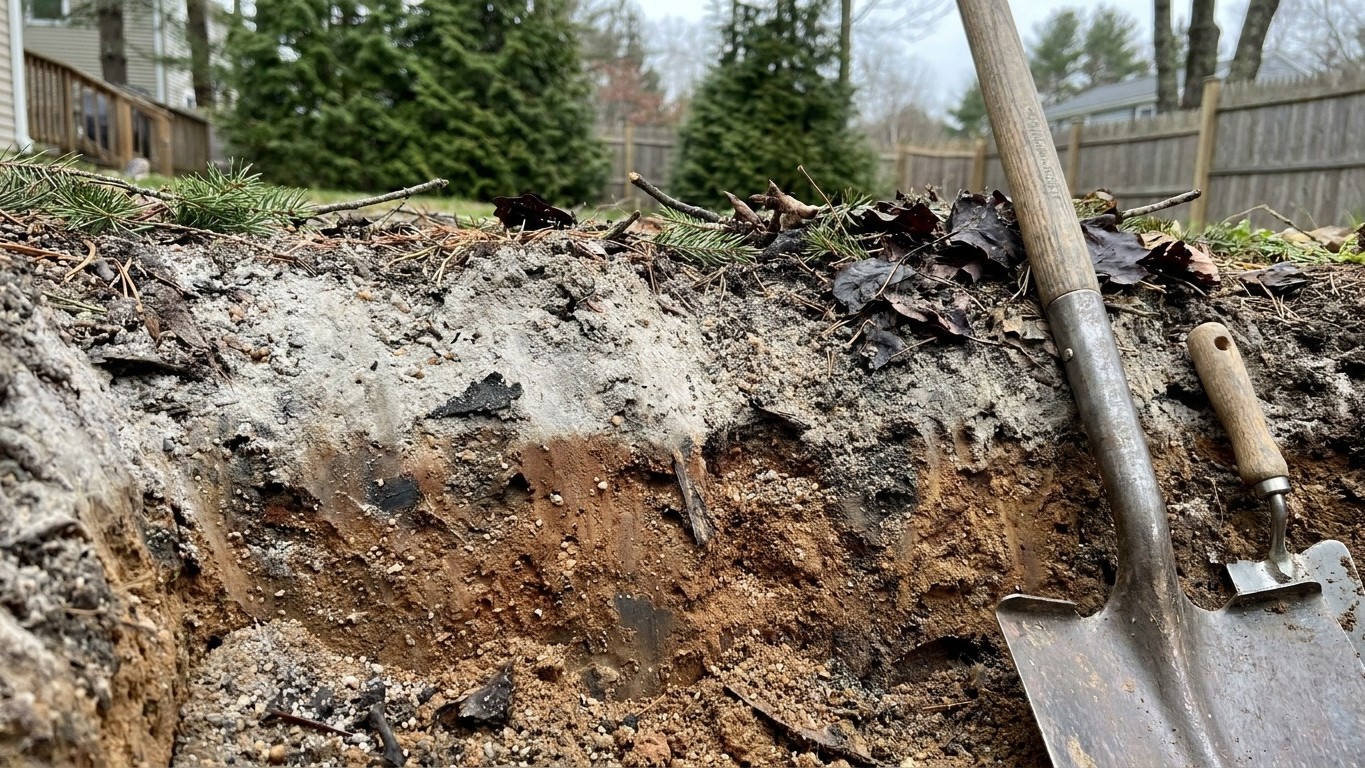

New Brunswick’s cropland is mapped mostly as Podzol, an acid soil that forms under spruce and fir, running a median surface pH of about 4.7, with a loam-to-silt texture of 47 percent sand, 16 percent clay, and 37 percent silt, and roughly 3.4 percent organic matter. That’s the province’s dominant profile. What’s actually under your own garden could be close to it, or nothing like it at all.
What is under your garden

Across the mapped agricultural soils of New Brunswick, the single most common order is Podzol, covering 46 percent of the surface, with Gleysolic soils as the runner-up. A Podzol forms where centuries of rain move through coniferous leaf litter and slowly strip minerals and bases out of the top layer, leaving an acid, often pale, leached horizon above a darker band where the washed-out material piles up lower in the profile. That’s a soil built by spruce, fir, and steady precipitation, not by farmers.
The numbers from the Canadian Soil Information Service put the median surface pH at about 4.7, which counts as strongly acid. The texture comes out to 47 percent sand, 16 percent clay, and 37 percent silt, a loam-to-silt blend that isn’t heavy clay and isn’t beach sand either. Organic matter sits around 3.4 percent, estimated from measured organic carbon. Drainage across these mapped soils is generally classed as well drained.
Why this number isn’t your number
This is a median drawn from 418 mapped soil components in the province’s agricultural zones, not a reading from any one garden. It leaves out the far north, where farmland thins out and the survey doesn’t reach. It also leaves out anything a builder has touched. Fill dirt trucked in for a subdivision, ground compacted by heavy equipment, or a yard scraped down to subsoil during construction can behave nothing like the native profile, no matter what the regional map says. Treat the 4.7 median as a description of what the region’s ground tends to do, useful for guessing before you dig, not a stand-in for a real reading from your own beds.
Read it yourself in five minutes
Two quick checks tell you more than a glance at a map ever will.
- The ribbon test: wet a small handful of soil until it holds together, then squeeze it between thumb and forefinger, pushing it upward into a ribbon. Clay-heavy soil forms a long, slick ribbon over 2 inches before it breaks. Loam forms a short, crumbly ribbon of an inch or so. Sandy soil won’t ribbon at all; it just falls apart.
- The jar test: fill a clear jar about a third full of soil, top it off with water, shake hard, and let it sit overnight. Sand settles first and sits on the bottom by morning, silt layers in above it, and clay stays suspended longest or forms the thinnest top layer once it finally drops.
Run both, and you’ll be able to say out loud, honestly, what you’re actually digging into, rather than borrowing a provincial average.
Testing before you amend
A soil test tells you what your eyes physically can’t: the actual pH of your bed, the available phosphorus and potassium, and sometimes organic matter content, all as numbers instead of guesses. Skip it and you’re amending blind, which is how gardeners end up dumping lime on ground that was already fine, or fighting yellow leaves for two seasons without knowing iron is the real problem.
Taking a sample properly matters more than most people assume. Pull several cores, not just one, from different spots across the bed, at the depth where roots actually live (about the top 6 inches for most vegetables and flowers, a bit deeper for shrubs and trees). Mix the cores together in a clean bucket, remove stones and roots, and send in that blended sample rather than a single scoop from one corner. A test taken 2 inches deep from beside the mailbox tells you nothing useful about a raised bed 30 feet away.
When results come back, the pH number is the one to read first, because it governs how available every other nutrient is, regardless of how much fertilizer you add. Given the region’s median of 4.7, it’s reasonable to expect a reading somewhere in acid territory before you test. But expecting isn’t knowing. Old lime applications, marine clay pockets near the coast, and construction fill can all push a given garden well off that median in either direction, and the only way to find out is the lab result sitting in your hand.
Amending it
With a median surface pH of about 4.7, New Brunswick’s typical ground sits solidly in strongly acid territory, well below the 5.5 mark where most vegetables and lawns start to struggle. That number points in one direction: lime is the tool, not sulphur. Adding sulphur to ground that’s already this acid does nothing but push the pH lower and make the underlying problem worse. Acid soil in this range locks up phosphorus so tightly that plants can’t take it up even when soil tests show plenty is present, and it’s exactly the condition that favors clubroot in brassicas like cabbage, broccoli, and kale, a soil-borne disease that thrives in low pH and is one of the clearest signals that lime is overdue.
Liming is not a quick fix. Ground limestone needs to react with soil moisture and microbial activity over months, and a single application typically shifts pH gradually across one to two growing seasons rather than overnight. Apply it in fall where possible, work it into the top few inches, and retest the following year rather than assuming one bag solved the problem for good.
Working with the texture you actually have
The texture figures for this soil, 47 percent sand, 16 percent clay, 37 percent silt, describe a loam-to-silt loam blend, not the heavy clay or straight sand that demand the most dramatic fixes. That’s a relatively workable middle ground: it holds moisture better than sandy ground and drains better than heavy clay, which is part of why it supports the province’s forests and farmland reasonably well. The main lever here is organic matter, which currently sits around 3.4 percent. Working in compost, aged manure, or leaf mold every year improves structure, buffers pH swings, and helps the soil hold nutrients without needing the more urgent interventions clay or sand demand.
If your own ribbon and jar tests come back showing something well outside that median, treat it as its own case. Heavy clay needs organic matter worked in gradually and should never have sand mixed straight into it, since that combination can set up like concrete; it also should never be worked while wet, which destroys structure for a full season. Sandy ground needs organic matter too, but its real weakness is that water and nutrients pass straight through, so shorter, more frequent watering matters more than any single amendment. Loam improvements like this one often show results within a season; correcting true heavy clay or straight sand realistically takes two to three.
Drainage and compaction
The mapped agricultural soils of New Brunswick are generally classed as well drained, meaning water moving through a typical profile doesn’t sit at the surface for long after a normal rain. Standing water an hour after a storm usually points to compaction, a hardpan layer, or a low spot rather than the native soil type itself failing at its job.
The percolation test
Confirm your own drainage directly. Dig a hole about a foot deep and a foot wide, fill it completely with water, and let it drain once to saturate the surrounding soil. Refill it a second time and time how far the water level drops over an hour. A drop of 1 to 3 inches per hour is workable for most garden plants. Faster than that and water and nutrients are moving through too quickly to be used. Slower than an inch an hour signals compaction or a dense clay layer that needs addressing before amendments will do much good.
Compaction from foot traffic, wheelbarrows, and equipment is often the real culprit behind poor drainage on ground that’s naturally decent. Repeated pressure squeezes air pockets out of the top several inches, and roots simply can’t push through what’s left. Double digging, once the standard fix, has fallen out of favor because it disturbs soil biology and earthworm channels that took years to establish, often doing more harm than the compaction it was meant to solve. A single pass with a broadfork, done when the soil is moist but not wet, does far less damage while still relieving compression.
Sometimes the honest answer isn’t more digging at all. On ground with a stubborn hardpan, heavy foot traffic history, or a percolation result under an inch an hour, a raised bed filled with a purchased or blended soil mix will outperform three years of patient amendment, and it starts producing this season instead of the one after next.
Local help
Soil testing in New Brunswick runs through the provincial agriculture department, with results interpreted alongside federal soil data from Agriculture and Agri-Food Canada. A local or regional office can walk through a lab result with a gardener line by line, translating the pH and nutrient numbers into an actual plan for a specific bed rather than a provincial average.
Common questions
Is all New Brunswick soil this acidic?
No. The 4.7 figure is a median across mapped agricultural soils, not a universal reading. Marine clay pockets, old farmland with a liming history, and disturbed urban lots can all sit at a very different pH. A soil test is the only way to know your own number.
Can I use garden lime on any acidic New Brunswick soil?
Only after testing confirms the pH is genuinely below about 5.5. Lime moves soil chemistry slowly and in one direction, so applying it without a baseline reading risks overshooting into alkaline territory, which locks up iron and causes its own set of yellowing, green-veined leaves.
Why is my soil so much sandier or heavier than the provincial figures?
The province-wide texture of 47 percent sand, 16 percent clay, and 37 percent silt is a median, and local geology varies block by block. River terraces run sandier, old lakebeds and marine clay deposits run heavier. Run the ribbon and jar tests on your own soil rather than assuming the median applies.
How often should I retest my soil?
Every two to three years for an established garden, or the year after any major lime or sulphur application, to confirm the amendment worked and hasn’t overshot the target range.