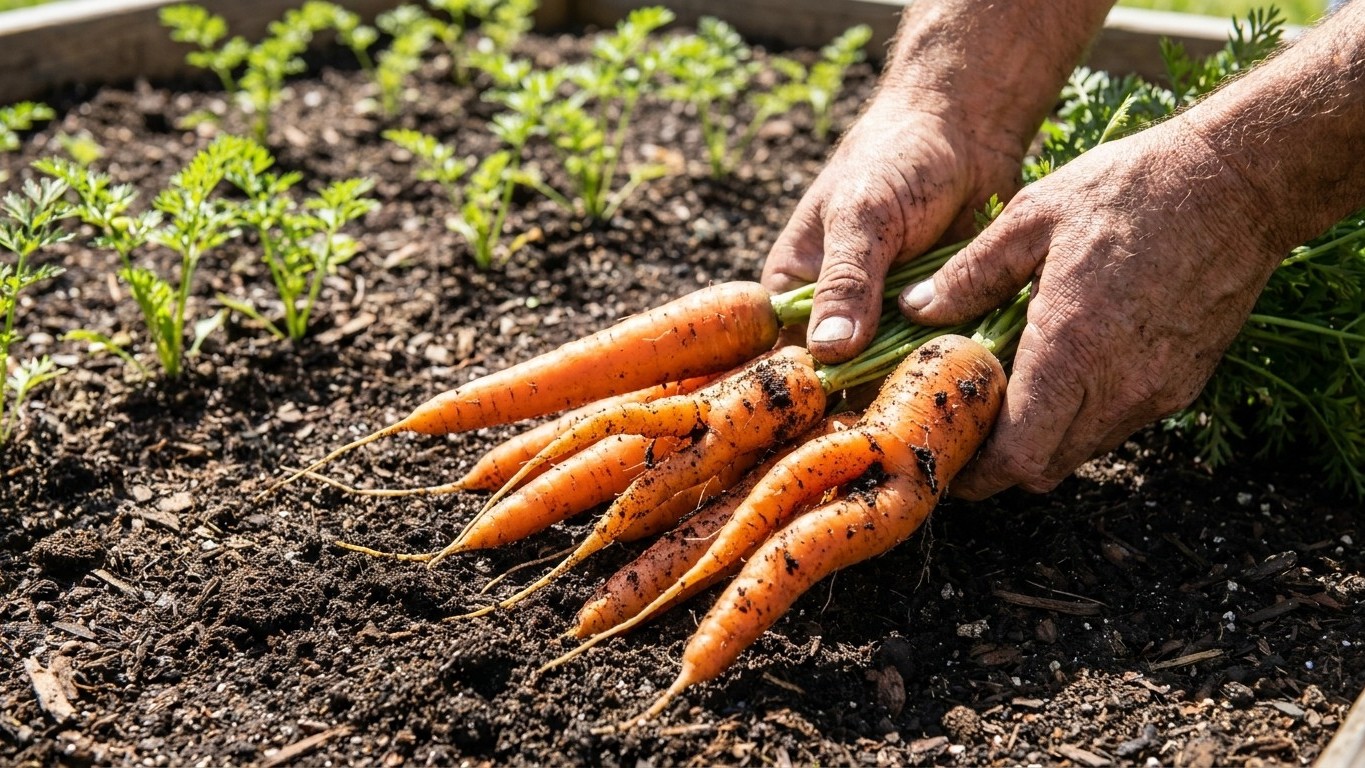

New Mexico gardeners sow carrot seed directly into the ground while soil is still cool, ahead of the last frost, because young carrot plants shrug off a light freeze far better than they shrug off dry, crusted soil. There’s no single statewide frost date published here to count back from anyway; the state’s elevation swings from low desert to high mountain valleys, so that number changes garden to garden. What doesn’t change nearly as much is the ground itself, and that’s where the real answer starts.
The short answer
The soil USDA lists as representative of New Mexico is the Penistaja series, an Aridisol, the kind of dry-climate ground that’s usually alkaline and often carries salts. At the surface, Penistaja runs about 7.5 pH, sandy in texture: 69 percent sand, 15 percent clay, 16 percent silt. Organic matter sits low, around 1.4 percent. Drainage class is well drained. Those figures come from USDA NRCS Soil Data Access, averaged across 47 mapped components of the series.
For a root crop, that combination is genuinely mixed. Carrots want deep, sandy, well-drained soil rich in organic matter, according to Utah State University Extension, and heavy or rocky ground is what makes a taproot fork into a Y instead of running straight down. Penistaja is sandy and well drained, so the structural setup that causes forking, dense clay or embedded rock resisting the root, isn’t the default risk on ground that matches this profile. There’s little clay here to push a root sideways.
What Penistaja doesn’t offer is fuel. At roughly 1.4 percent organic matter, that surface horizon is thin for a crop that wants rich, loose ground to grow into. Utah State’s standard answer for difficult soil is compost worked in generously, paired with double digging where the ground resists a shovel. On Penistaja-like ground, that same compost step matters mainly for feeding the root rather than loosening the structure, since there’s little structure left to loosen. Double digging still helps if you hit a denser layer underneath the sandy surface, but the more consistent need is nutrients.
The alkalinity is worth noting as a measured fact and nothing more. Utah State’s guidance on carrots doesn’t tie any specific pH threshold to success or failure, so a 7.5 surface reading sits on this page as a real number, not as a verdict on whether carrots will thrive in it.
None of this settles what’s actually under your own boots. Penistaja represents the state; it doesn’t represent every acre inside it. New Mexico spans hundreds of mapped soil series, and a plot in a river bottom, a plot on a hillside, and a plot where a builder scraped and refilled the ground before building a subdivision can each land somewhere completely different from the numbers above. Treat this as the region’s starting tendency, sandy, well drained, low in organic matter, alkaline, not as a diagnosis of your particular raised bed or back acre.
The test that settles it in your own garden
Your garden isn’t a soil survey map, and it doesn’t need to be for you to find out what you’re actually working with. A short afternoon with a shovel and a bucket of water tells you more about whether carrots will run straight in your bed than any statewide profile can.
- Pick the exact spot where you intend to sow, not a random corner of the yard, and dig a hole as deep as your shovel or a post-hole digger will comfortably go.
- Pay attention to where the digging gets hard. A carrot needs a clear vertical run underground; hitting rock, a hardpan layer, or dense clay partway down tells you the root will meet that same wall and fork around it.
- Pull a handful of moist soil from the hole and squeeze it into a ball. Sand falls apart the moment you open your hand. Clay holds together and rolls into a ribbon between your fingers. Loam crumbles gently, holding its shape briefly before breaking apart under light pressure.
- Refill the hole with water and watch what happens. Water that disappears quickly points to fast, sandy drainage. Water that sits for hours, or is still there the next morning, points to a heavier or compacted layer somewhere in that profile.
- If you want an actual number instead of a feel for it, send a sample to a soil testing lab for pH and organic matter. That’s the only way to replace a statewide estimate with a figure that belongs to your own plot.
None of these steps call for special equipment. What they buy you is an answer specific to your bed instead of a guess borrowed from a series map. A hole that drains fast and squeezes apart in your hand looks closer to the sandy, well-drained pattern described above. A hole that holds water and rolls into a clay ribbon means you’re dealing with heavier ground, and the compost-and-raised-bed fix matters more for you than the state average would suggest.
What goes wrong here
Most carrot problems on New Mexico ground trace back to one of a few things: the shape of the soil, the dryness of the air, or the rhythm of the watering can. Each one has a specific, workable fix.
- Forking or Y-shaped roots where the ground is heavy or full of rock. Utah State University Extension ties this directly to soil texture: a taproot that meets resistance splits around it instead of pushing through. Where the test hole above turns up clay or stone, work compost into the bed and double dig it before sowing, or sidestep the problem entirely with a raised bed filled with loose, sandy mix.
- Weak, thin, or stunted roots from low organic matter. Ground built like the Penistaja series, sandy and well drained but only around 1.4 percent organic matter at the surface, drains well but offers little to feed a root crop as it bulks up. Working compost into the bed before sowing closes that fertility gap without disturbing the drainage that’s already working in the carrot’s favor.
- Poor germination during a hot, dry stretch. Carrot seed is small and sits near the surface, and sandy ground in a dry climate can crust over or dry out before the seed has a chance to sprout. Keeping the top inch of soil consistently damp until seedlings appear, using light and frequent watering rather than one deep soak, keeps the germination clock running instead of stalling it.
- Split roots from uneven watering. A root that goes through a dry spell and then gets hit with a heavy soak tends to crack as it swells unevenly under the sudden change. A steady watering rhythm, rather than long dry stretches followed by a flood, keeps the root growing at one pace instead of lurching forward and splitting its skin.
Common questions
Does New Mexico’s alkaline soil hurt carrots?
The Penistaja series that represents the state runs about 7.5 pH at the surface, which counts as alkaline but not extreme. Utah State University Extension’s carrot guidance doesn’t set a pH threshold, so there’s no published figure here that says a 7.5 reading helps or hurts the crop directly.
Do carrots need a set number of weeks before the last frost?
No specific week count is published on this page. Carrots go into the ground as seed, not transplants, and the general practice is to sow once the soil is workable and still cool rather than count exact weeks against a fixed calendar date, since New Mexico’s frost timing shifts widely with elevation.
Does the 70 to 100 day maturity window start at frost or at sowing?
It starts at sowing. Carrots are seeded directly where they’ll grow, with no transplant step in between, so the full 70 to 100 day range Utah State University Extension describes for the crop counts from the day the seed goes into the ground, never from a frost date.
What if my garden isn’t sandy like the Penistaja series?
That’s a common outcome. New Mexico spans hundreds of mapped soil series, and river bottoms, hillsides, and any ground disturbed by construction can differ completely from the state’s representative profile. The dig-and-squeeze test earlier on this page settles the question for your own bed faster than any statewide figure can.