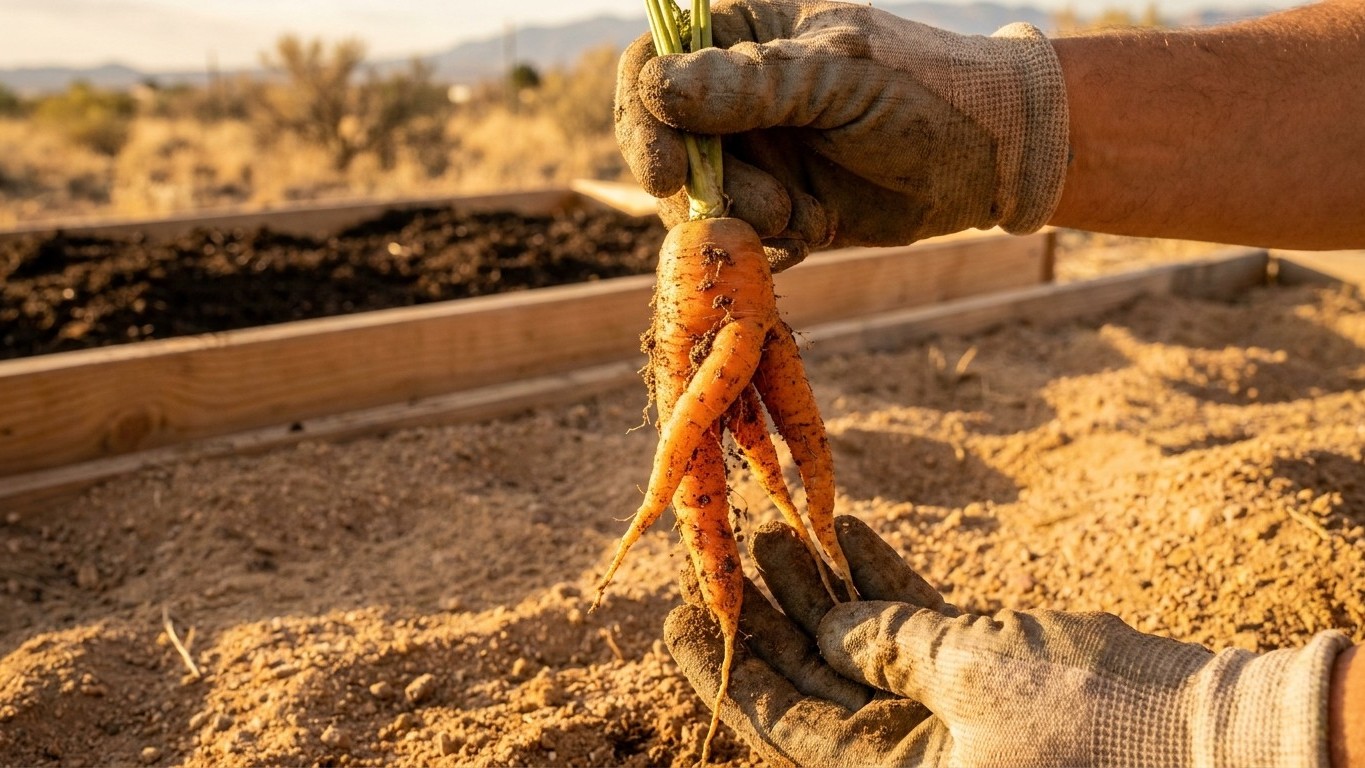

New Mexico’s dominant garden soil leans sandy and alkaline, which works in a carrot’s favor: sandy ground rarely produces the forking and stunting that plague heavy clay gardens. But sow too early, or let watering swing from bone-dry to soaked, and you’ll still pull up twisted, split roots. The fix, when your own dirt doesn’t match that sandy profile, is compost, double digging, or a raised bed. Timing matters just as much: carrots go into the ground as seed, weeks before your last frost, never as a transplant, so check When to Sow Carrots in New Mexico before you plant.
The short answer
The soil USDA lists as representative of New Mexico is the Penistaja series, an Aridisol, the kind of dry-climate soil that forms under low rainfall and tends toward alkaline, sometimes salty, conditions. Its surface horizon runs about 69 percent sand, 15 percent clay and 16 percent silt, with a pH near 7.5 and organic matter around 1.4 percent. It’s classified well drained. Those numbers come from USDA NRCS Soil Data Access, averaged across 47 mapped components of the series.
For a carrot, that combination is mostly good news. Sand doesn’t compact into the dense wall that turns a taproot into a fork, and “well drained” means water moves through instead of sitting around the root and rotting it or forcing it sideways around a wet pocket. Utah State University Extension, the authority behind the carrot-growing guidance on this page, is blunt on the mechanism: carrots want deep, sandy, well-drained soil rich in organic matter, and heavy or rocky ground makes the root fork. A soil that’s already 69 percent sand and well drained clears the first two boxes without effort, though it’s worth digging deeper into Will Carrots Fork in New Mexico Soil? to see how these numbers play out in practice.
Where it falls short is organic matter. At roughly 1.4 percent, this soil is thin on the stuff that feeds a fast-growing root and holds moisture evenly between waterings. Utah State’s answer for soil that isn’t naturally rich is compost, worked in before sowing, and double digging where the loose layer is shallow. If your garden also carries stones, a hardpan a few inches down, or a clay lens left behind by grading, a raised bed sidesteps the problem instead of fighting it season after season.
None of this is a verdict on your particular backyard. New Mexico spans hundreds of mapped soil series, and the Penistaja profile is a statewide representative, not a survey of every plot in it. River bottoms run heavier and hold more organic matter. Hill country sheds water faster and exposes more rock. Anywhere a builder scraped, filled or compacted before you moved in will behave nothing like the undisturbed series USDA mapped. Treat these figures as the starting tendency for the region, then confirm what’s actually under your carrots.
The test that settles it in your own garden
A state soil series describes millions of acres. Your carrot bed is maybe forty square feet. The only way to know which one you’re actually working with is to look, feel and watch, right where you plan to sow.
- Dig a hole about a foot deep. Note how far down the soil stays loose and workable before you hit a hard layer, dense clay, or a bed of stones. Carrots need that loose depth to grow straight; a hardpan a few inches down will turn every root into a fork regardless of what’s above it.
- Check for stones and debris as you dig. Any root that meets a rock, a chunk of old concrete, or a buried root ball will split around it. Pull out what you find, or plan on a raised bed if the ground is full of it.
- Do a texture squeeze. Take a handful of moist soil and squeeze it. Sandy soil falls apart and won’t hold a shape. Clay-heavy soil forms a slick, sticky ribbon that holds together. Loam sits somewhere in between, holding a loose shape that crumbles with a light poke.
- Run a drainage check. Dig a hole, fill it with water, let it drain completely, then fill it again and watch how the water level drops. Water that lingers for hours points to poor drainage and a higher risk of forking and rot; water that vanishes almost immediately points to sandy, fast-draining ground that will need more frequent watering and more organic matter to hold moisture.
Whatever combination you find, it tells you more about your carrots’ future than any state average can.
When to sow here
Carrots are a direct-seed crop from start to finish. There’s no transplanting, no seedling tray, no hardening-off step, so every day counted here runs from the day seed goes into the ground, not from any later stage.
- Start from the local frost window. NOAA NCEI’s 1991-2020 climate normals put the last spring freeze at this region’s reference weather station somewhere between March 31 and April 12, based on 32°F freeze probabilities.
- Count backward two to three weeks. Carrots tolerate cool soil better than most root crops, so the recommended sowing window falls two to three weeks before that last-frost range, roughly the second and third weeks of March, running into very late March depending on which end of the frost window your county falls on.
- Confirm the soil, not just the calendar, is ready. Soil temperature needs to be at least 40°F before seed will germinate at all, and germination performs best in the 55 to 65°F range. In many New Mexico gardens, especially at higher elevation, soil lags behind the calendar date, so a soil thermometer beats guessing from the frost window alone.
- Remember gardens outside town run later. The NOAA normals come from an airport weather station. Suburban and rural gardens, and anywhere with more elevation, typically see their last frost land one to two weeks later than that reference figure, which pushes the safe sowing window later too.
Sowing early into cold soil doesn’t kill carrot seed the way it would a tomato transplant, but seed that sits in soil colder than 40°F simply won’t sprout, and it can rot before it gets the chance.
What goes wrong here
- Forking in heavy or rocky pockets. Even in a mostly sandy region, a clay lens, buried debris, or a shallow hardpan will split a taproot around the obstruction. Utah State Extension’s remedy is working in compost and double digging to loosen and enrich the bed, or building a raised bed where the native ground is too shallow or too full of stones to fix in place.
- Poor germination during a hot spell. Carrot seed germinates best between 55 and 65°F, and New Mexico’s spring can swing hot fast. Soil that overshoots that range dries out and stalls germination. Watering lightly and often to keep the seedbed cool and moist, and sowing on the early side of the window rather than the late side, keeps more seed from stalling out.
- Splitting from uneven watering. A root that grows through a dry stretch and then gets soaked, or the reverse, tends to crack along its length as it expands unevenly. Sandy soil like the region’s dominant series drains fast and dries out fast, which makes irregular watering an easy trap. A steady watering routine, plus a layer of mulch to slow evaporation, evens that out.
Checking this against your own county
Everything above starts from a statewide soil series and a single reference weather station. Your county’s actual frost dates, elevation and typical garden soil can shift the picture meaningfully, especially anywhere above valley floor. The New Mexico State University Cooperative Extension Service, at aces.nmsu.edu, runs county offices across the state and can point you to local frost data and soil testing for your specific address. A county agent, or a lab-tested sample from your own bed, will always beat a statewide average for deciding exactly when to sow and how much compost to work in first.
Common questions
Do I need to test my soil’s pH before planting carrots?
The state’s representative soil runs alkaline, around 7.5, but that figure describes a mapped series, not your bed. A soil test through your county extension office gives you your actual number and whether it needs adjusting.
Can I sow carrots directly into unimproved sandy soil?
Yes, sandy soil is favorable for straight roots, but the region’s representative soil carries only about 1.4 percent organic matter, which is thin for feeding a fast-growing root. Working in compost before sowing helps even naturally sandy ground perform better.
Why did my carrots come up sparse this spring?
Germination performs best between 55 and 65°F. If soil temperature swung above that range during a warm spell, or stayed below 40°F too long, uneven or sparse germination is the likely cause rather than the seed itself.
Is a raised bed necessary everywhere in the state?
No. Where native soil is loose, sandy and free of stones to a foot or more, direct sowing into amended ground works fine. A raised bed becomes the practical answer mainly where a hardpan, heavy clay pocket or rocky fill sits close to the surface.