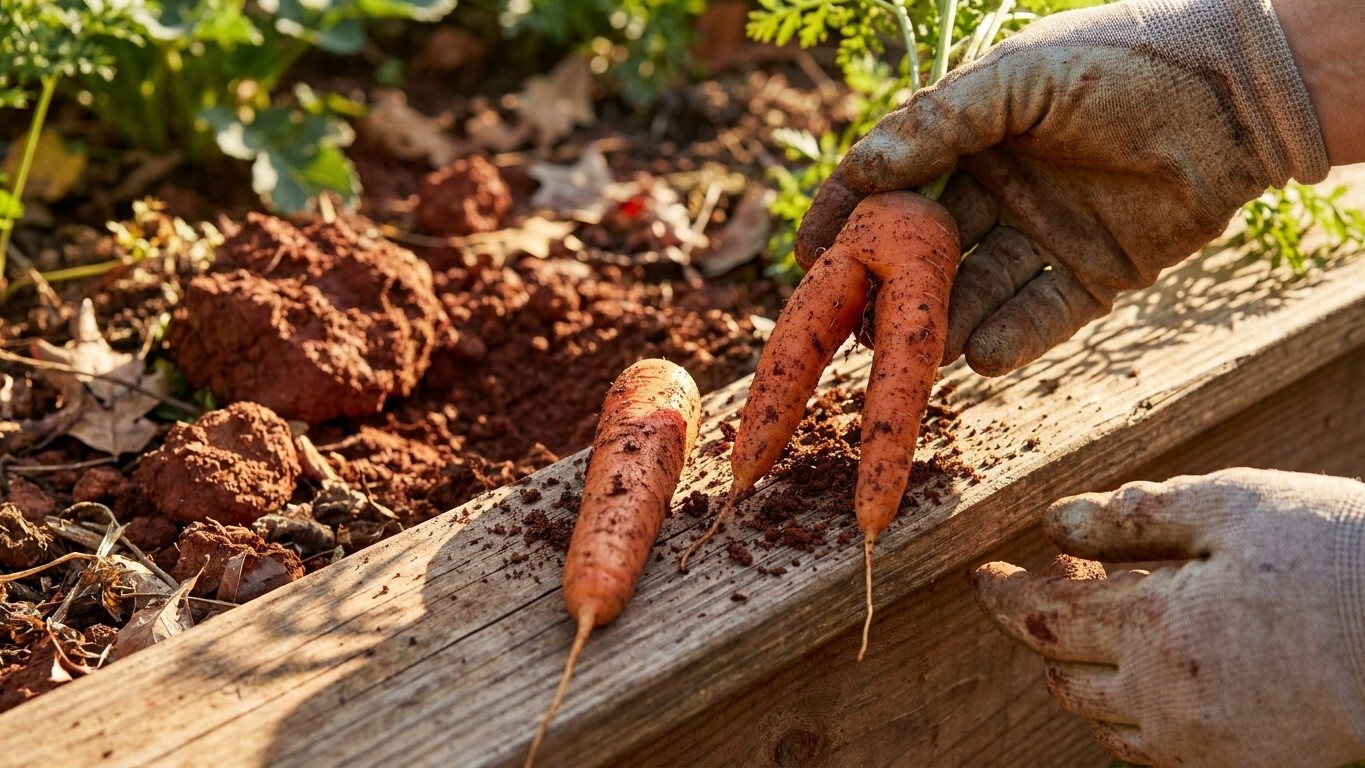

The dominant soil across Newfoundland and Labrador’s farmed ground is a Podzol: 56 percent sand, 9 percent clay, 35 percent silt, imperfectly drained, and strongly acid. That texture leans sandy, which usually keeps carrot roots straight. So the short answer is that most of this soil shouldn’t fork a carrot on texture alone, but the imperfect drainage and the acidity are a different story, and both call for compost worked into the bed before you sow.
The short answer
Start with the numbers. Across the mapped agricultural soil components of Newfoundland and Labrador, the most common soil order is Podzol, covering 59 percent of the mapped surface, with Organic soils as the runner-up. The median surface horizon runs 56 percent sand, 9 percent clay, and 35 percent silt, a loam to silt loam blend with a strongly acid median pH around 4.3 and organic matter near 3.3 percent. Drainage across this median profile is classed as imperfect, meaning water moves through slowly enough to leave the root zone damp longer than a carrot prefers, without being outright waterlogged. That figure comes from the Canadian Soil Information Service’s Soil Name Table and Soil Layer Table, covering 459 mapped soil components across the province’s agricultural regions.
Put that against what a carrot actually wants. Utah State University Extension is clear that carrots need deep, sandy, well-drained soil rich in organic matter, and that heavy or rocky ground is what bends and forks the root. On texture, this province’s typical profile isn’t the villain you’d expect: 9 percent clay is low, and 56 percent sand is a solid start. The forking risk here comes less from clay content and more from the imperfect drainage and the acid pH, which slows organic matter breakdown and can leave a crusty, uneven root zone if the bed isn’t loosened and fed. The fix Utah State names for heavy or poorly structured ground is plenty of compost and double digging, working the bed a full spade deeper than usual so roots meet no resistance and no standing water. Where a yard sits on a low, wet corner of that imperfectly drained profile, a raised bed solves the drainage problem outright, since it lifts the root zone above the water table instead of trying to out-dig it.
None of this is a verdict on your specific yard. Newfoundland and Labrador spans hundreds of individual soil series once you get past the province-wide median, and a bed twenty feet from a stream, a bed on filled land, or a bed near boggy muskeg can each behave nothing like the numbers above. Think of this Podzol profile as the province’s starting assumption, the kind of soil you’d expect if you knew nothing else about your yard. The next section is how you replace that assumption with an actual answer.
The test that settles it in your own garden
- Dig a hole a full foot deep where you plan to sow. Carrots need that much clear depth to grow straight, so if you hit a hardpan, a rock layer, or dense clay before you reach twelve inches, that’s your forking cause right there, no lab test needed.
- Check what’s in the dirt as you dig. Pull out any stones, roots, or chunks of undecomposed sod. Utah State University Extension names rocky soil as one of the two direct causes of forked roots, and a handful of gravel in your first shovelful is a clearer answer than any soil map.
- Feel the texture between your fingers. Grab a moist handful and squeeze. Soil that stays in a slick, sticky ribbon is high in clay and needs work. Soil that falls apart immediately and feels grainy is sandy, closer to what a carrot wants. Something in between, holding a loose shape but crumbling with a little pressure, is the loam texture carrots do best in.
- Watch how water drains. Dig a hole about a foot deep, fill it with water, let it drain once, then fill it again and time it. Water that’s gone within a few hours drains well. Water still sitting the next morning tells you the bed is holding moisture the way an imperfectly drained soil does, and that’s the situation a raised bed is built for.
- Send a sample to a soil test lab if you want the acidity question answered for real. A province-wide median pH is not your yard’s pH, and only a lab reading tells you whether lime is worth adding before you sow.
What goes wrong here
- Forking in heavy, poorly drained ground. Where a yard sits on the denser, wetter end of this province’s soil range, roots meet resistance and split around it instead of pushing through. Utah State University Extension’s answer for heavy soil is compost worked in generously along with double digging, loosening the bed a full spade deeper than the carrot’s expected root length so nothing stops it on the way down.
- Poor, patchy germination. Carrot seed is tiny and needs the top inch of soil to stay evenly moist for the full stretch until it sprouts. In soil that crusts over between rains, or in a sandy patch that dries out fast, germination comes in thin and uneven. A light mulch layer and a daily check during the sprouting window keep that top inch from drying out or hardening.
- Splitting from uneven watering. A carrot root that goes from parched to soaked and back again tends to crack down its length rather than fork at the tip. On soil already inclined to hold water unevenly, the fix is a steady watering habit rather than an occasional heavy soak, so the root isn’t swinging between drought and flood.
- Stunted roots in acid, low-fertility patches. A strongly acid profile slows the breakdown of organic matter and can tie up nutrients a carrot needs to bulk up its root. Working compost into the bed before sowing, rather than after growth has already stalled, is the straightforward remedy.
Common questions
Does sandy soil mean carrots definitely won’t fork?
Sandy soil lowers the odds but doesn’t erase them. Utah State University Extension names heavy or rocky soil as the direct cause of forking, so a sandy bed free of stones and dug deep is the safer setup. Sand alone doesn’t fix poor drainage or a hardpan layer sitting underneath it, so it’s still worth digging that test hole before you sow.
Should I add lime to bring the acidity up?
That depends on a number this page doesn’t have, since the province’s median pH is not your yard’s pH. A soil test lab is the only way to get a real reading and a lime recommendation matched to it. Guessing at a lime amount without that number risks overcorrecting.
Is a raised bed always the answer on imperfectly drained soil?
It’s the most direct fix when a hole you dug stays wet overnight. A raised bed lifts the root zone above that slow-draining layer instead of trying to loosen it in place. On a spot that drains within a few hours in your own test, double digging with added compost may be enough without building a frame.
How many days should I expect from seed to harvest?
Carrots are sown directly in place, with no transplanting step, so any days-to-harvest figure on a seed packet counts from the day you sow, not from any later date. This page doesn’t carry a specific number for that count, so check the seed packet you’re using for its own figure.