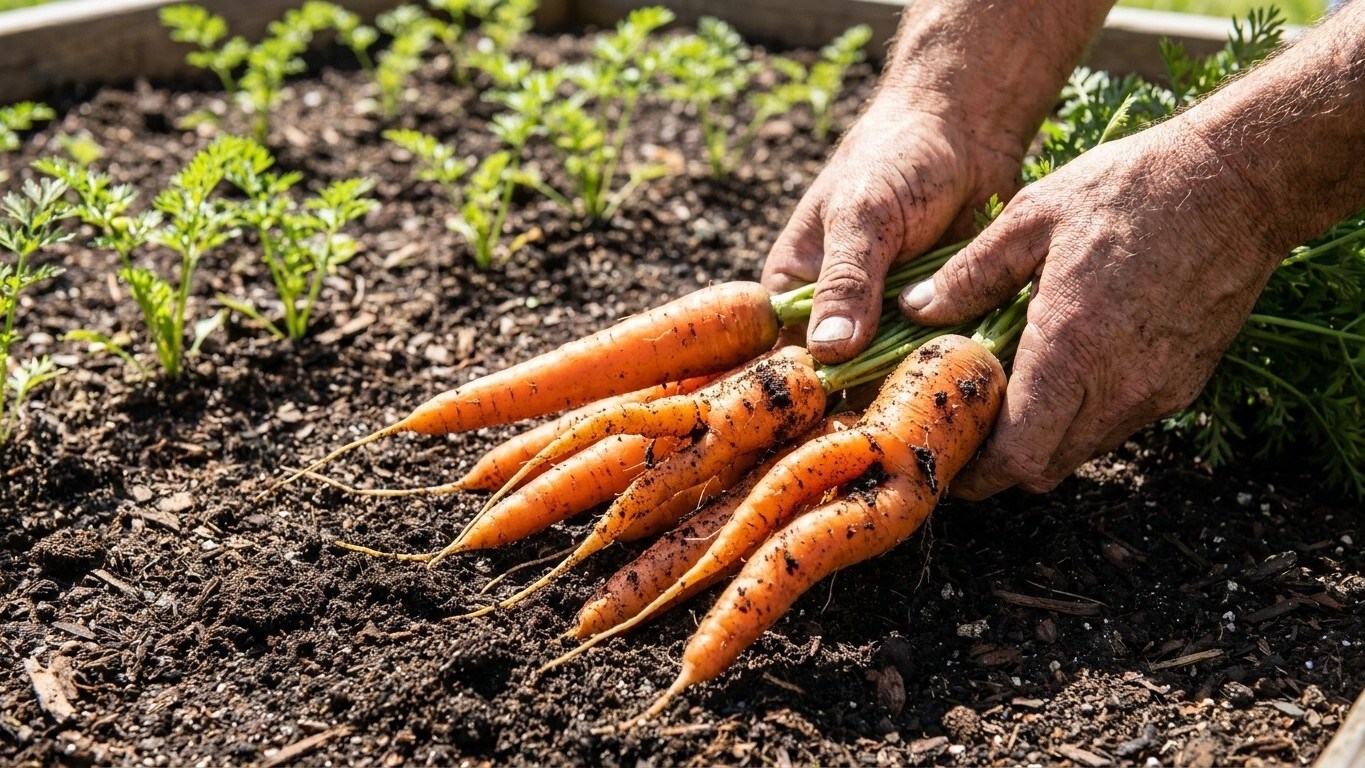

Sow carrot seed directly outdoors as soon as the ground can be worked in spring, timing it against your last expected frost rather than the calendar. There’s no published province-wide last-frost date to hand you here, and across a coastline this long, that date shifts by weeks between the Avalon Peninsula and Labrador’s interior. What holds steadier across the province is the soil most gardeners are actually digging carrots out of, and that soil tells you more about your crop than a single date on a chart ever will.
The short answer
Most agricultural soil mapped across Newfoundland and Labrador falls into one soil order more than any other: Podzol, the acid, leached soil that forms under a conifer canopy where rain has washed the bases out of the topsoil. It covers 59 percent of the mapped surface, with Organic soils running a distant second. The median surface comes out strongly acid, about pH 4.3, and texture-wise it lands as a loam to silt: 56 percent sand, 9 percent clay, 35 percent silt, carrying roughly 3.3 percent organic matter and draining imperfectly rather than freely.
For a carrot, that combination is a mixed blessing. A clay share of just 9 percent is low enough that this typical ground isn’t the dense, sticky clay that twists a taproot into a fork; carrots actually want sandy, loose soil, and Newfoundland and Labrador’s dominant profile leans that way already. The catch is drainage. Imperfectly drained ground holds water through wet stretches and can dry unevenly in between, and Utah State University Extension is direct about what that does to a carrot: heavy or rocky soil forks the root, and the fix is generous compost worked in along with double digging to loosen the profile.
On a Podzol like this, the practical move leans less toward fighting clay and more toward breaking up compaction and building organic matter past that 3.3 percent baseline. Double digging to loosen the ground well below the reach of a spade, with compost worked through the top layer, gives a carrot the loose runway it needs. Where drainage is the bigger issue than clay content, a raised bed does the same job without the digging: it lifts the root zone above standing water and lets excess moisture drain off the sides instead of pooling around the taproot.
None of this describes any one garden, and that’s the detail worth holding onto. A province spans hundreds of mapped soil series, and this dominant profile is a median drawn from 459 soil components, not a reading from a specific backyard. River bottoms, drained bog, and any lot a builder has filled or graded will differ from it, sometimes completely, so treat this as a starting point for what the region’s ground tends to do, not a diagnosis of what’s under your own carrots.
The test that settles it in your own garden
The province-wide numbers describe a median across hundreds of soil series, not the bed you’re about to plant. Before committing to double digging, a raised bed, or nothing at all, run a quick check on the actual ground where the carrots will grow.
- Dig a test hole. Open it deep enough to clear a spade’s full blade, deeper if you can manage. Carrots need clear, loose depth to grow straight, so if you hit a hardpan, a rock layer, or heavy clay before you get that deep, that’s roughly where your roots will stall too.
- Look at what comes out. Spread the excavated soil on a tarp and check for stones, gravel, and clumps of dense clay. Carrots fork and split around obstructions, so a scattering of gravel through the profile tells you as much as a lab result would.
- Feel the texture. Take a moist handful and squeeze it. Soil that ribbons out smoothly and holds a shape runs high in clay. Soil that falls apart and feels grainy is sandy, closer to what carrots want. Something in between is loam.
- Watch how water drains. Fill the test hole with water and note how quickly it disappears. Water that vanishes fairly quickly points to free-draining ground. Water that’s still sitting there well after you’d expect it to be gone points to the kind of imperfect drainage that leaves carrots sitting in uneven moisture.
None of these four checks needs a lab, and together they say more about this year’s carrot bed than any provincial average can. If the hole is clear and deep, the handful falls apart sandy, and the water drains off in reasonable time, the ground is already close to what a carrot wants, and a light dose of compost is likely enough. If any one check comes back against you, stones near the top, a clay ribbon, or water that lingers, that’s the specific problem to solve with compost, double digging, or a raised bed, rather than guessing from a map.
What goes wrong here
Two things drive most carrot failures in Newfoundland and Labrador: a dominant soil order that runs acid and imperfectly drained by nature, and a coastal climate where weather doesn’t always cooperate with a slow-germinating seed. Here’s where that combination bites, and what fixes each problem.
- Forking in heavy or stony ground. Even with a province-wide clay share as low as 9 percent, individual gardens sitting on till or a compacted subsoil layer will still split a taproot around any obstruction it meets going down. Utah State University Extension names this directly: heavy or rocky soil forks the root, and the remedy is generous compost worked in plus double digging deep enough to clear the obstruction, or a raised bed built above it entirely.
- Poor germination in a hot, dry spell. Carrot seed is slow to germinate and needs the top inch or so of soil to stay consistently moist through that window. A stretch of sun and wind dries that surface layer fast, and once it crusts over, seedlings that have already cracked their seed coat can stall before breaking through. Light, frequent watering, or a thin covering that shades the row without blocking emerging seedlings, keeps that surface from drying out while germination finishes.
- Splitting from uneven water. Imperfectly drained ground, the drainage class most common across the province, swings between soggy after rain and dry in between more than free-draining soil does. A root that grows through a wet stretch, then a dry one, then wet again, tends to crack lengthwise as it expands unevenly. Even, consistent watering through the season, rather than deep soaks followed by dry gaps, keeps that expansion steady and the root intact.
None of these three problems trace back to the wrong sowing date. They trace back to what’s happening at root level while the carrot is already growing, which is exactly why the soil test above matters more here than pinning down an exact last-frost date.
Common questions
Should I add lime to acidic soil before sowing carrots?
The province’s median surface reading is strongly acid, about pH 4.3, but that’s a reading of the region’s dominant soil order, not a target figure for carrots specifically. Test the pH of your own bed before deciding whether lime is worth adding, rather than assuming the provincial median applies to your plot.
What’s the best soil texture for carrots?
Utah State University Extension describes it plainly: deep, sandy, well-drained soil rich in organic matter. Newfoundland and Labrador’s typical texture, at 56 percent sand and just 9 percent clay, leans in that direction already, though the imperfect drainage common across the province still calls for attention.
Do I need a raised bed to grow carrots here?
Not automatically. The province’s dominant soil runs sandier and lower in clay than a lot of gardeners assume, which cuts down forking risk from texture alone. A raised bed earns its place when your own dig test turns up standing water, stones, or a clay layer close to the surface, not simply because you’re gardening in Newfoundland and Labrador.
How long from sowing to harvest?
Carrots are sown directly in place, with no transplanting step, and the usual window runs 70 to 100 days counted from the day the seed goes into the ground, not from any later stage. Soil conditions along the way, not the sowing date itself, tend to decide whether that root comes out straight.