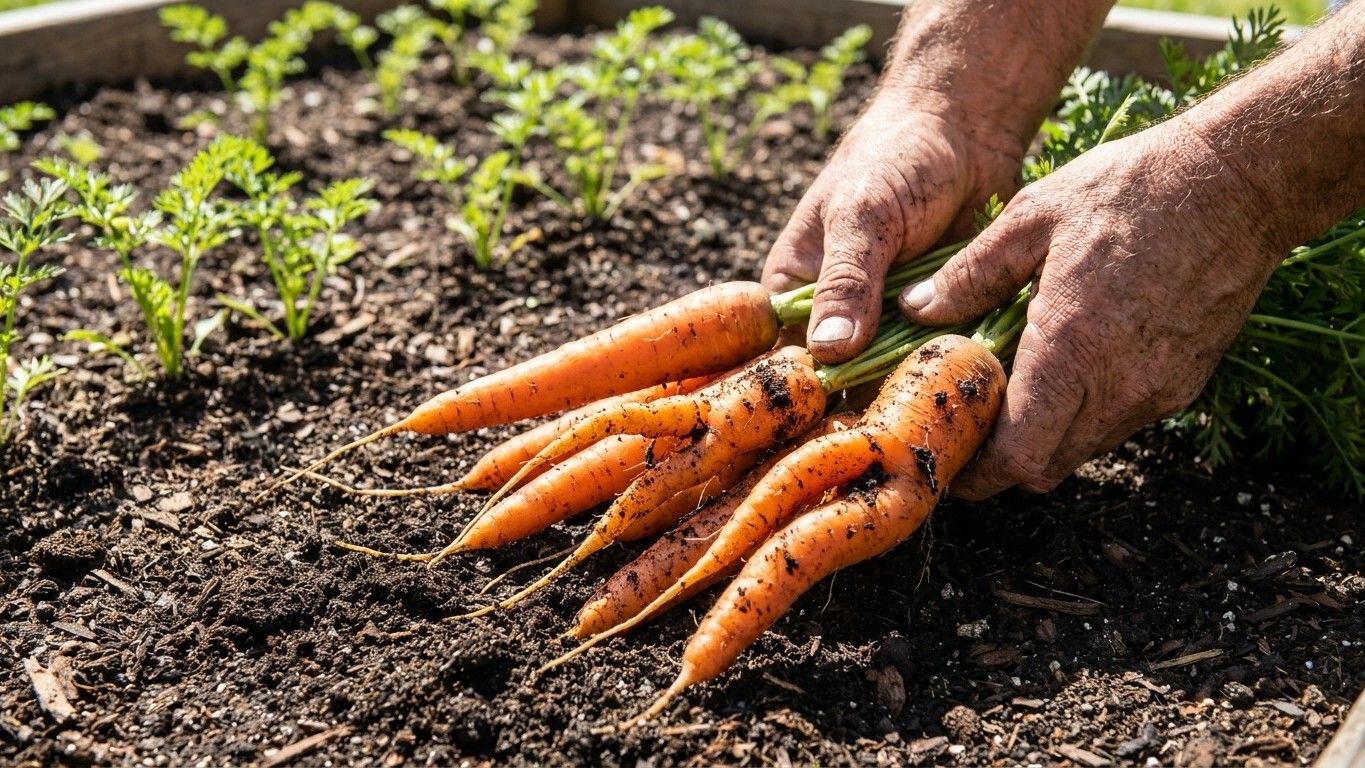

Counting back from the last frost gives you a calendar window for sowing carrots in Prince Edward Island, but the soil under your boots decides whether that window actually works. Carrots go into the ground as seed, never as transplants, so the 70 to 100 days to harvest start the moment that seed meets soil loose enough, warm enough, and drained enough to let a taproot run straight. Before you circle a date, know what you’re sowing into.
The short answer
Across Prince Edward Island’s agricultural land, the soil that turns up most often in provincial mapping is a Podzol, the acid, leached soil that forms under conifers once rain has washed the bases out of the topsoil. It accounts for 33 percent of mapped surface horizons, more than any other order, with Gleysolic soils close behind. The median surface reading for these mapped soils comes in at pH 4.8, strongly acid. Texture runs sandy, 66 percent sand, 7 percent clay, 27 percent silt, with organic matter around 2.2 percent. Despite all that sand, the drainage class comes back imperfect rather than good, which points to something under the surface, a denser layer or a perched water table, that keeps water moving through more slowly than the sandy topsoil alone would suggest. That picture comes from Agriculture and Agri-Food Canada’s Canadian Soil Information Service, built from 542 mapped soil components across the province’s farmed regions.
How does that stack up against what a carrot actually wants? Utah State University Extension puts it plainly: carrots need deep, sandy, well-drained soil rich in organic matter, and heavy or rocky ground makes the root fork instead of growing straight. PEI’s sand content works in the reader’s favor on paper. But 2.2 percent organic matter is thin, and imperfectly drained is not the same as well-drained. A bed that matches this median profile is less likely to fork from clay than one in heavier country, but it may still hold more water at root depth than a carrot wants, and that thin organic layer won’t feed roots the way a compost-built bed does.
Compost answers both problems at once. Worked into the bed ahead of sowing, it lifts organic matter, opens drainage where water is sitting too long, and loosens any dense patch that would otherwise catch a taproot and split it into forks. Where a yard sits toward the heavier end of the range, a season or two of double digging, breaking the ground a full spade deeper than usual and mixing in compost as you go, does the same job faster. A raised bed filled with a sandy, compost-rich mix sidesteps the question of what’s already there entirely.
None of this diagnoses any one garden. Prince Edward Island’s mapped soils run to hundreds of series once you move past the province-wide median, and a plot near a river, on reclaimed lowland, or on ground a builder graded and refilled can sit nowhere near these figures. Treat the median as a starting line, not a finish.
The test that settles it in your own garden
The provincial median is an average built from hundreds of samples spread across the island, not a reading from your particular bed. The only way to know what a carrot will meet at root depth is to dig into your own ground and look.
- Dig a test hole at least a foot deep in the spot you plan to sow, and set the soil aside in the order it came out so you can see how it changes as you go deeper.
- Check for stones and any hard layer. A taproot forks around whatever it can’t push through, so run your hand through each level of the hole and note anything, a rock, a compacted band, that would stop a root from growing straight down.
- Feel the texture at each depth. Squeeze a handful of moist soil in your fist. Sand falls apart and feels grainy when you rub it between your fingers, clay holds together in a ribbon when pressed, and silt feels smooth, almost floury, somewhere between the two.
- Watch how water drains. Fill the hole with water and time how long it takes to disappear. Water gone in minutes signals sandy, fast-draining ground; water still standing after hours points to a heavier or compacted profile that needs work before carrots go in.
- Repeat the test in two or three spots. One hole can miss a buried hard layer or a low corner that holds water differently than the rest of the bed, so check more than once before deciding how much compost or digging the plot actually needs.
What goes wrong here
- Forking in a hidden hard layer. Even where the topsoil runs sandy, PEI’s imperfect drainage often means a denser band sits underneath in patches, exactly the kind of obstruction Utah State University Extension names as a cause of forked roots. Double dig the bed a spade deeper than usual and mix in compost, or build a raised bed with a looser mix, so the root never meets that layer.
- Poor germination during a hot, dry stretch. Carrot seed sits shallow and small, so a baking surface dries it out before it can sprout. Keep the seedbed damp with light, frequent watering until seedlings appear, and a thin layer of mulch slows the moisture loss between waterings.
- Splitting from uneven watering. Letting a bed dry out and then soaking it heavily makes roots swell fast and crack along the way. A steady watering schedule, rather than a cycle of drought followed by a downpour, keeps roots growing at an even pace.
- Thin roots from low organic matter. With median organic matter near 2.2 percent, the province’s typical soil doesn’t carry much reserve to feed a growing taproot. Working compost into the bed before sowing, rather than counting on what’s already in the ground, gives carrots the reserve that median figure doesn’t.
Common questions
Do carrots need a specific soil pH in Prince Edward Island?
No pH target for carrots is published in the source used here, and the province’s median surface reading of 4.8 is specific to the soils Agriculture and Agri-Food Canada mapped, not to any one garden. A soil test of your own bed is the only way to know your actual number.
Can I sow carrots straight into imperfectly drained soil?
It’s the harder path. Utah State University Extension calls for well-drained ground, and imperfect drainage means water lingers at root depth longer than a carrot prefers. Compost worked in ahead of sowing, or a raised bed, gets you closer to what the crop wants.
How deep should I dig before sowing carrots?
Utah State University Extension recommends double digging heavy soil, working it a spade deeper than the usual single pass and mixing in compost as you go, rather than sowing into ground that hasn’t been loosened first.
Does the 70 to 100 day carrot timeline start at sowing or at transplanting?
At sowing. Carrots are a direct-seeded crop, sown in place with no transplant step, so every day of that 70 to 100 day window is counted from the moment seed goes into the soil.