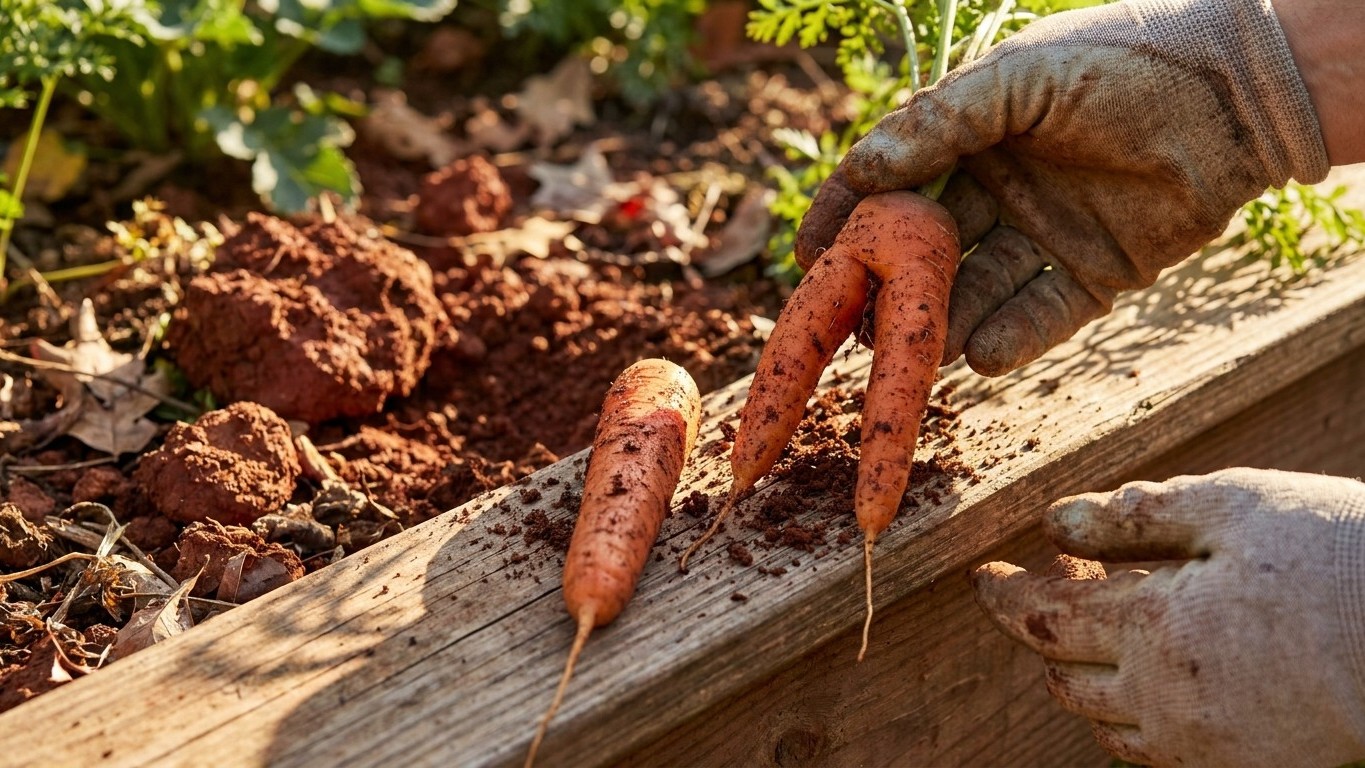

Saskatchewan’s dominant soil is a Chernozem, the dark, organic-rich prairie soil that covers 68 percent of the province’s mapped agricultural land. It runs loam to silt, with a texture of 43 percent sand, 22 percent clay and 35 percent silt, and it drains well. That mix sits close to the sweet spot carrots want, but 22 percent clay is enough to bend a taproot around a compacted layer if the bed hasn’t been loosened first.
The short answer
Start with what’s actually under a Saskatchewan garden. The province’s most common soil, according to Agriculture and Agri-Food Canada’s Canadian Soil Information Service, is a Chernozem, the deep, dark grassland soil that built the prairie’s reputation for grain. Across the mapped surface horizons of the agricultural zone, the median texture comes out to 43 percent sand, 22 percent clay and 35 percent silt, a loam-to-silt blend, with organic matter around 4.0 percent and a median surface pH near 6.8, close to neutral. Drainage is classed as well drained. On paper, that’s a decent starting point for root vegetables.
Carrots, according to Utah State University Extension, want deep, sandy, well-drained soil rich in organic matter. Heavy or rocky ground is what makes the root fork, split, or stall out stubby and misshapen. A Chernozem with 22 percent clay isn’t heavy clay soil in the way a river-bottom or gumbo soil would be, but it isn’t pure sand either. In a bed that’s been worked for years and kept loose, forking is unlikely. In a bed that’s compacted, has a hardpan a few inches down, or carries stones from glacial till, forking becomes the default outcome, not the exception.
The fix Utah State names is specific: heavy soil needs plenty of compost worked in, plus double digging, turning the soil to a full spade’s depth (or two) rather than just scratching the surface. For a Chernozem garden that tests on the clay side of that 22 percent median, or that sits over undisturbed subsoil, that combination, compost plus double digging, usually solves the forking problem without switching crops or hauling in new soil. Where digging that deep isn’t practical, because of rock, roots, or a raised water table, a raised bed filled with a loose, sandy-loam mix sidesteps the issue entirely and gives the taproot a clean run straight down.
None of this is a diagnosis for any one yard. Saskatchewan’s agricultural zone alone contains thousands of mapped soil components, and the Chernozem figures above are a median, not a promise. A garden two miles from a Chernozem-mapped field can sit on a completely different soil order, and even within a single Chernozem series, texture and depth shift block to block depending on how the ground was cleared, graded, or filled. Treat the numbers above as a reason to test your own bed, not as a stand-in for testing it.
The test that settles it in your own garden
A soil map answers a regional question. A carrot bed needs a yard-specific answer, and getting one takes about twenty minutes with a shovel.
- Dig a hole at least a foot deep in the bed where the carrots will go. Note where the soil color or texture changes, that’s often where a compacted or rocky layer starts.
- Check that depth for obstacles. Pull out any stones, chunks of gravel, or dense clay clods you hit along the way. Carrots fork around anything solid in their path, so what’s sitting a few inches to a foot down matters more than what’s on the surface.
- Grab a handful of moist soil from that hole and squeeze it. Sand falls apart when you open your hand. Loam holds a loose shape but crumbles with a light poke. Clay stays balled up and feels slick or sticky between your fingers, that’s your heavy-soil signal.
- Pour a bucket of water into the hole and time how long it takes to drain. Water that sits for hours points to poor drainage and a compaction problem worth fixing before seeding. Water that disappears quickly suggests a well-drained profile closer to the province’s Chernozem norm.
- Send a sample to a soil testing lab if you want an actual pH and nutrient reading, since nothing above substitutes for a lab number, and the provincial median given here isn’t your garden’s pH.
What goes wrong here
- Forking in heavy or compacted ground. Even in a province where the dominant soil runs loam to silt, pockets of denser clay or a compacted subsoil layer will split a taproot around anything solid. Utah State University Extension’s remedy is direct: work in plenty of compost and double dig the bed before seeding, or build a raised bed filled with looser soil if digging that deep isn’t realistic.
- Poor germination during a hot, dry stretch. Carrot seed is small and sits shallow, so the top inch of soil drying out during a warm spell can stop germination cold. Keeping that top layer consistently damp, with light, frequent watering rather than one heavy soak, until seedlings are up carries the row through the gap.
- Splitting from uneven watering. A root that grows steadily, then gets hit with a sudden heavy watering after a dry stretch, can split lengthwise as the interior swells faster than the skin. A steady watering schedule, rather than feast-or-famine soakings, keeps that growth rate even.
- Stubby, misshapen roots in shallow beds. Even good Chernozem topsoil sitting over a shallow hardpan or undisturbed subsoil gives a taproot nowhere to go. Double digging to loosen that lower layer, or switching to a raised bed with more depth, lets the root grow down instead of sideways.
Common questions
Does a well-drained soil rating mean my yard won’t need any amendment?
No. The well-drained rating and the 43-22-35 sand-clay-silt median describe the mapped Chernozem average across Saskatchewan’s agricultural zone, not any single lot. A yard on the clay-heavy side of that range, or sitting over a compacted layer, still benefits from compost and deeper digging before carrots go in.
Is Saskatchewan’s soil pH a problem for carrots?
The median surface pH reported for the province’s dominant Chernozem soil is about 6.8, close to neutral. That figure describes the mapped median, not your garden, so a soil test is the only way to know your bed’s actual pH.
How deep should I dig before seeding carrots in heavy ground?
Utah State University Extension recommends double digging, working the soil to roughly double the depth of a single spade turn, for heavy soil, combined with a generous amount of compost. No specific inch measurement is given beyond that.
How long until carrots are ready after seeding in Saskatchewan?
Carrots are sown directly in place, they aren’t transplanted, so days to maturity are counted from the seeding date. This page doesn’t carry a specific days-to-maturity figure for the province; check the seed packet for the variety you’re growing.