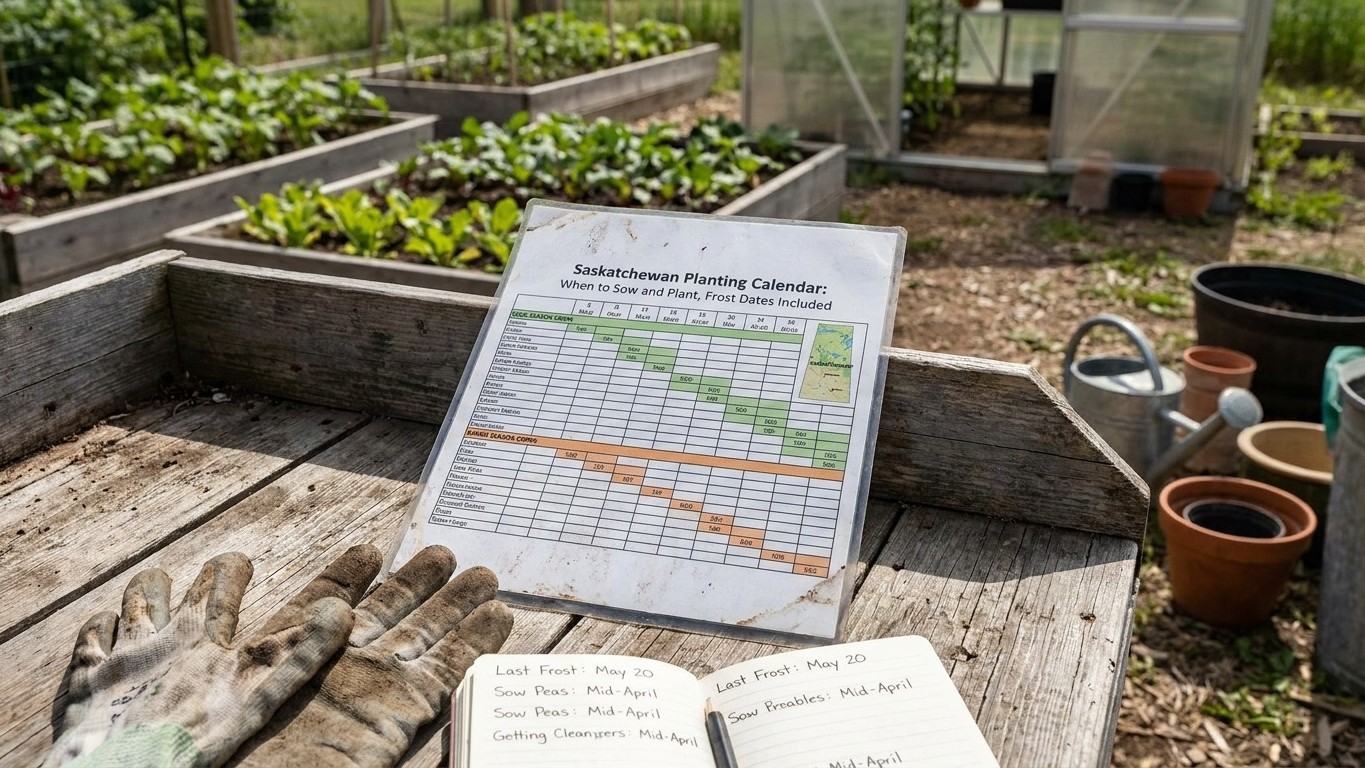

Saskatchewan’s growing season, on average, runs from a last spring frost around May 18 to a first fall frost around September 18, both measured at the Saskatoon SRC station by Environment and Climate Change Canada’s 1981-2010 climate normals. That gives an average frost-free stretch of roughly four months. Check your own garden’s microclimate against these dates before you trust them for a single growing season, since a mean date is not a guarantee.
The frost window in Saskatchewan

Two dates anchor every planting decision in this province: a last spring frost averaging May 18 and a first fall frost averaging September 18, both drawn from Environment and Climate Change Canada’s 1981-2010 Canadian Climate Normals at the Saskatoon SRC station. Those numbers are means, not thresholds. Environment Canada’s own definition of a normal means that in roughly one year out of two, frost arrives later than May 18 in spring or earlier than September 18 in fall. Treat both dates as the middle of a window, not the edge of a safe zone.
The Saskatoon SRC reading is a single point in a large province. Northern Saskatchewan, the higher ground around the Cypress Hills, and any low-lying frost pocket will run behind this schedule, sometimes by several weeks. Southern grain-belt districts closer to the US border tend to warm a little earlier in spring and hold heat a little longer in fall. If you garden outside the Saskatoon area, use the mean dates above as a starting reference and adjust based on what you actually observe in your own yard over a few seasons.
Subtracting the two mean dates gives an average frost-free season of about 123 days, call it four months, running from mid-May to mid-September in a typical year at Saskatoon. That is a short window by North American standards, and it is the single fact that drives everything else in this calendar: what you can direct-sow outdoors, what needs a head start indoors, and how much margin a given crop has before the season closes on it. Gardeners further north effectively lose weeks off both ends of that window, which is why local observation matters more than any provincial chart.
Cool-season crops
Cool-season vegetables are the ones that tolerate a light frost and actually prefer to mature before summer heat sets in, so they go in the ground well before the mean last-frost date of May 18 rather than after it. Peas, spinach, lettuce, radishes, and most brassica transplants such as broccoli and cabbage fall into this group. For guidance on starting seeds indoors and prepping beds ahead of that window, see What to Plant in Saskatchewan in March, and for what follows once that window opens and the warm-season crops take over, see What to Plant in Saskatchewan in June up, check What to Plant in Saskatchewan in April. If you want to get a jump start indoors even earlier, see What to Plant in Saskatchewan in November, or if you’re planning ahead for the end of the season and want to know which crops still have time to mature before the first fall frost, check out What to Plant in Saskatchewan in September, or if you’re planning ahead for the end of the season, check What to Plant in Saskatchewan in October, What to Plant in Saskatchewan in December, What to Plant in Saskatchewan in January and What to Plant in Saskatchewan in August for guidance on the tail end of the season, and What to Plant in Saskatchewan in July for guidance once the frost-free stretch is in full swing, and What to Plant in Saskatchewan in February. For a fuller month-by-month breakdown, see What to Plant in Saskatchewan in May. Their seedlings can handle a few degrees of frost, and their germination is sluggish in cold soil but not blocked by it the way warm-season crops are.
What goes in first
- Peas and spinach: direct-sown as soon as the soil can be worked, often several weeks before May 18
- Lettuce and radishes: direct-sown early, with repeat sowings every couple of weeks for a longer harvest
- Onion sets and seed potatoes: planted while soil is still cool, ahead of the mean frost date
- Brassica transplants (broccoli, cabbage, kale): hardened off and set out roughly a month before the mean last frost
- Carrots and beets: direct-sown early since both need a long enough season to size up before fall
The logic here is timing relative to the frost date itself, not to a calendar month. Because the May 18 figure is a mean and not a guaranteed safe day, a late cold snap after these crops are already up rarely does serious damage. Peas shrug off a light freeze. Lettuce and spinach bolt in heat far sooner than they suffer from cold. The real risk with cool-season crops in Saskatchewan is not frost, it is running out of cool weather before summer heat arrives, so getting them in early rather than waiting is usually the safer call.
Roots deserve a specific note. Carrots, beets, and parsnips need a long, steady stretch of cool-to-moderate soil to develop properly, and starting them as early as the ground allows gives them the best shot at reaching a useful size before the shorter days of a Saskatchewan fall.
Warm-season crops

Tomatoes, peppers, squash, beans, and corn are all frost-tender, and unlike the cool-season group, they are also stalled by cold soil even without a frost. Soil temperature, not the calendar date, is what actually determines when these crops start growing once you set them out. A tomato transplant sitting in soil that is barely above freezing point will simply not grow, frost or no frost, and can even suffer chilling injury.
Because the May 18 mean last-frost date is a coin-flip average, the safer practice for warm-season transplants is to wait past it rather than plant exactly on it. That is the reasoning behind the early June set-out window used for the tomato varieties below: it builds in two to three weeks of buffer past the Saskatoon mean, covering the years when frost runs later than average.
Counting back for indoor starts
Tomatoes and peppers need six to eight weeks of indoor growth before they are ready to transplant. Counting back from an early-June set-out date lands seed-starting indoors in mid-to-late April, a range rather than a fixed day, since the exact week depends on how the season is running and how much light your seed-starting setup provides.
Direct-sown warm-season crops such as beans, squash, and corn skip the transplant step, but they still need warm soil to germinate reliably, so they generally go into the ground around the same early-June window rather than on the frost date itself.
Tomato varieties and their margin before fall frost
Every catalogue days-to-maturity figure below is counted from transplant, and actual timing shifts by a week or two depending on the season. Cross that figure against Saskatoon’s mean fall frost of September 18 to see how much room each variety has.
| Variety | Days to maturity | Type | Key resistance | First ripe (calculated) | Margin before fall frost |
|---|---|---|---|---|---|
| Sakura | 55 | Indeterminate | Fusarium Wilt, Tomato Mosaic Virus | Late July | ~54 days |
| Edox | 55 | Indeterminate | Fusarium Wilt, Tomato Mosaic Virus | Late July | ~54 days |
| Valentine | 55 | Indeterminate | Early Blight (Intermediate) | Late July | ~54 days |
| Glacier | 55 | Determinate | None listed | Late July | ~54 days |
| Sun Gold | 57 | Indeterminate | Tobacco Mosaic Virus, Fusarium Wilt race 1 | Late July | ~52 days |
| Supersweet 100 | 60 | Indeterminate | Verticillium Wilt, Fusarium Wilt race 1 | Late July | ~49 days |
| Juliet | 60 | Indeterminate | Late Blight, Early Blight | Late July | ~49 days |
| Amalfi | 68 | Determinate | Nematodes, Late Blight, Early Blight | Early August | ~41 days |
| Cherokee Purple | 72 | Indeterminate | None listed | Mid August | ~37 days |
| Big Beef Plus | 72 | Indeterminate | Nematodes, Gray Leaf Spot, Tomato Mosaic Virus | Mid August | ~37 days |
| Tiren | 75 | Indeterminate | Verticillium Wilt, Tomato Mosaic Virus, Fusarium Wilt race 1 | Mid August | ~34 days |
| Granadero | 75 | Indeterminate | Nematodes, Verticillium Wilt, Tomato Mosaic Virus | Mid August | ~34 days |
| San Marzano II | 78 | Indeterminate | None listed | Mid August | ~31 days |
| Celebrity Plus | 78 | Determinate | Nematodes, Gray Leaf Spot, Tomato Mosaic Virus | Mid August | ~31 days |
Every variety on this list still ripens with a comfortable margin before the Saskatoon mean fall frost, but the shorter-season group at the top of the table, Sakura, Edox, Valentine, and Glacier, gives you the widest buffer if a cold spring pushes your set-out date later than planned.
The fall planting window
Working backward from the mean first fall frost of September 18, the question for any crop is whether it has enough days left to mature, plus a cushion for the fact that growth slows as daylight shortens in late summer even before a frost arrives. A crop rated for a given number of days to maturity in the heat of June often takes noticeably longer to reach the same size in late August and September, so treating a catalogue days-to-maturity figure as exact for a fall planting overstates how much time you actually have.
Second plantings after midsummer harvests
Once early crops like peas, spinach, or the first lettuce sowing are cleared, the space they leave behind is often still usable for a second planting, provided the replacement crop is fast enough to mature and mature safely before the season’s mean end date. Quick-maturing greens, radishes, and another round of spinach are the safest bets for a second planting in a four-month season, since the slow-down effect of shortening days matters less over a short maturity window.
Crops that improve after frost
Not every crop needs protection from the first fall frost. Kale, spinach, carrots, and parsnips all tend to sweeten after a light frost, because the plant converts stored starches into sugars as a response to cold. Leaving these in the ground for a light touch of frost, rather than rushing to harvest everything the moment temperatures drop near September 18, often improves flavor rather than damaging the crop. Heavier or repeated hard frosts are a different matter, and root crops left too long can still suffer once the ground itself starts to freeze.
Reading a planting calendar properly
A provincial planting calendar, including this one, is built from data collected at one weather station. Saskatoon SRC’s normals describe Saskatoon’s climate, not the climate of every county in the province, and the gap between them can be substantial. Elevation is the biggest single factor: gardens in higher, more exposed parts of the province cool off faster in the evening and warm up slower in the morning than the river-valley conditions the Saskatoon reading reflects.
Proximity to a large lake changes the picture too, since a big body of water holds heat longer into fall and delays warming in spring, shifting both frost dates in opposite directions from what a station further from water would show. Urban areas generate their own heat island effect, so a garden in the middle of a city often runs measurably warmer at night than open farmland just outside it, which can push both the last spring frost earlier and the first fall frost later than the regional average.
What to track instead of trusting the chart
A late cold snap is the scenario every calendar figure fails to capture, since a mean date by definition includes years where frost showed up two or three weeks after it. The most reliable fix is not a better chart, it is your own notebook: record your own garden’s frost dates for a few seasons and you will end up with a number that fits your yard specifically, rather than a station reading from somewhere else in the province.
Local help
For county-level frost dates, soil testing, and crop advice specific to your part of the province, the Saskatchewan Ministry of Agriculture is the right first call, since its staff work with local data that a province-wide station reading cannot capture. A soil test through the same office is worth doing before you commit to a full planting schedule, since soil temperature and fertility both shift the timing recommendations above. For more on planting by frost date across the rest of the province, see our broader Saskatchewan guides.
Common questions
Is May 18 actually safe to plant tomatoes outside in Saskatchewan?
No. May 18 is a mean last-frost date from Environment and Climate Change Canada’s Saskatoon SRC normals, which means frost arrives later than that in roughly half of all years. That is why the tomato varieties on this page are set out in early June, giving two to three weeks of buffer past the mean.
Why does my neighbor two towns over plant weeks ahead of me?
Local microclimate differences, especially elevation, proximity to water, and urban heat, can shift effective frost dates by weeks even within the same province. The Saskatoon SRC figures used here are a starting reference, not a guarantee for every yard.
Can I get a longer season by starting tomatoes indoors earlier than mid-to-late April?
Starting much earlier usually backfires, since transplants held too long indoors get leggy and stressed before the soil outside is warm enough to receive them. Matching the six-to-eight-week indoor window to an early-June set-out date keeps the transplants at the right stage when it is finally safe to plant.
Do I need to cover crops on September 18 to protect them?
Not necessarily. September 18 is Saskatoon’s mean first fall frost, not a guaranteed frost date, and several crops like kale, spinach, carrots, and parsnips actually improve in flavor after a light frost rather than needing protection from it.
How does Saskatchewan’s frost window compare to other cold-climate provinces and states?
Saskatchewan’s roughly four-month frost-free season is short but not unusual among northern growing regions. Gardeners dealing with an even tighter window can compare notes with our Yukon planting calendar, while those wanting to see how a longer US Midwest season is scheduled can check our Iowa planting calendar.
Related guides
- Alberta Planting Calendar: When to Sow and Plant, Frost Dates Included
- Manitoba Planting Calendar: When to Sow and Plant, Frost Dates Included
- Yukon Planting Calendar: When to Sow and Plant, Frost Dates Included