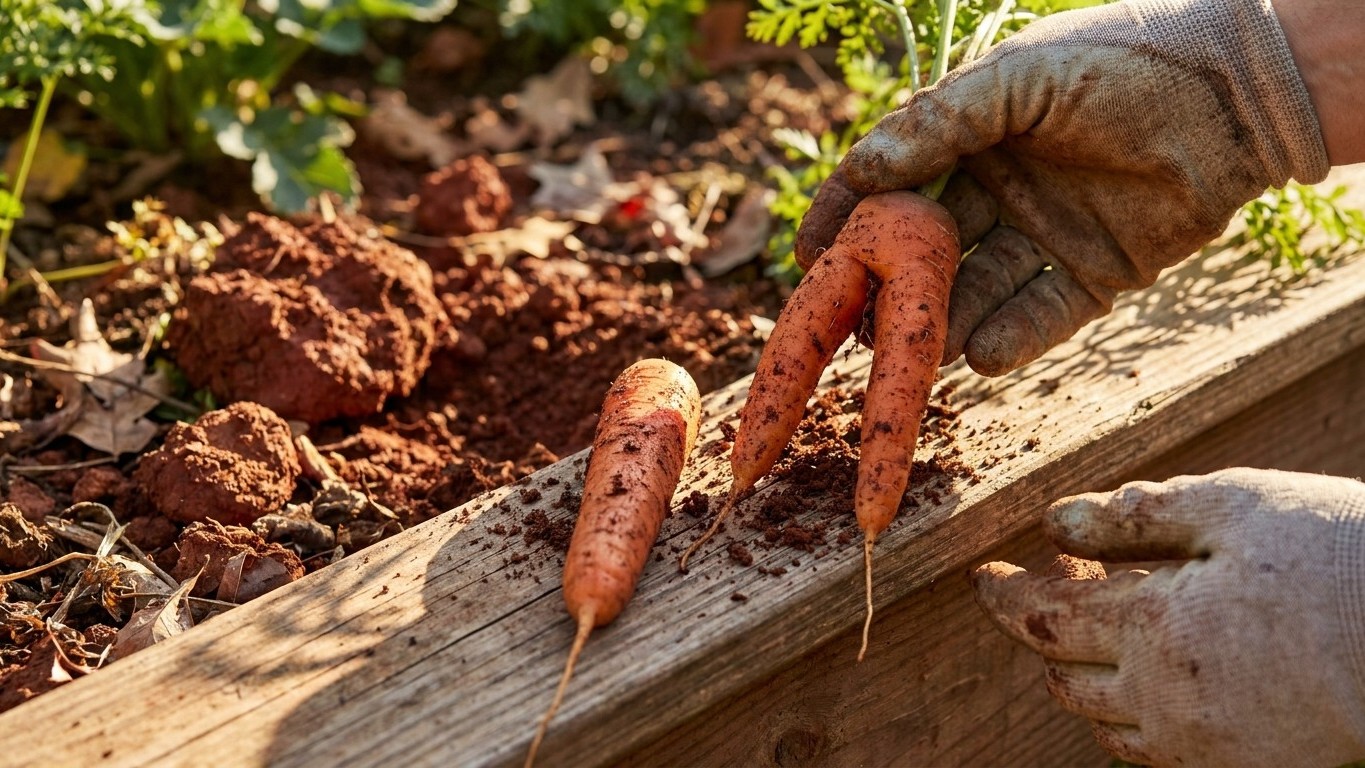

Odds are, yes. West Virginia’s official state soil, the Monongahela series, runs 18 percent clay and only 27 percent sand, with a strongly acid surface layer. That mix tends to resist a carrot’s straight taproot, splitting it into forks around rocks or dense pockets. Compost, double digging, or a raised bed usually turns that around, but the real test happens in your own dirt.
The short answer
West Virginia’s state soil, named by state law and mapped across the region under the name Monongahela, is a silt loam: 27 percent sand, 18 percent clay, and 54 percent silt in its surface layer. It carries about 3.0 percent organic matter and drains moderately well, not fast, not slow. The surface pH runs around 5.0, which counts as strongly acid. It’s an Ultisol, meaning it’s old, heavily weathered, and naturally short on nutrients compared to younger soils farther west.
Carrots want something different. Utah State University Extension puts it plainly: carrots need deep, sandy, well-drained soil rich in organic matter, and heavy or rocky soil makes the root fork. Set that against the Monongahela numbers and the mismatch is obvious. Eighteen percent clay isn’t extreme on its own, but paired with 54 percent silt, the soil compacts easily and doesn’t crumble the way a sandy loam does. A carrot pushing down through that kind of density hits resistance, meets a stone or a dense seam, and splits into two or three legs instead of growing one clean root.
The fix Utah State names for heavy ground is direct: work in plenty of compost and double dig the bed, loosening soil well past the depth the root will reach. For a lot of West Virginia gardens sitting on clay-heavy ground, a raised bed filled with a lighter, blended mix skips the problem entirely rather than fighting it season after season. Either approach works. What doesn’t work is planting carrots in unamended, compacted native soil and hoping for straight roots.
None of this is a verdict on your particular garden. A state soil is a representative average built from measurements across 231 soil components mapped under that series name, not a soil test of any one backyard. West Virginia spans hundreds of distinct soil series, and hillside plots, river-bottom gardens, and anything near a house foundation where fill dirt got dumped in during construction can look nothing like the Monongahela profile. Treat this section as a starting point that tells you what the region’s ground tends toward, not a diagnosis of the bed you’re about to plant.
The test that settles it in your own garden
- Dig a test hole at least as deep as a full-size carrot variety will grow, and look at what you find. Note whether you hit a hard, dense layer, a shelf of rock, or a change in soil color that suggests a buried clay pan. Any of those will stop or deflect a taproot the same way tight, unworked clay does.
- Pull a handful of moist soil from that hole and rub it between your fingers. If it feels gritty, that’s sand. If it feels slick and stays in a ribbon when you squeeze it, that’s clay. Silt sits in between, feeling smooth but powdery rather than sticky. Most West Virginia gardens will land somewhere on the loam-to-clay end of that scale, but only your own hands can tell you where.
- Check for stones and rock fragments as you dig. Rocky ground is one of the most common causes of forking that Utah State University Extension flags, and it’s also one of the easiest to miss until you’re a foot down and hitting fragments every few inches.
- Run a simple drainage check. Dig a hole roughly a foot deep, fill it with water, let it drain once, then fill it again and time how long the second fill takes to disappear. Water that lingers for hours points to compaction or a clay-heavy subsoil; water that vanishes almost immediately suggests a sandier, faster-draining spot.
- Watch the bed after a heavy rain. Standing water an hour or two later confirms poor drainage. A surface that dries and cracks within a day suggests a lighter, sandier composition closer to what carrots actually prefer.
What goes wrong here
- Forking in heavy, compacted ground. Clay-rich soil like the Monongahela profile’s 18 percent clay resists a straight taproot and pushes it around obstacles. Double dig the bed and mix in plenty of compost before sowing, or build a raised bed filled with a lighter blend so the root never meets the native clay at all.
- Poor germination during a hot, dry stretch. Carrot seed is slow to sprout under the best conditions, and a crusted, dried-out surface layer makes it worse. Keep the seedbed consistently moist with light, frequent watering or a thin mulch layer until seedlings are up, rather than relying on the same watering schedule as later in the season.
- Splitting roots from uneven watering. A dry spell followed by a heavy soak makes roots swell too fast and crack along the surface. Set a steady watering rhythm instead of letting the bed dry out completely between waterings, especially once roots start sizing up.
- Stunted or misshapen roots in strongly acid soil. A surface pH around 5.0, which is what the Monongahela series carries, limits how well plants take up certain nutrients even in decent soil texture. Amending pH toward a more neutral range with lime, based on a home soil test rather than a guess, gives compost and loosened soil a better chance of actually paying off.
Common questions
Does the West Virginia state soil tell me what’s actually in my backyard?
Not directly. It’s a representative profile built from soil survey data across the state, and the state itself contains hundreds of distinct soil series. Use it as a general sense of regional tendencies, then confirm your own texture and drainage with the steps above.
Can I avoid forking without building a raised bed?
Yes, if you’re willing to double dig and mix in generous compost, which is exactly what Utah State University Extension recommends for heavy soil. A raised bed is simply the faster route if your native ground is consistently dense or rocky.
How do I know if my soil is too acidic for carrots?
The only reliable way is a home soil test kit or a lab test through your local extension office. The Monongahela series surface pH runs around 5.0, but that figure describes the mapped state soil, not your particular bed.
What is the Monongahela soil series actually good for?
It’s a moderately well drained silt loam with decent organic matter, useful for a range of crops once it’s limed and loosened. Its natural acidity and clay content just mean it needs preparation before a taprooted crop like carrots will grow straight in it.