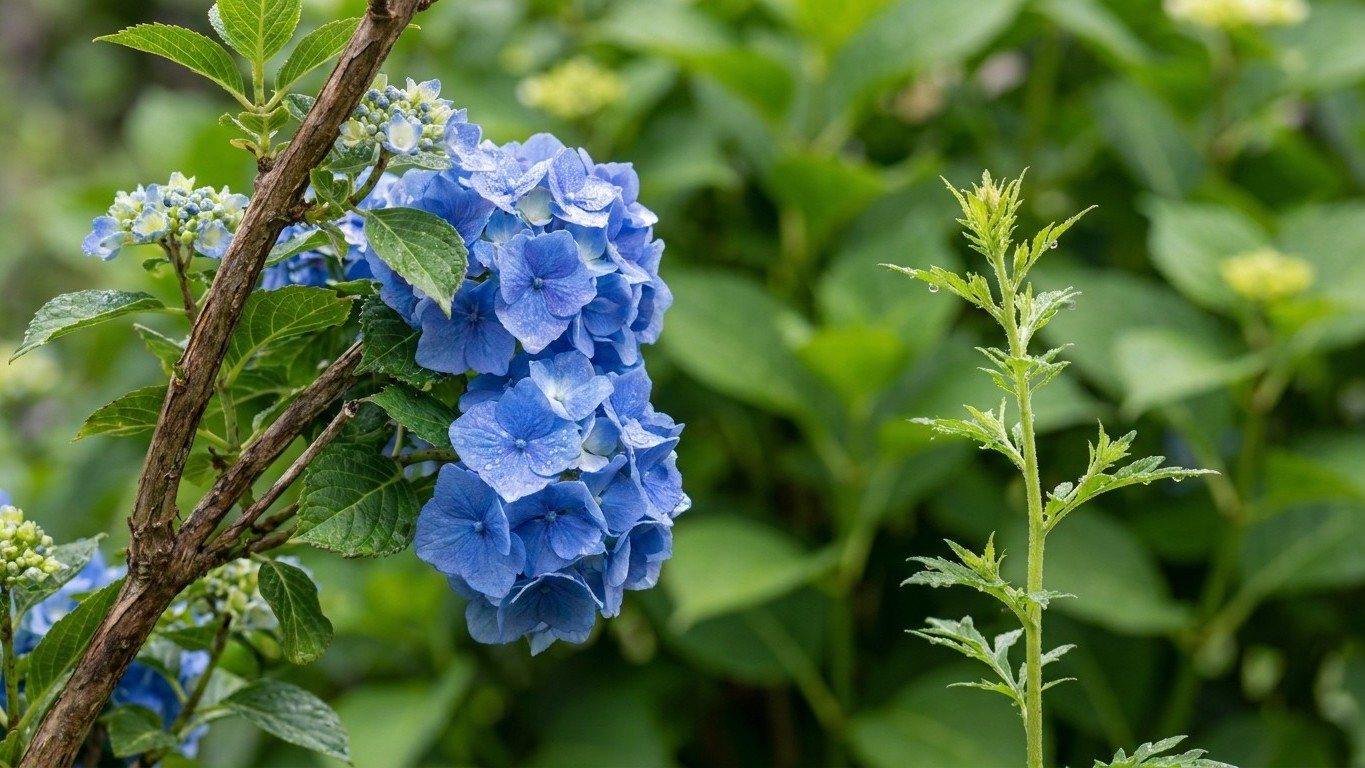

Almost all of them survive. West Virginia runs from USDA zone 5b to 7a, and conditions differ from county to county. Bigleaf hydrangeas live through the winter too, but in colder counties they often lose their flower buds and put out only leaves. The difference comes down to when the flower buds form and how they handle a hard January followed by a warm March.
What this comes down to in West Virginia

At the Charleston reference station, NOAA’s NCEI 1991–2020 Climate Normals put the median last spring freeze in mid-to-late April and the median first fall freeze in late October, and a frost after the spring date is not unusual. Inside that season and the state’s 5b to 7a range on the USDA Plant Hardiness Zone Map, the question is whether each hydrangea below flowers the following summer.
Flowering depends on wood. Old-wood bloomers set their flower buds in late summer and carry them through winter on last year’s stems, so a cold snap or a freeze after early leaf-out can kill the buds while the plant itself lives. New-wood bloomers make their flower buds on spring growth, so even a winter that freezes the stems to the ground usually costs them little. The six cultivars below run from the most dependable in a short, cold season to the most exposed.
Annabelle
Annabelle is a smooth hydrangea (Hydrangea arborescens) rated for zones 3 to 9, with big white round flower heads on new wood. It regrows from the base and flowers from early summer. The heads are heavy and tend to flop after a hard rain, which is its main weakness here.
Incrediball
Incrediball is a smooth hydrangea rated for zones 3 to 8, white on new wood, bred from the same species as Annabelle. Its stems are stiffer, so the larger heads stand up better in summer storms. It handles cold, but check with your local extension office about the coldest parts of the state.
Limelight is a panicle hydrangea (Hydrangea paniculata) rated for zones 3 to 9. Its cone-shaped blooms open lime green, turn white, then blush pink as nights cool, all on new wood. It tolerates more sun than the other species here and flowers dependably from midsummer into fall, even after a winter that damages everything above ground.
Snow Queen is an oakleaf hydrangea (Hydrangea quercifolia) rated for zones 5 to 9, with white cone-shaped flowers on old wood and deep burgundy fall foliage. Its flower buds are hardier than those of bigleaf types. A severe winter in the high country can thin the bloom.
Endless Summer is a bigleaf hydrangea (Hydrangea macrophylla) rated for zones 4 to 9, blue or pink depending on soil acidity. It blooms on both old and new wood. When winter kills the old-wood buds, it still flowers later in summer on new growth, which makes it more forgiving than Nikko Blue in a zone 5 yard.
Nikko Blue is a bigleaf hydrangea rated for zones 6 to 9, blue in acid soil, and it blooms on old wood only. In the warmer river valleys it flowers well. In colder spots the buds die in a hard winter or in a late freeze after leaf-out, and the shrub stays green and flowerless until the following year.
Working it out for your own garden
Three questions sort any hydrangea. Is it rated for your zone? Does it flower on old wood or new wood? Does the planting date leave it enough weeks to root before the ground freezes? Answer them in that order and the cultivar tag becomes a decision instead of a hope.
Take Limelight as a worked example. It is rated for zones 3 to 9, so no part of the state is too cold for it. It flowers on new wood, so stems frozen back in winter regrow and still bloom from midsummer on. For a fall planting, a hydrangea needs time to root before the ground freezes. Planted early enough to root before the freeze, Limelight flowers the next summer.
Now run Endless Summer through the same steps. It is rated for zones 4 to 9 and blooms on old and new wood. The same fall planting timing applies, but the bloom is less certain. In a zone 5 spot, expect the old-wood buds to freeze in a hard winter, and plan on flowers from new growth in mid to late summer, with the first fall frost not far behind. Nikko Blue adds one more step. It needs old wood to flower, so it belongs where winter cold is mildest, in a sheltered spot, and with a thick mulch layer over the crown after leaf drop.
Scratch a stem with a thumbnail in late spring. Green tissue underneath means the stem is alive, and brown and dry means it is dead. Slice a swollen bud open: green inside means a flower is coming, brown means the bud froze. A shrub with live stems, healthy leaves and no flowers has lost buds to cold or been pruned at the wrong time. A shrub with dead stems all the way to the soil line has suffered dieback, and new shoots will come from the base.
What changes across the state
Charleston sits in a river valley, and river valleys are the mild end of West Virginia. Climb out of them and the season shortens. The Allegheny Highlands, in counties like Pocahontas, Randolph and Tucker, freeze earlier in fall and later in spring than the Kanawha and Ohio river bottoms. The zone 5b to 7a spread reflects that difference: the low end belongs to the high country and the top end to the warmest low valleys.
Elevation is the main driver, but it is not the only one. Cold air is heavy and drains downhill, so a hollow or the foot of a slope can freeze when a house on the hillside above it stays clear. That matters most in April, when a hollow can take a frost that a ridge home never sees. Ridgetops have the opposite problem, since wind strips snow cover and dries out exposed stems and buds.
North to south counts for less than height does. The Eastern Panhandle along the Potomac and the Northern Panhandle along the Ohio River have their own pockets of mild air, and a south-facing wall almost anywhere in the state gives bigleaf buds shelter. At high elevations, stick with smooth and panicle hydrangeas for reliable flowers. Down in the valleys, bigleaf and oakleaf types will usually perform as the tags say.
The mistakes this state punishes

Early leaf-out is among the costliest errors. A run of warm days in March coaxes bigleaf buds open, and then an April frost, which can come around or even after the median last-freeze date, burns the new leaves and the flower buds with them. Keep winter mulch on until the typical last-frost date has passed, so the plant is not pulled out of dormancy early.
Pruning at the wrong time can cost you the flowers. Old-wood bloomers like bigleaf and oakleaf types carry next summer’s blooms on stems that exist now, so cutting them back in fall or winter removes the flowers. The rules for each type are laid out in When to Prune Hydrangeas in West Virginia.
Planting too late in fall leaves roots shallow when the ground freezes. A shrub set out in November, after the first frost typically arrives in late October, heaves out of the soil in the first freeze-thaw cycles. Plant earlier, or hold it in its pot until spring.
Putting a tender cultivar in the wrong place does the rest. A Nikko Blue on an open ridge or in a frost pocket will lose its buds in many winters, while the same shrub on a sheltered south-facing wall does fine. Heavy nitrogen feeding in late summer also pushes soft growth. Stop fertilizing in late summer.
Checking this against your county
The Charleston dates and the 5b to 7a zone range are a starting point. Your own yard may freeze earlier or later, depending on elevation and how cold air moves across your lot. West Virginia University Extension has an office in each county, and the agents there know the local frost pockets and which cultivars have held up nearby. For the basics of siting, soil and watering that apply to every cultivar above, see the state guide to growing hydrangeas in West Virginia.
Common questions
Will a bigleaf hydrangea come back after a hard winter? The roots almost always survive, and new shoots come up from the base in spring. Whether it flowers that year depends on the cultivar. Nikko Blue needs surviving old wood to bloom, while Endless Summer can still flower on new growth.
Which hydrangeas bloom most reliably after a hard winter? Smooth and panicle hydrangeas, such as Annabelle, Incrediball and Limelight. They flower on new wood, so winter dieback rarely affects the bloom, although a hard freeze after leaf-out can still set them back.
Do hydrangeas need winter protection? Smooth and panicle types do not. Bigleaf types in zone 5 spots benefit from a thick layer of mulch over the crown after the leaves drop. A cage of chicken wire filled with shredded leaves gives the stems and buds extra protection.
Can a hydrangea stay in its pot outdoors over winter? Roots in a pot are exposed to cold air on every side, so they freeze harder than roots in the ground. Sink the pot into soil, bank mulch around it, or move it against a wall or into an unheated garage until spring.