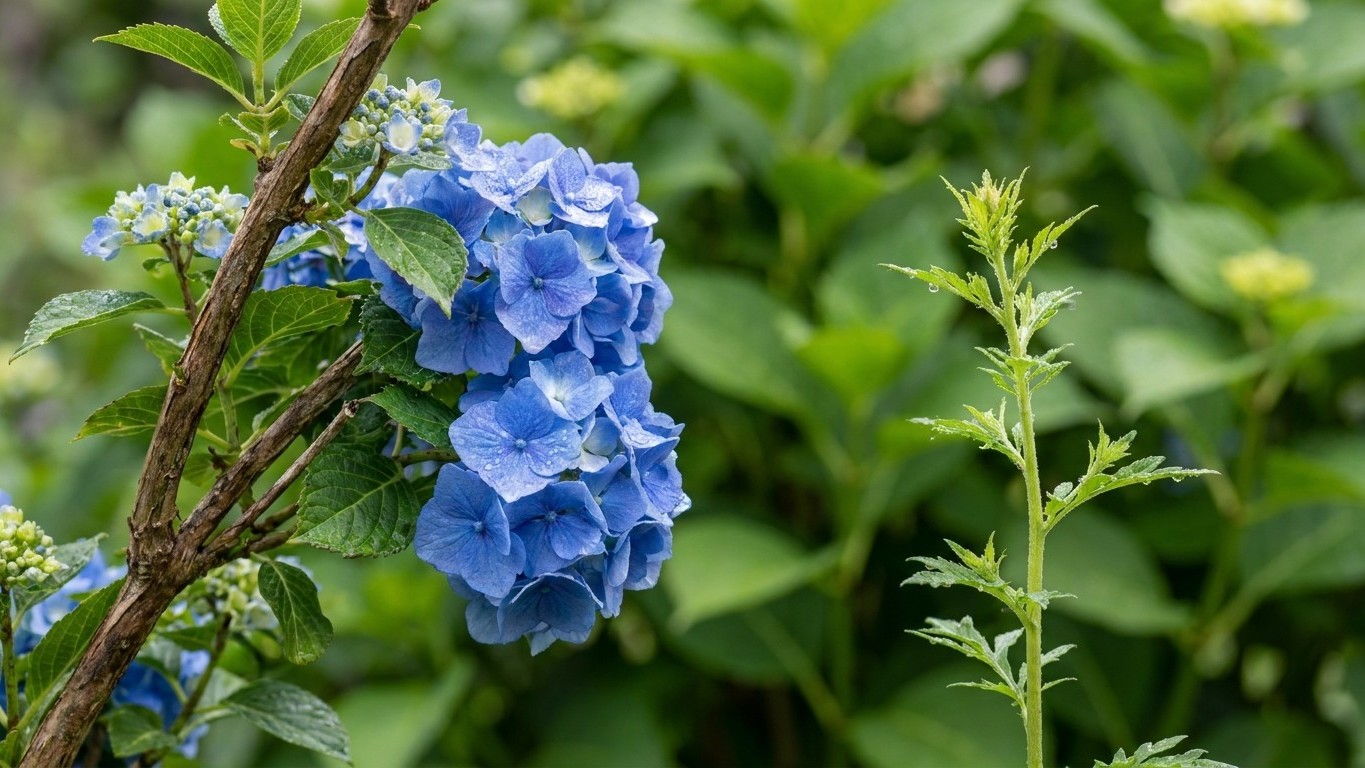

Hydrangeas flower pink when the soil around them sits near neutral, and blue when it is acidic enough to let the roots absorb aluminum. In West Virginia, limestone valleys, lawn lime and concrete foundations push many beds toward pink. Shifting to blue takes a soil test, a lower pH and a season or two of patience. Only bigleaf and mountain hydrangeas can change color; the other species stay the color they came in.
What this comes down to in West Virginia

Hydrangeas often bloom pink in West Virginia where the soil pH is too high for the roots to take up aluminum. The fix is to lower it during the growing season, which at Charleston, the reference city for the state’s frost dates, runs from a last spring frost between April 9 and April 23 to a first fall frost between October 18 and November 1 (NOAA NCEI Climate Normals). Charleston sits in a river valley, so higher ground freezes noticeably earlier in fall.
The color comes from a single pigment in the sepals, the petal-like parts that make up the showy bloom. Without aluminum the pigment reads pink to red. With aluminum bound to it, the same pigment reads blue. West Virginia soils usually hold plenty of aluminum, but it dissolves into a form roots can use only in acid ground. Aluminum has to be available, not just present, and pH decides that.
Bigleaf hydrangea (Hydrangea macrophylla), in both its mophead and lacecap forms, responds to soil chemistry. So does mountain hydrangea (Hydrangea serrata). Smooth hydrangea (H. arborescens, the Annabelle type), panicle hydrangea (H. paniculata) and oakleaf hydrangea (H. quercifolia) do not. A panicle that blushes pink in late summer is showing age and cool nights, and no soil amendment will change that.
Several things raise pH or lock up aluminum in home landscapes here. Limestone-derived soils in the valleys run near neutral. Lime spread on lawns washes into neighboring beds. Concrete foundations, sidewalks and gravel drives leach calcium into the soil beside them. Hard well water adds alkalinity every time you irrigate. And a fertilizer high in phosphorus, the middle number on the bag, binds aluminum in the soil even where pH is acceptable.
| Flower color | Soil pH | What is happening in the soil |
|---|---|---|
| Blue | About 5.2 to 5.5 | Aluminum dissolves and the roots absorb it |
| Purple or mixed | About 5.5 to 6.0 | Some aluminum is available, some is bound |
| Pink | About 6.0 to 6.5 and above | Aluminum is locked in the soil |
Working it out for your own garden
The method is the same in any county: measure the pH, move it in the direction you want, and time each step against the growing season. A shrub that has bloomed pink for years will not turn blue in a month, so the order matters.
How do you test soil pH for hydrangeas?
Take small samples around the drip line, the circle beneath the outer branch tips. Mix them in a clean bucket and send a cup to a lab through your county extension office. A garden-center probe or kit gives a rough reading, but a lab report also shows phosphorus, which can keep a shrub pink even when pH looks right. Compare the pH to the table above and decide whether you are aiming for blue or content to keep pink.
How do you lower soil pH for blue flowers?
Aluminum sulfate works fastest. Apply it diluted over moist soil around the root zone, repeating through spring. Count back from bloom to find the start: if the flowers open in mid-June, subtract 8 to 10 weeks to estimate when to begin. That overlaps the last spring frost window at Charleston, so begin as leaves open and cover the shrub if a late freeze is forecast. Water the soil with plain water first, because applying the solution to dry ground can burn roots.
Elemental sulfur is gentler but slower, since soil bacteria must convert it to acid. It needs warm soil and several months, so work it in while the soil is still warm. That leaves weeks of warmth before the first fall frost, which falls between October 18 and November 1 at Charleston. Switch to a fertilizer low in phosphorus and higher in potassium. To keep a shrub pink in acid soil, use dolomitic lime at the rate the soil test report gives.
What changes across the state
Charleston’s frost dates describe a river valley, not the whole state. Higher ground freezes earlier in fall and wakes later in spring, so gardeners in the mountains start treatments later and finish them sooner. Cold-air pockets in hollows hold frost longer than the ridge above them, which shifts the schedule for a single yard.
Geology moves the soil chemistry. The Greenbrier Valley and the Eastern Panhandle sit on limestone and calcareous shale, so soil there tends toward neutral or alkaline and hydrangeas lean pink. The sandstone and shale plateau across the southern and western counties is naturally acid, and bigleaf plants there often come in blue or purple until lawn lime and concrete tip a bed the other way. A gardener on limestone needs more aluminum sulfate or sulfur and more patience than one on acid ground.
Cold decides whether color matters at all. The USDA Plant Hardiness Zone Map, which rates zones by the average annual extreme minimum temperature, places the state in zones 5b to 7a. Traditional bigleaf types set flower buds the summer before and carry them on old wood. Where winter cold kills those buds you get leaves and no blooms, whatever the soil pH. Reblooming types also flower on new growth and give you a second chance; the state’s guide to winter protection for hydrangeas in West Virginia covers how to shield those buds.
The mistakes this state punishes

Adding aluminum sulfate without a soil test is a costly error. In limestone country the soil can buffer against acid, so a single dose does little. In already acid soil, repeated doses can push aluminum to levels that burn roots. Test first and keep a record of each application.
Planting beside a foundation or walk undoes the work. Lime keeps leaching from concrete, so a bed treated in April can drift back toward pink by August. Set bigleaf hydrangeas out from foundations, or use sulfur if the bed must stay against the house.
Feeding with a bloom-booster fertilizer can keep pink shrubs from turning blue. Those blends carry a high middle number, and the phosphorus ties up the aluminum you are trying to supply. Choose a low-phosphorus formula.
Spring pruning cuts off flower buds, and a color change that has not yet shown will not show if the stems are gone. Bigleaf types set buds on last year’s stems, so wait until after bloom. The guide to When to Prune Hydrangeas in West Virginia gives the timing. Last, expect results over a full season. A shrub treated in April usually shows purple that summer and blue the next.
Checking this against your county
The dates and pH ranges here are a starting point, and your county can differ with elevation, bedrock and past lawn treatments. West Virginia University Extension has offices in each county that can explain how to submit a soil sample and read the report. For siting, watering and general care, see growing hydrangeas in West Virginia.
Common questions
Do coffee grounds turn hydrangeas blue? Used grounds are close to neutral and do little to lower pH, so they will not change flower color. Sulfur or aluminum sulfate, applied by soil test, does the job.
Can a white hydrangea be turned blue? No. White varieties of smooth, panicle and oakleaf hydrangea lack the pigment that responds to aluminum, and white bigleaf cultivars stay white as well.
How long does the change take? Most bigleaf shrubs show a purple tint the first summer after treatment, and a clear blue the following one. Soil that starts well above neutral can take a second season.
Why does one plant carry blue, purple and pink flowers? Uneven pH in the root zone causes it, often from lime leaching out of nearby concrete or from lime lumped in one part of the bed. Water the whole root zone evenly and take samples from both sides of the plant.