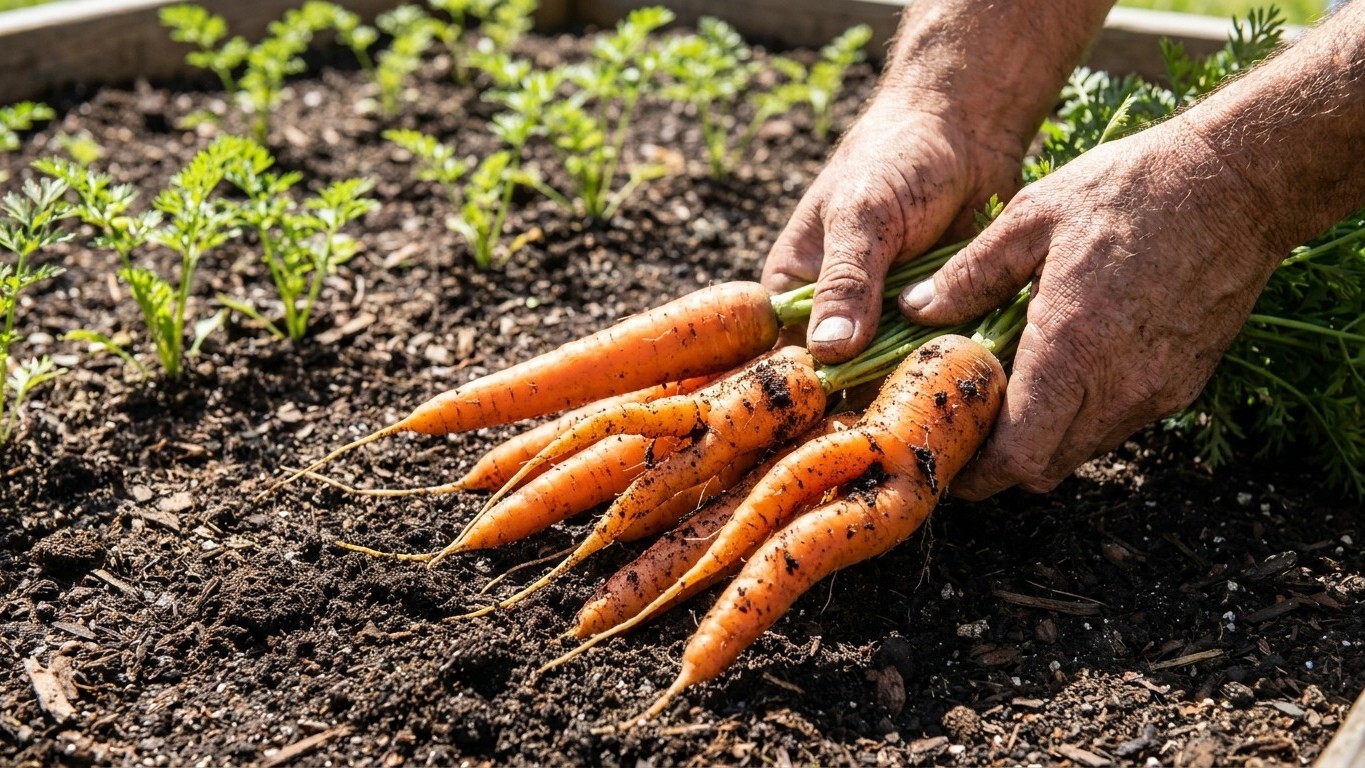

Sow carrot seed directly in the ground here in early spring, as soon as the soil can be worked, since carrots shrug off a light frost and need somewhere between 70 and 100 days from seeding to reach full size. Counting backward from your local last-frost date only pays off if the ground cooperates: heavy, poorly drained soil forks the roots and stalls germination no matter what the calendar says. West Virginia’s official state soil offers a clue to what most gardeners are working with, and it isn’t naturally suited to a carrot.
The short answer
West Virginia’s state soil is the Monongahela series, an Ultisol, the kind of soil that has weathered and leached for a very long time and comes out acid and short on nutrients as a result. The surface layer runs about 5.0 on the pH scale, which counts as strongly acid. Texture-wise it breaks down to 27 percent sand, 18 percent clay and 54 percent silt, putting it solidly in silt loam territory, with organic matter around 3.0 percent. USDA classes its drainage as moderately well drained, not fully well drained.
None of those four numbers is disqualifying on its own, but stacked together they explain a lot about how carrots behave in West Virginia gardens. Utah State University Extension puts it plainly: carrots want deep, sandy, well-drained soil rich in organic matter, and heavy or rocky ground makes the root fork. A silt loam with only moderate drainage and clay sitting at 18 percent isn’t the sandy, loose profile that lets a carrot taproot slide straight down. It’s not brick-hard clay either, so the news isn’t all bad. But it leans toward compaction after a hard rain, and that compaction is exactly what pushes a carrot root sideways or splits it into two legs instead of one.
The fix Utah State recommends for heavy soil is straightforward: work in plenty of compost and double dig the bed, breaking up the profile a foot or more down so there’s no resistance waiting for the root. Where the native ground is especially compacted or shallow to rock, a raised bed filled with a loose, sandy mix sidesteps the problem completely instead of fighting it season after season. Either approach beats hoping a stubborn root will find its own way through.
None of this is a verdict on any one backyard. A state spans hundreds of soil series, and the Monongahela profile is a statewide representative figure, not a measurement of your raised bed or the strip along your driveway. Treat it as a starting point that tells you what the region’s ground tends to do, then confirm what you actually have before you commit a season’s worth of seed to it.
The test that settles it in your own garden
The state figures describe a mapped average. Your plot might match it closely or not at all, especially if a previous owner brought in fill dirt, built near a creek bottom, or graded the lot when the house went in. A short walk outside answers the question the soil survey can’t.
- Dig a test hole. Go down at least 12 inches where you plan to sow. Note whether the color and texture change partway down, and whether you hit a dense, compacted layer or solid rock before you reach that depth.
- Check for stones and rubble. Sift through what comes out of the hole. Frequent pebbles or chunks of rock are a direct warning sign for forking, since a growing root will hit them and split or bend around them.
- Run the ribbon test. Take a handful of moist soil and squeeze it between your fingers. Sandy soil falls apart immediately. Clay-heavy soil holds together and can be smeared into a ribbon that doesn’t crack. Loam sits somewhere in between and crumbles gently.
- Watch how water drains. Fill the test hole with water and time how long it takes to disappear. Water that lingers for hours points to a drainage problem that will keep roots wet and prone to rot or splitting.
- Repeat in more than one spot. Soil can change character within the same yard, so test near where you’ll actually plant, not just wherever digging is easiest.
These five checks won’t hand you a lab-grade number, but they’ll tell you honestly whether you’re closer to the loose, sandy bed carrots want or the compacted, silty ground that tends to work against them, and that’s the decision that actually matters before you open a seed packet.
What goes wrong here
- Forking in heavy or compacted ground. Roots hit resistance from clay content or buried stones and split into two or more legs instead of growing straight down. Work in generous compost and double dig the bed to loosen the profile, or switch to a raised bed filled with a looser mix if the native soil resists every season.
- Poor germination during a hot, dry stretch. Carrot seed is small and sits near the surface, where it dries out fast once temperatures climb. Keep the seedbed consistently damp with light, frequent watering until seedlings appear, and consider a thin layer of mulch or a shade cloth to slow moisture loss during a warm snap.
- Splitting from uneven watering. A dry spell followed by a heavy soaking makes roots swell too fast and crack open. Water on a steady schedule instead of letting the bed dry out completely between soakings, and mulch to even out moisture swings between rains.
- Slow, stunted growth in acidic, nutrient-poor soil. Soil that trends strongly acid and low in organic matter, the tendency in this region’s representative profile, gives roots less to work with. Building up organic matter with compost addresses both the nutrient shortfall and the soil structure at the same time.
Common questions
Does the state’s official soil tell me exactly what’s in my backyard?
No. It’s a statewide representative figure for the Monongahela series, one of hundreds of soil series mapped across West Virginia. Your own yard, especially near a river bottom, on a hillside, or anywhere fill dirt was brought in during construction, can differ from it completely. Use the test steps above to check your own ground.
Do I count the 70 to 100 days from when I sow or from a transplant date?
From seeding. Carrots are sown directly in the ground and are never transplanted, so every day of that 70 to 100 day window runs from the day the seed goes into the soil, not from any later date.
Is a pH of 5.0 the number I should use for my garden?
No. That figure describes the surface horizon of the Monongahela series as mapped across the state, not a measurement of a cultivated bed. Test your own soil’s pH before adjusting it, since a worked garden bed with added compost can read very differently from the native, unworked profile.
My soil is heavy. Should I pick a different carrot variety instead of fixing the soil?
Utah State University Extension’s guidance points the other direction: heavy or rocky soil causes forking, and the remedy is working in compost and double digging the bed, or building a raised bed filled with a looser mix. Changing the soil, not swapping varieties, is the fix that actually addresses the cause.