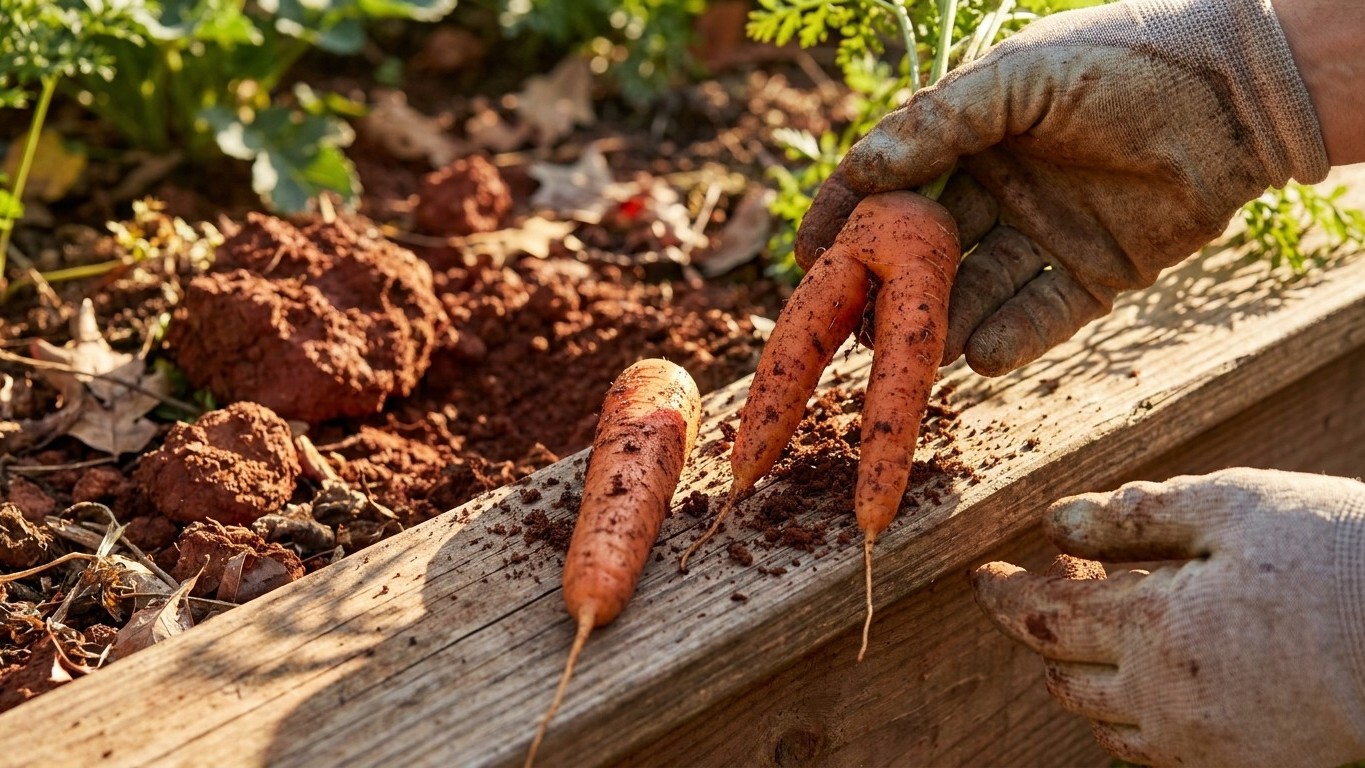

The typical agricultural soil in Yukon is a loam-silt Brunisol with only 15 percent clay, so most carrots grown there won’t fork from the soil texture alone. The bigger risk is drainage: this ground is rated imperfectly drained, which can crowd roots and cause splitting. Compost, raised beds, and loosening the top foot of soil fix both issues before they start.
The short answer
Across the agricultural regions of Yukon, the soil that shows up most often in mapped surface horizons is a Brunisol, a young soil whose layers are only beginning to separate, typically found on recent or coarse parent material. It accounts for 41 percent of the mapped surface, with Gleysolic soils as the runner-up. The median surface pH sits at about 6.8, close to neutral. Texture-wise, this ground runs loam to silt: 47 percent sand, 15 percent clay, and 38 percent silt, with organic matter around 12.0 percent, which is high for garden soil anywhere in North America. Drainage is rated imperfectly drained.
That combination is mostly good news for carrots. Carrots want deep, sandy, well-drained soil rich in organic matter, according to Utah State University Extension. Heavy or rocky soil is what makes the root fork, splitting into two or more legs as it hits resistance and grows around it instead of straight down. At 15 percent clay, Yukon’s typical soil isn’t heavy in the way that stops a taproot cold. The organic matter content, sitting well above what most vegetable gardens start with, also works in the carrot’s favor, since loose, humus-rich ground gives a taproot room to push down without hitting a wall.
The catch is drainage, not clay. Imperfectly drained soil holds water longer than carrots like, and wet, compacted ground near the surface can still deflect a root tip sideways just as effectively as a rock can. If a garden bed sits on ground that stays soggy after rain, or if the silt fraction (38 percent here) has compacted into a crust, the fix is the same one Utah State recommends for heavy soil: work in plenty of compost and double dig the bed, turning the soil to a full spade’s depth and breaking up the layer below. Where drainage is a real problem rather than just a texture issue, a raised bed filled with a loose, sandy mix solves it outright, since it lifts the root zone above the water table and lets excess moisture drain off the sides.
None of this is a diagnosis of any one backyard. A territory this size spans hundreds of distinct soil series, and the number above is a median drawn from mapped agricultural soils, not a reading from any particular plot. River bottoms, muskeg edges, and any ground a builder has scraped, filled, or trucked in gravel over will differ from this profile, sometimes completely. Treat the Brunisol figures as a starting point for what the region’s ground tends to do, then check the actual dirt in front of you.
The test that settles it in your own garden
A state or territory average can’t tell you what’s under your own raised bed, your own back corner, or the plot you inherited with the house. The only way to know if your soil will fork a carrot is to look at it directly, and that takes about fifteen minutes with a shovel.
- Dig a hole at least a foot deep where you plan to sow. Carrots need clear, unobstructed depth to grow straight, so this is the single most useful thing you can check before anything else.
- Look for rocks and hardpan. Pull out anything the size of a marble or bigger as you go, and note whether the shovel hits a dense, compacted layer partway down. That layer is exactly what makes a root fork or curl sideways.
- Feel the texture between your fingers. Grab a handful of moist soil from the hole and squeeze it. If it holds a tight ball and feels sticky or slick, you’re dealing with more clay than the carrot wants. If it falls apart immediately and feels gritty, it leans sandy, which carrots generally prefer. Something in between, crumbly but able to hold a loose shape, is closer to loam.
- Watch how water drains. Fill the hole with water and time how long it takes to soak in. Water that lingers for hours, rather than draining steadily, points to the same imperfect drainage that shows up in the territory-wide data, and it’s a signal to build up rather than dig down.
Run this test in more than one spot if your yard has any slope, any fill dirt, or any spot that’s obviously wetter than the rest. Soil can change completely within twenty feet, especially near a foundation, a driveway, or an old gravel pad. What you’re really after is a plain read: is this ground loose and deep enough for a straight root, and does water move through it in a reasonable time? Everything else, the compost, the raised bed, the double digging, follows from that answer.
What goes wrong here
- Forking in heavy or compacted ground. Even at a modest 15 percent clay territory-wide, any spot with more clay than that, or with a compacted layer under the topsoil, will split a taproot into two or more legs. The remedy is the one Utah State University Extension gives for heavy soil generally: work in generous compost and double dig the bed to break up the resistant layer before sowing.
- Poor stands where the ground crusts over. Carrot seed is small and needs steady contact with loose, moist soil to germinate evenly. On silty ground (38 percent silt is typical here), a hard rain followed by drying sun can bake the surface into a crust that seedlings can’t push through, leaving gaps in the row. Keeping the seedbed loose and lightly covered until seedlings emerge avoids this.
- Splitting from uneven watering. Roots that grow through inconsistent moisture, wet, then dry, then wet again, tend to crack open along the side as they swell unevenly. On imperfectly drained ground this swing is easy to trigger, since the soil holds water after rain and then dries out fast in between. A steady watering schedule, rather than heavy watering only when the bed looks dry, keeps the taproot growing at an even rate.
- Stunted roots in soil that never loosens past the topsoil. High organic matter near the surface, which this territory has in abundance at around 12.0 percent, can mask a denser layer just below it. A carrot that grows fine for its first few inches and then stalls or forks lower down is usually hitting exactly that layer, which is why the depth check in a hand-dug hole matters more than judging soil by its top few inches alone.
Common questions
Does a near-neutral pH like 6.8 matter for carrots?
The median surface pH across Yukon’s mapped agricultural soils is about 6.8, which sits close to neutral. That figure describes the territory-wide median, not any single garden, so it’s worth checking your own soil rather than assuming this number applies plot for plot.
Is a raised bed always necessary in imperfectly drained soil?
Not always. If your own dig test shows loose, deep soil and reasonably quick drainage, double digging and added compost may be enough. A raised bed becomes the more reliable fix specifically where water lingers in the test hole for hours, since it lifts the root zone clear of that standing moisture.
How deep does the soil need to be loose for a straight carrot?
The carrot’s own root length sets that bar, so the practical guide is the depth you can keep loose and stone-free through double digging or a raised bed, checked hole by hole with the test described above rather than assumed from a territory average.
Are carrots sown directly, or started indoors and transplanted?
Carrots are sown in place, directly into the garden bed. There is no transplanting step for this crop, and any days-to-maturity figure for carrots is counted from the seeding date, not from a transplant date.