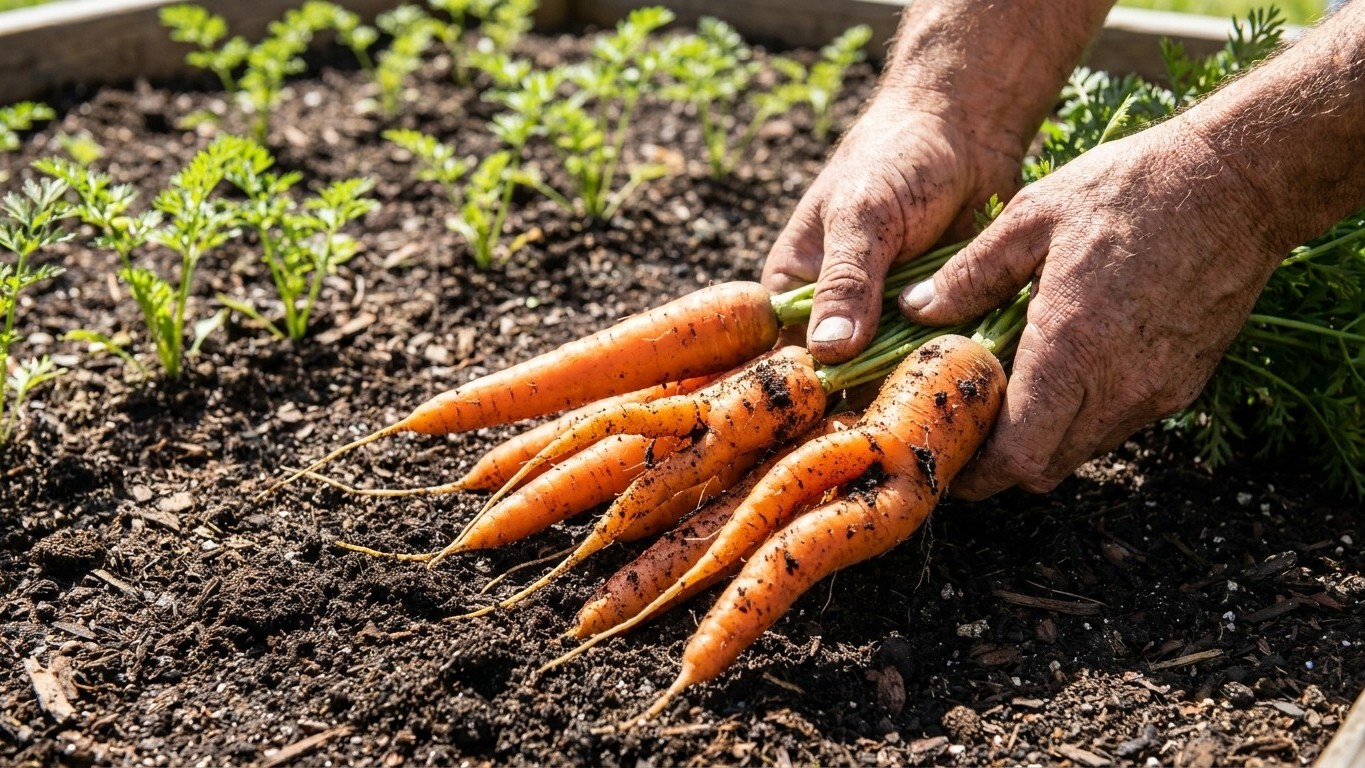

Carrots go into the ground before the last frost, not after. The seedlings tolerate cold that would wreck a tomato start. But no single date drives that decision in Yukon the way it might for a warm-season crop. What actually decides whether your carrots come out straight or forked has less to do with the calendar and everything to do with what’s under your boots: the texture, drainage and depth of the soil those seeds land in.
The short answer
Across Yukon’s mapped agricultural regions, the most common soil order turns up as a Brunisol, a young soil whose horizons are only beginning to separate, typical of recent or coarse parent material. It shows up in 41 percent of the mapped surface, with Gleysolic soils as the runner-up. The median surface reading sits at about pH 6.8, close to neutral, with a texture that lands in the loam to silt range: 47 percent sand, 15 percent clay and 38 percent silt. Organic matter comes in around 12.0 percent, which is a rich figure for a mineral soil. Drainage is classed as imperfect, meaning water moves through slower than a gardener would like but doesn’t sit stagnant either.
Set that against what a carrot actually wants. Utah State University Extension is blunt about it: carrots need deep, sandy, well-drained ground loaded with organic matter, and heavy or rocky soil makes the root fork. Measured against that standard, Yukon’s typical profile is a mixed bag. The sand content leans favorable, and the organic matter figure is a genuine asset, carrots pull nitrogen and moisture from that kind of humus-rich ground without much complaint. The concern is the drainage class. Imperfect drainage means the root zone can stay wetter than carrots like right when the taproot is trying to push straight down, and that combination of a fine silty fraction with sluggish drainage is exactly the setup that produces forked or stubby roots in a bed that hasn’t been amended.
The fix, per the same Extension guidance, is not a different variety. It’s compost worked in generously and double digging to break up any compaction below the topsoil, or building a raised bed where you control the depth, the texture and the drainage from the start. A raised bed filled with a loose, sandy, compost-heavy mix sidesteps the imperfect drainage problem entirely, since water isn’t waiting on the surrounding subsoil to let it through.
None of this is a verdict on your own backyard. Yukon spans hundreds of individual soil series, and this profile is the dominant one measured across the province’s agricultural land, not a diagnosis of any single plot. A garden near a river bottom, on filled ground, or in an old muskeg pocket can look nothing like the median number above. Treat it as a starting point for what the region tends to do, then check your own dirt before you commit a whole bed to carrots.
The test that settles it in your own garden
- Dig a test hole. Go down through the topsoil until you hit a distinct change in color or a layer of rock or hardpan. That depth tells you how far a carrot root actually has room to grow before it hits resistance and forks or stops.
- Look at what comes out. Spread the excavated soil on a tarp and check for rocks, roots and clumps. Carrots forking around a stone is one of the most common complaints gardeners run into, and it’s visible before you ever plant a seed.
- Feel the texture. Take a handful of moist soil and squeeze it. If it forms a slick, sticky ribbon that holds its shape, you’re dealing with a clay-heavy soil that will need compost and loosening. If it falls apart and feels grainy, you’re closer to the sandy end that carrots prefer.
- Watch how water drains. Pour water into the test hole and time how long it takes to disappear. Water that lingers for hours points to the same imperfect drainage the province’s dominant soil profile carries, and that’s your signal to raise the bed rather than fight the ground as it sits.
Nothing here needs a lab. It needs a shovel, a tarp and about twenty minutes, and it tells you more about your specific carrot bed than any provincial average can.
What goes wrong here
- Forking in heavy or compacted ground. When the silt and clay fraction sits on top of anything compacted, a growing taproot hits resistance and splits into two or three legs instead of one straight root. The remedy is compost worked in a full spade deep, plus double digging to break up the layer underneath, or simply building up rather than digging down with a raised bed.
- Poor germination during a hot, dry spell. Carrot seed is small and sits near the surface, and it dries out fast once the topsoil crusts over. The remedy is keeping the seedbed consistently damp until sprouts appear, using a light mulch or a board laid over the row to hold moisture in without smothering the seedlings once they emerge.
- Splitting from uneven watering. A dry stretch followed by a heavy soak makes the root swell faster than its skin can stretch, and it cracks open. The remedy is a steady watering rhythm rather than feast-or-famine, especially in a soil that already drains imperfectly and can swing between soggy and crusted if you’re not paying attention.
- Stunted roots in soil that’s richer on paper than in practice. That 12.0 percent organic matter figure is a provincial median, not a guarantee for every plot, and a bed that’s been scraped, filled or heavily cropped for years may have far less structure left. Working in fresh compost before sowing closes that gap regardless of what the regional number says.
Common questions
Do carrots need to be transplanted after starting indoors?
No. Carrots are sown directly in place, and the 70 to 100 days to maturity that most references cite are counted from the seeding date, never from a transplant date, because there isn’t one.
Is Yukon’s soil naturally good for carrots?
It’s mixed. The typical profile leans loam to silt with a strong organic matter content, both points in carrots’ favor, but the imperfect drainage class works against a crop that wants water to move through freely. Amending with compost or switching to a raised bed addresses the weak point directly.
What pH do carrots need, and does Yukon’s soil match it?
The measured median for Yukon’s dominant mapped soil sits at about 6.8, which is close to neutral. No specific pH target for carrots is given in the sourced guidance here, so treat that 6.8 figure as a description of the regional soil, not as confirmation that it’s ideal for the crop.
Why did my carrots fork even though I didn’t see any rocks?
Rocks are one cause, but compacted subsoil does the same thing without a single stone in sight. If your test hole showed a hard, dense layer a few inches down, that layer is likely the culprit, and double digging or raising the bed above it solves the problem without needing to remove anything.