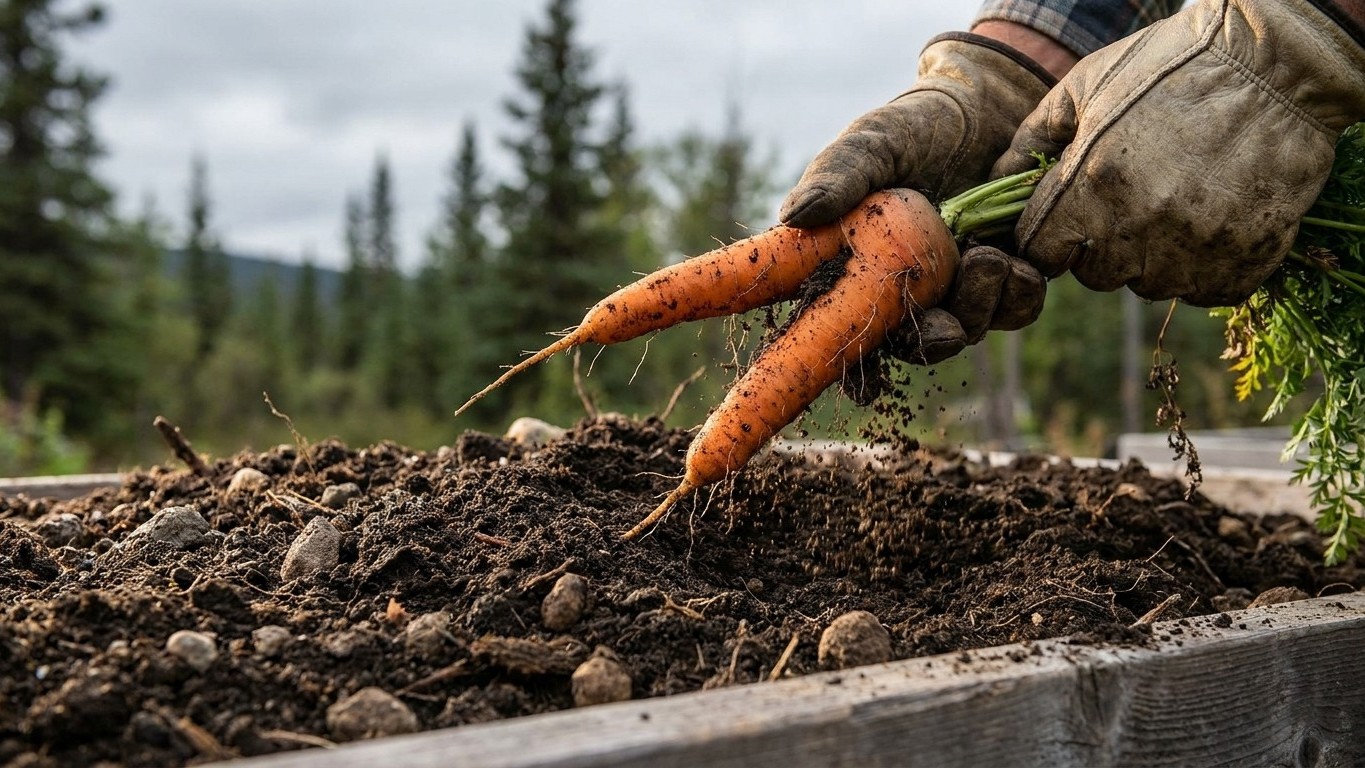

Yukon’s most common ground is a loam-to-silt Brunisol, well short of the sandy, stone-free bed carrots want, and it drains imperfectly rather than freely. That combination doesn’t rule out straight roots, but it does mean most gardeners here need to build the bed rather than trust the native ground. Sowing timing matters just as much: seed goes in the soil, not a tray, and the local frost window sets the calendar, so it’s worth checking When to Sow Carrots in Yukon before planning your bed.
The short answer
Across the mapped agricultural soils of Yukon, the single most common order is Brunisol, covering 41 percent of the surface, with Gleysolic soils close behind. A Brunisol is a young soil, one where the horizons are only starting to separate out, typical of ground built on recent or coarse parent material. The median surface reading for these soils comes out to about 47 percent sand, 15 percent clay and 38 percent silt, which places the texture in loam-to-silt territory rather than the coarse sand carrots prefer. Organic matter runs around 12.0 percent, a respectable figure, and the median pH sits near neutral at about 6.8. Drainage is classed as imperfect, meaning water moves through slowly enough to pool at times rather than passing straight down.
For a carrot root, imperfect drainage paired with a silt-heavy loam is a mixed signal. Straight sand would let a taproot slide down without resistance. Heavy clay would stop it cold, forking it around any dense patch or stone the way a plumbing line detours around a boulder. A loam-to-silt profile with 15 percent clay isn’t the worst case, but it’s dense enough that compaction, a buried rock, or a hardpan a few inches down can still split a root into two or three legs, which raises the practical question of Will Carrots Fork in Yukon Soil? Utah State University Extension notes plainly that heavy or rocky soil makes carrot roots fork, and that the fix for heavy ground is generous compost worked in plus double digging to break up the profile below the seed line.
Given the imperfect drainage on top of that texture, a raised bed earns its keep here more than in a straight sandy-loam region. Raising the growing surface four to six inches above grade, filled with a loosened, compost-rich mix, sidesteps both problems at once: it drains faster than the imperfectly drained native ground below, and it gives the taproot a stone-free path down without the gardener needing to hand-pick rocks from a full garden bed. Double digging the existing soil before building the raised frame helps too, since it breaks up any compacted layer that would otherwise sit right under the new bed.
None of this is a verdict on any one backyard. Yukon’s agricultural soils span far more than one profile, this Brunisol figure only describes the ground that was actually mapped and surveyed, and the province’s remote north isn’t represented in it at all. A garden near a river bottom, on filled ground, or in old muskeg can be nothing like the median described above. Treat the numbers here as the region’s general tendency and nothing more, then confirm what’s actually under your own feet before deciding how much compost or how deep a bed you need.
The test that settles it in your own garden
The only way to know if your ground will fork a carrot is to look at it directly, not to trust a provincial average. None of the following steps require lab equipment, just a spade, a bucket of water, and about twenty minutes.
- Dig a hole at least a foot deep where you plan to sow. Note where the soil changes color or texture, and whether you hit a hard, compacted layer or a shelf of stones before that depth.
- Check for rocks and buried debris in the loosened soil. Anything larger than a marble sitting in the top eight to ten inches is a candidate for forking a taproot around it.
- Rub a handful between your fingers. Gritty and loose suggests sand; smooth and sticky when wet suggests clay; a soil that holds a loose ball but crumbles with a light poke is closer to loam.
- Fill the hole with water and time the drain. Water that vanishes within a few minutes points to fast-draining, sandy ground. Water that sits for an hour or more points to the kind of imperfect drainage that calls for a raised bed.
- Repeat in more than one spot. A garden can change texture within a few feet, especially near a foundation, a driveway, or a spot that was once graded or filled.
What you’re really testing for is depth and drainage, since those two things decide whether a carrot root can travel straight down without hitting resistance or sitting in standing water. If the hole drains slowly and the soil below eight inches feels dense or gritty with rock, that’s your answer: build up rather than dig in, and mix in compost generously before you sow.
When to sow here
Carrot seed goes straight into the garden bed. There’s no transplanting step to count from, so every date below runs from the day the seed goes into the ground.
- Start with the local frost record. The average last spring frost at the Whitehorse A station runs to June 5, based on the 1981-2010 climate normals from Environment and Climate Change Canada. That’s a mean date, not a guarantee: in roughly half of all years, frost arrives later than June 5, so treat it as the middle of a window rather than a safe cutoff.
- Confirm the soil itself has warmed, not just the calendar. Carrot seed needs soil at a minimum of 40 F to sprout at all, and pushing seed into colder ground just wastes it sitting dormant, or rotting, until temperatures rise.
- Count back two to three weeks from that average last frost date. Working from June 5, that lands sowing in the second half of May for most years, sooner if the ground has already warmed, later if a cold spring is dragging on. Since one year in two runs later than the average, a gardener working from the early end of that window should watch the soil thermometer rather than the calendar alone.
- Aim for the germination sweet spot once seed is in. Carrot seed germinates best between 55 F and 65 F. Soil that just cleared the 40 F minimum will germinate carrots slowly and unevenly; soil in the mid-to-upper 50s and low 60s gets a faster, more uniform stand.
- Expect the root itself to take its time. From that seeding date, count on somewhere between 70 and 100 days to a harvestable root, depending on the variety, with none of that clock starting any earlier or later than the day seed actually goes into the ground.
What goes wrong here
- Forked roots in heavy or stony ground. A carrot taproot splits when it meets a rock, a compacted layer, or dense clay it can’t push through. Given the loam-to-silt texture and imperfect drainage typical of this region’s soils, double digging before sowing and working in compost through the full root zone, or moving to a raised bed filled with loosened, stone-free soil, is the fix.
- Poor or patchy germination during a hot stretch. Carrot seed germinates best between 55 F and 65 F, and a sudden warm spell that pushes soil well past that range can slow sprouting or thin out the stand. Watering lightly and often to keep the seedbed cool and consistently moist during germination helps close that gap.
- Splitting from uneven watering. A root that grows through a dry stretch, then gets soaked all at once, can crack along its length as the interior swells faster than the skin. Watering on a steady schedule rather than in occasional floods keeps the root growing evenly.
- Slow starts in cold, imperfectly drained soil. Ground that holds water longer than it should stays colder longer too, delaying the point at which soil temperature clears that 40 F minimum. Raised beds warm faster in spring than flat, imperfectly drained ground, which can buy back some of that lost time.
Checking this against your own county
Everything above describes the general tendency of Yukon’s mapped agricultural soils, not the dirt in any one garden. Before committing to a full bed of carrots, it’s worth checking your own conditions against a source that works at the ground level rather than the territorial one. Agriculture and Agri-Food Canada, reachable at agriculture.canada.ca, is the federal department behind the soil survey data referenced on this page, and it’s a reasonable starting point for tracking down more localized soil and growing guidance for your specific district. A short conversation with someone who knows your immediate area can settle in minutes what a provincial average never will.
Common questions
Does every Yukon garden have imperfectly drained soil?
No. That figure describes the median across the mapped agricultural soils of the territory, dominated by Brunisols. Individual gardens, especially ones on sandy river terraces or filled ground, can drain quite differently, which is why the dig-and-water test matters more than the territorial average.
Can I just pick a shorter carrot variety to avoid forking?
The soil texture and any compaction or rocks below the surface are the actual cause of forking, not the variety length. Fixing the ground with compost, double digging, or a raised bed addresses the root of the problem more reliably than switching seed.
Is June 5 safe to sow on?
June 5 is the average last spring frost at the Whitehorse A station over the 1981-2010 period, meaning frost still arrives later than that in roughly half of all years. Sowing runs two to three weeks before that average date, but soil temperature at or above 40 F matters more than any single calendar day.
How long until I can harvest?
Counting from the day seed goes into the ground, most carrot varieties need somewhere between 70 and 100 days to reach a harvestable root. There’s no transplant step in this crop, so that clock never starts earlier than the actual sowing date.