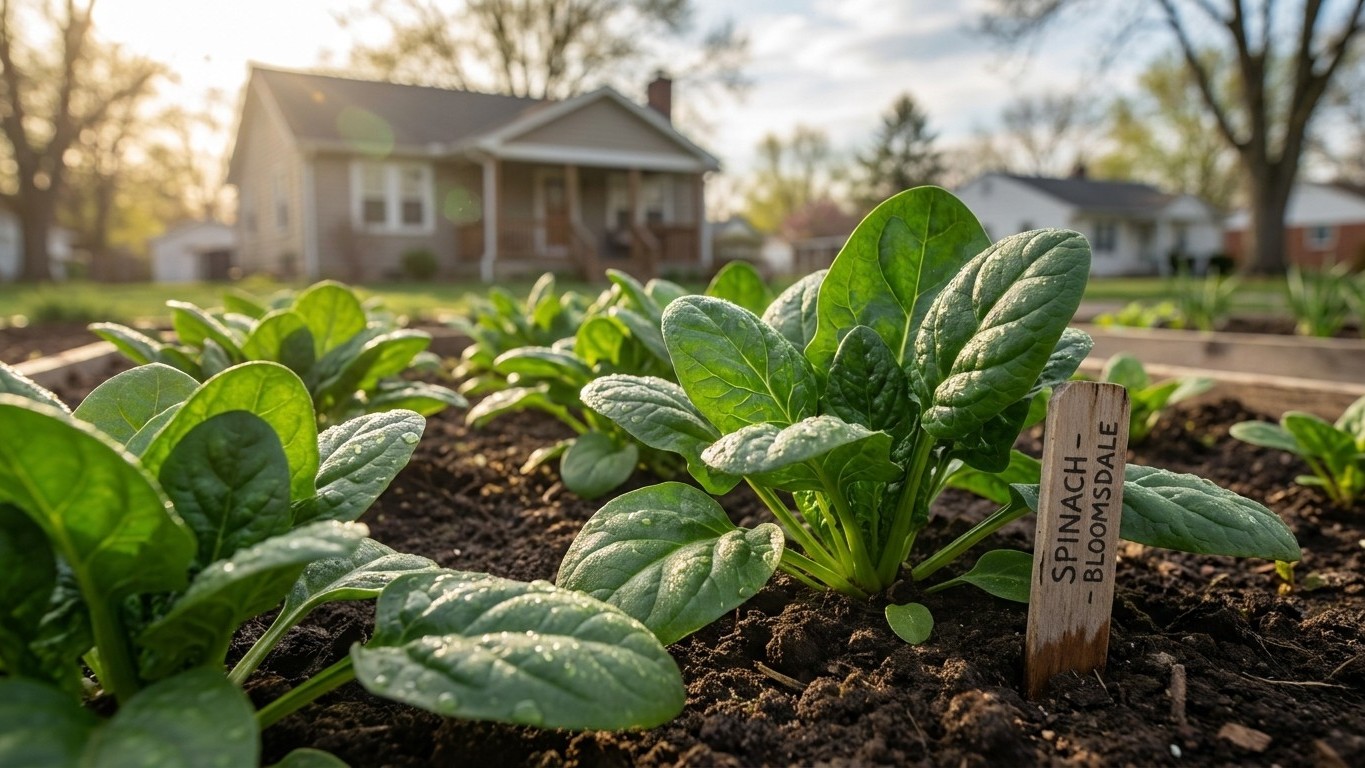

Spinach in Arkansas bolts fast, usually within six to eight weeks of a spring sowing, because long daylight hours and quick-arriving heat hit the plant at the same time. Will Spinach Bolt Early in Arkansas? The state’s summer day length reaches 14 hours and 20 minutes at its longest, and that alone pushes flowering along even before the thermometer gets involved. Add in a climate that averages 69.2 days a year above 90 F, and the spinach season here closes on both ends at once.
The short answer
Little Rock and the rest of Arkansas see 14 hours and 20 minutes of daylight on the longest day of the year. For spinach, that number works against the plant rather than for it. Long days trigger flowering (bolting) in spinach regardless of temperature, so even a mild, overcast summer would not buy extra harvest weeks here. That distinction matters because gardeners sometimes assume a cooler summer automatically means a longer spinach season, and with this crop that assumption is wrong.
But Arkansas rarely offers a mild summer to test that theory. With 69.2 days a year reaching 90 F or higher, the state’s heat load is substantial, and spinach starts struggling well before those 90-degree afternoons show up. Utah State University Extension puts the practical growth ceiling at 75 F, past which the plant slows down and the leaves turn bitter. In Arkansas, that 75-degree line arrives early in the year, often while the days are still gaining length.
So the honest answer is both. Long days and rising heat converge here rather than one dominating the other, and that convergence is exactly why the spring spinach window in Arkansas feels short compared to states with cooler, longer springs. The two pressures do not take turns; they stack. A gardener watching only the calendar for frost dates will be surprised when a spinach bed bolts on a day that does not feel especially hot, because the daylight hours crossed their threshold days or weeks earlier and heat simply finished the job.
This is also why fall spinach performs better across most of the South, Arkansas included. As days shorten heading into winter, that bolting trigger disappears, and the plant can put energy into leaves instead of flower stalks. The obstacle in autumn is not day length at all. It is getting the seed into the ground while the soil is still too warm to germinate well, a timing question covered in When to Sow Autumn Spinach in Arkansas, and which the next two sections work through in detail.
How long the spring window really is
- The last spring frost in Arkansas, based on NOAA NCEI 1991-2020 Climate Normals for station USW00013963, falls between March 12 and March 28. Spinach seed goes in the ground two to three weeks ahead of that date, which puts a realistic sowing date somewhere between the last days of February and the first week of March.
- Once sown, spinach germinates and grows through the remaining cool weeks of March, a period when both day length and temperature still favor leaf production over flowering.
- April changes the equation. Daylight lengthens quickly through the month, and Arkansas temperatures climb toward the 75 F ceiling that marks both slowed growth and the start of bitter-tasting leaves. Somewhere in this stretch, the combination of longer days and warmer air pushes the plant toward bolting.
- Adding it together, the usable spring window in Arkansas runs roughly from late February or early March sowing through a harvest that needs to wrap up before the plant bolts in April. That leaves something in the neighborhood of six to eight productive weeks, a tight window compared to states farther north where cooler air lingers longer even as days lengthen at a similar rate.
Gardeners who want to stretch those weeks a little further sometimes rely on light shade cloth or an earlier sowing right at the edge of the frost-risk period, but neither trick changes the fundamental math: the days are getting longer no matter what, and that clock keeps running underneath any temperature management.
The autumn crop, and when the soil lets you sow
Fall spinach avoids the day-length problem entirely, since daylight is shrinking rather than growing through September and October. That removes one of the two pressures working against the plant in spring. What replaces it is a different obstacle tied to soil rather than sunlight, followed by the season’s hard stop at first frost.
Soil still too warm to germinate
Utah State University Extension notes that spinach seed germination drops off once soil temperatures climb above 80 F. Arkansas soil holds heat well into late summer, particularly in a state averaging nearly 70 days a year above 90 F air temperature, and topsoil in August routinely sits above that 80-degree mark. Sowing too early into that warm soil means poor, patchy germination even if the air temperature has started to feel more tolerable in the evenings. The practical move is waiting for soil to cool rather than watching the calendar or the air thermometer alone.
Counting back from first frost
The first fall frost in Arkansas, again from NOAA NCEI 1991-2020 Climate Normals at station USW00013963, arrives between November 7 and November 20. Utah State University Extension recommends sowing a fall spinach crop 50 to 75 days before the date you want to harvest. Working backward from the start of that frost window, November 7, a 75-day count lands on roughly August 24, and a 50-day count lands on roughly September 18. That gives a sowing range of late August through mid-September for gardeners aiming to harvest right around when the first frost risk begins.
The catch is that late August soil in Arkansas is often still running above that 80 F germination threshold, so many gardeners get better stands by sowing toward the later end of that window, closer to mid-September, and accepting a slightly tighter runway before frost. Named varieties sometimes grown in the region include Bloomsdale, Melody, Teton, and Olympia, though Utah State University Extension does not publish days-to-maturity figures for any of them, so timing decisions should rest on the sowing-to-frost math above rather than a variety label.
Checking this against your own county
Frost dates and heat averages used here come from a single reference station, and Arkansas is a wide state with real differences between the Ozark highlands, the Delta, and the southern counties near the Louisiana line. A garden in the northern hill country can see frost show up earlier than one in the Delta lowlands, and soil warms and cools at different rates depending on drainage and sun exposure. Before locking in a sowing date, run the numbers against local records through the University of Arkansas Cooperative Extension Service, which maintains county-level guidance and can confirm how closely your specific location tracks the statewide averages used in this article.
Common questions
Can shade cloth stop spinach from bolting in Arkansas?
Shade cloth can lower the air temperature around the plants and may buy a little time against the 75 F growth ceiling, but it does not change day length, which is the other trigger behind bolting. It helps, but it is not a full fix.
Is fall spinach actually easier than spring spinach in Arkansas?
For the bolting problem, yes, since shortening days remove that trigger entirely. The tradeoff is a narrower germination window because the soil needs to cool below roughly 80 F before seed will come up reliably.
Does a bolted spinach plant still produce edible leaves?
Leaves usually turn bitter once the plant shifts into flowering, which lines up with crossing the 75 F ceiling mentioned by Utah State University Extension. Harvesting everything as soon as bolting starts is the usual recommendation rather than waiting.
Do Bloomsdale, Melody, Teton, and Olympia bolt at different rates in Arkansas?
These are varieties sometimes grown in the region, but Utah State University Extension does not publish comparative bolting or maturity data for them, so no variety-specific timing claim can be made here.