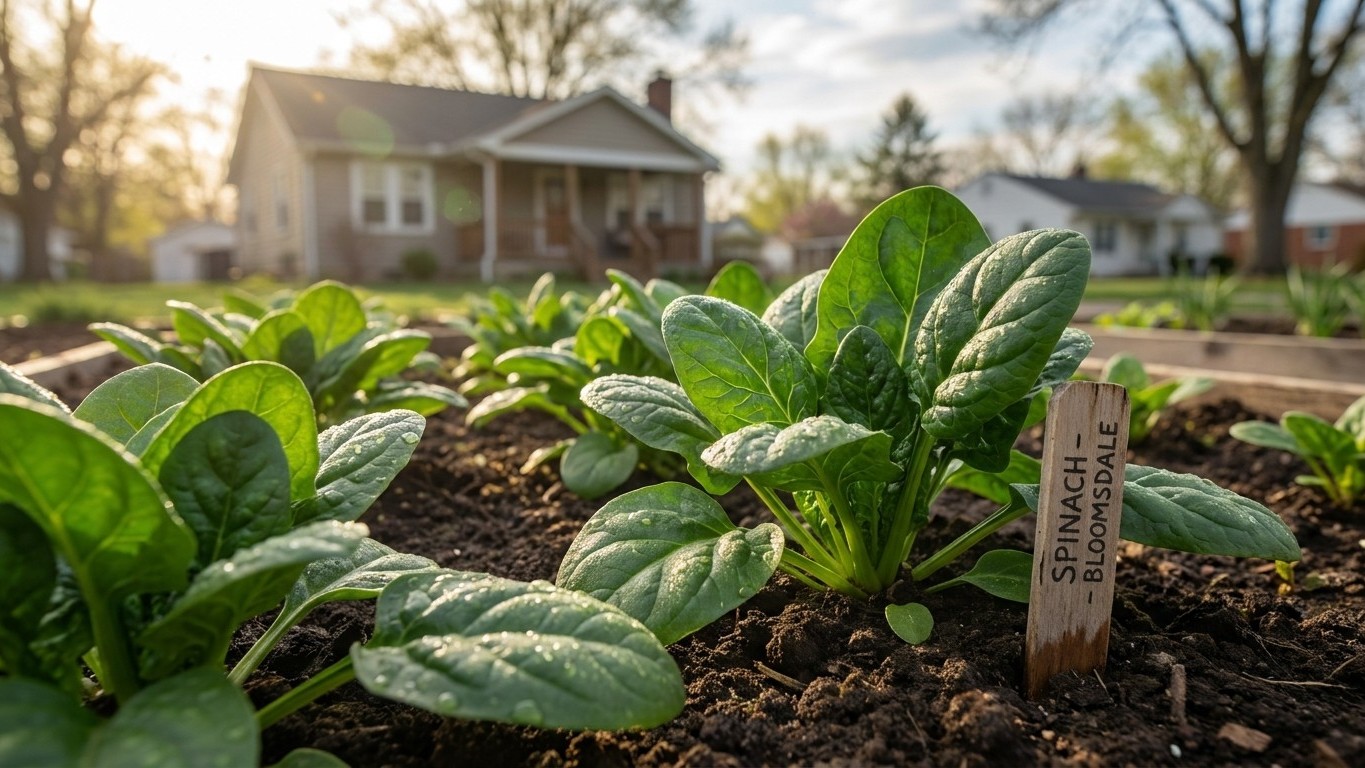

Minnesota spinach bolts on a clock set mostly by daylight, not by the thermometer, and that clock runs the same whether the summer feels mild or brutal. The Twin Cities area gets 15 hours and 25 minutes of daylight at the solstice, long enough to push spinach toward flowering on its own, and the region’s heat adds a second push on top of that. The practical result is two short windows, spring and fall, bracketing a summer stretch spinach simply can’t survive.
The short answer
At the summer solstice, the Twin Cities area sees 15 hours and 25 minutes of daylight, the longest stretch of the year at this latitude. That number matters more than any thermometer reading, because spinach flowers on a long-day trigger: once daylight stretches past a certain point, the plant switches from making leaves to sending up a seed stalk, regardless of temperature. A mild, cool Minnesota summer does not slow that clock down. The day length does the same work whether the air sits at 65 degrees or 95.
That’s the part gardeners moving from warmer states often get backwards. In a hot climate, spinach bolts mainly from heat stress, and a cool spell can buy a few extra days. In Minnesota, the trigger fires largely on schedule, tied to sun angle rather than the mercury — which raises the question, Will Spinach Bolt Early in Minnesota? A rainy, unseasonably cool June will not rescue a spring spinach crop that’s already living on borrowed time as the days lengthen toward the solstice.
Heat adds its own pressure
Heat still matters, as a separate stressor riding alongside the day-length trigger. Minneapolis-St. Paul averages 10.6 days a year at 90 degrees or hotter, and spinach growth quality falls apart once temperatures push past 75 degrees. Leaves toughen, flavor turns bitter, and the plant is primed to bolt fast the moment a hot stretch lines up with long days. That overlap, roughly late spring into midsummer, is exactly when Minnesota gets both its longest daylight and its warmest weather at once.
The honest framing: Minnesota’s spinach season is limited by day length and heat working together, not by one alone. Day length sets the outer boundary no matter what happens with the weather; heat then decides how fast and how badly bolting shows up once that boundary gets crossed. Waiting out a cool spell won’t save a crop that’s already past its window. The fix is timing the whole crop to dodge the solstice, sowing early in spring before it arrives and again in late summer after the days have started shrinking back down — see When to Sow Autumn Spinach in Minnesota for the specifics of that second window.
How long the spring window really is
Working out Minnesota’s usable spring window means lining up three separate facts: the last frost date, the 75-degree growth ceiling, and the day-length climb that eventually tips the crop toward bolting.
Doing the math for the Twin Cities
- Start with the frost date. The last spring freeze at the Twin Cities reference station falls between April 17 and April 30. Spinach seed tolerates cold soil well, so sowing 2 to 3 weeks ahead of that date is standard, putting a realistic start somewhere between late March and mid-April.
- Add early growth time. Spinach grows slowly but steadily in cool soil, and no fixed days-to-maturity figure is published for the crop in the source data used here. What is published is the ceiling: growth quality holds up as long as temperatures stay under 75 degrees, which is easy to satisfy through April and most of May in Minnesota.
- Watch the daylight climb. Every week from the spring sowing forward, daylight lengthens toward the solstice peak of 15 hours and 25 minutes. That climb is what eventually flips spinach toward flowering, independent of how warm or cool the weather feels day to day.
- Mark where the two lines cross. By the time daylight nears its peak, usually in the back half of June, the combination of long days and the season’s first real heat (Minneapolis-St. Paul averages 10.6 days a year at 90 degrees or above, mostly starting in June and July) ends the spring crop’s productive run.
- Total it up. From a sowing date in late March or early April to a bolt-driven finish around mid-June, Minnesota gardeners get roughly ten to eleven weeks of usable spring spinach, a shorter run than the frost-free season alone would suggest.
The autumn crop, and when the soil lets you sow
Fall spinach in Minnesota isn’t blocked by the day-length trigger, since days are shortening by late summer, which actually favors the crop. The two real obstacles are soil still holding onto summer heat, and the calendar running out before the first hard frost.
Soil that’s still too warm to germinate
Utah State University Extension notes that spinach germination drops once soil temperatures climb above 80 degrees. Late July and much of August in Minnesota routinely leave topsoil warmer than that after weeks of summer sun, even though 90-degree air days average only 10.6 a year at the Twin Cities reference station. That gap between air readings and topsoil temperature is where fall sowings usually fail: gardeners sow on schedule by the calendar, but the seed sits in soil too warm to sprout. Mulching the row, sowing in a partly shaded spot, or watering to cool the soil before dropping seed all help close that gap, though none of them shortcut the need to wait for the hottest stretch of summer to break.
The frost that ends the season
The first fall freeze at the Twin Cities reference station lands between October 11 and October 23. Counting back the 50 to 75 days that Utah State University Extension recommends between sowing and a fall harvest, a target harvest in mid-October puts the sowing window somewhere between late July and late August. Gardeners aiming for an early-October harvest, ahead of the earliest frost dates, should lean toward the front of that window and sow closer to late July; those willing to gamble on the later end of the frost range, closer to October 23, can push sowing into early September and still land inside the 50-to-75-day range.
Checking this against your own county
Every date here comes from the Twin Cities reference station, the mildest, southernmost part of Minnesota. Head toward Duluth, Bemidji, or International Falls and both frost dates shift by two to three weeks in each direction: the last spring freeze lingers later, the first fall freeze arrives sooner, and the whole spinach calendar compresses on both ends. The day-length trigger stays the same statewide, since it depends on latitude more than local microclimate, but the frost-defined edges of spring and fall sowing shift county by county.
Common spinach varieties sold for Minnesota gardens include Bloomsdale, Melody, Teton, and Olympia; no days-to-maturity or bolt-resistance figures for these specific varieties are published in the source data used here, so treat seed packet claims as a starting point rather than a guarantee against the state’s long summer days. For dates specific to your county, along with current growing advisories, University of Minnesota Extension is the authority to check before locking in a sowing date.
Common questions
Can I grow spinach all summer in Minnesota?
No. Once daylight climbs toward its solstice peak of 15 hours and 25 minutes, spinach shifts toward flowering regardless of temperature, and Minnesota’s summer heat, averaging 10.6 days a year at 90 degrees or above in the Twin Cities, finishes the job. Spring and fall are the workable windows, not the months between.
What actually triggers spinach to bolt, heat or day length?
Both, acting together. Long days trigger flowering on their own, so a cool summer doesn’t buy extra weeks. Heat above 75 degrees then degrades leaf quality and speeds the process once the day-length trigger has already set the crop on that path.
When should I plant fall spinach in Minnesota?
Count back 50 to 75 days from the harvest date you want, per Utah State University Extension, and check that soil temperatures have dropped below 80 degrees before sowing, since germination falls apart in soil warmer than that. For a mid-October harvest in the Twin Cities area, that generally means sowing between late July and late August.
Is the spinach season shorter in northern Minnesota than in the Twin Cities?
Yes. Northern counties see frost dates run two to three weeks tighter on both ends, later in spring and earlier in fall, which shrinks the already narrow spring and fall sowing windows described here. The day-length trigger itself doesn’t change, but the frost boundaries around it do.