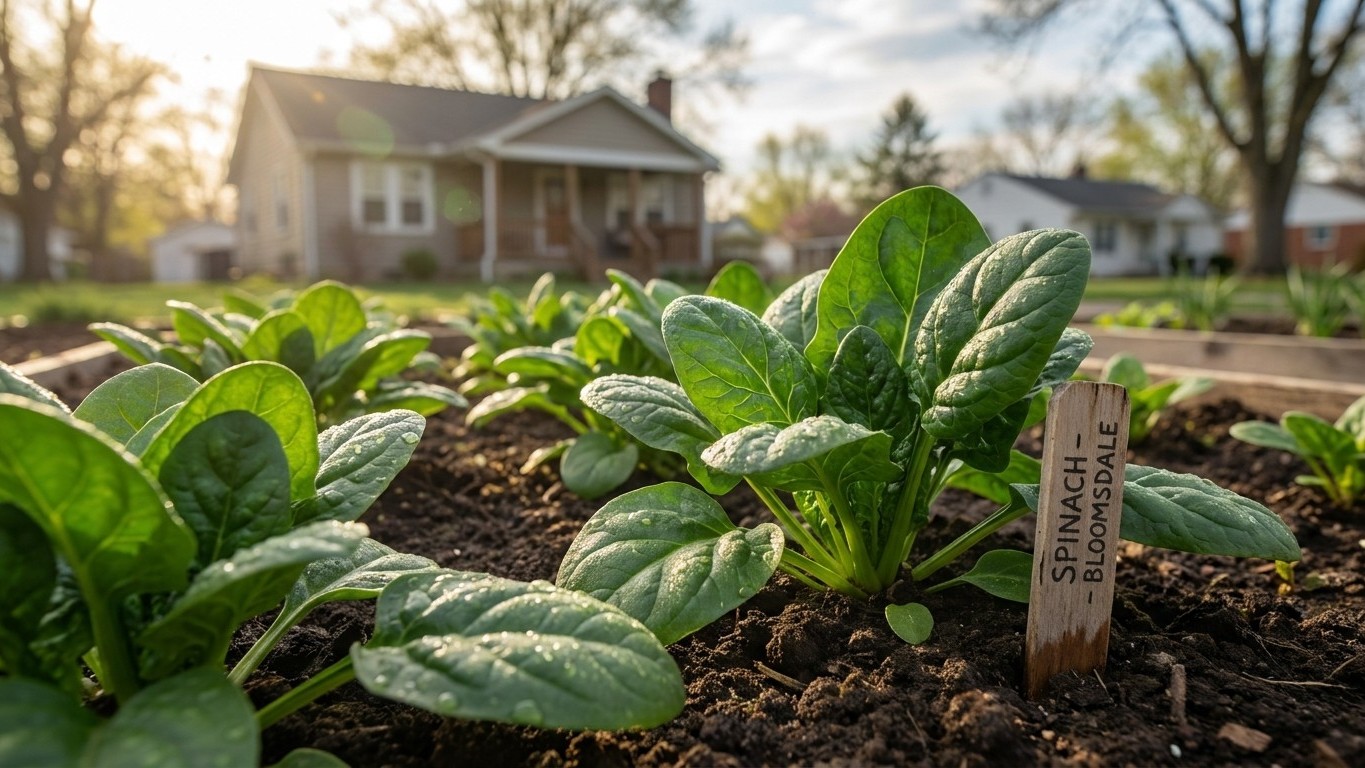

Vermont spinach bolts once the days grow long and stretch toward the solstice, not because of any heat wave. In Burlington, the longest day of the year brings 15 hours and 22 minutes of daylight, plenty to flip the flowering switch even in a cool mountain summer. That leaves two workable windows: early spring, sown weeks before the solstice, and late summer into fall, sown once daylight starts shortening again. Miss both, and the crop runs to seed, which raises the question of Will Spinach Bolt Early in Vermont?
The short answer
Burlington’s longest day delivers 15 hours and 22 minutes of daylight, one of the longer summer day lengths a home gardener anywhere in the Lower 48 will see. For spinach, that number is the whole story before a thermometer even enters the picture. Bolting is triggered by long days as well as by warm temperatures, so the plant doesn’t wait around for a heat wave before it starts running to seed. It reads the calendar through daylight length, and by the time Vermont reaches its solstice, the days are long enough to push nearly any spinach planting toward flower stalks.
That puts Vermont in an unusual spot compared with a hot southern state. In the South, heat is often the crop-ending factor: warm nights and daytime highs well above the 75 F growth ceiling shut spinach down even while the days are still moderate. Vermont carries comparatively little of that heat load. The reference station at Burlington averages only 5.4 days a year at 90 F or hotter, a small slice of a typical summer. Most Vermont summer days sit well below the point where heat alone becomes the problem.
So which factor actually ends the spinach season here, the day length or the heat? Both play a part, but day length arrives first and does most of the damage. Because Burlington’s daylight climbs into long-day territory well before the thermometer produces many 90-degree afternoons, gardeners tend to lose their spring spinach to bolting before summer heat ever becomes the dominant issue. The 75 F ceiling still matters, it’s the point where growth quality drops and leaves turn bitter, but in Vermont that ceiling gets crossed on relatively few days. Day length is the constraint that actually closes the window; heat mostly makes an already-bolting plant taste worse on its way out.
The practical result: a cool Vermont summer does not rescue a spring spinach planting. Growers sometimes assume that because the region isn’t scorching, the crop should hang on longer than it would in Georgia or Texas. It doesn’t, because the trigger isn’t the same one. Long days push the plant toward flower regardless of how mild the air feels. The only real strategy is to work around the daylight calendar itself, harvesting early in spring and shifting the second, larger crop to the shortening days of late summer and fall, with When to Sow Autumn Spinach in Vermont marking the right point to start that second planting.
How long the spring window really is
Utah State University Extension sets a simple sowing rule for spinach: put seed in the ground two to three weeks before the last expected frost. Running that rule against Burlington’s frost data and against the daylight calendar shows just how narrow the spring opportunity really is.
- Start with the frost date. NOAA’s 1991-2020 climate normals put Burlington’s last spring freeze between April 30 and May 10. That date anchors everything that follows.
- Move the sowing date back two to three weeks. That puts seed in the ground sometime in mid-to-late April, depending on how the season is running.
- Count forward to the solstice. From mid-to-late April to the summer solstice, when Burlington’s daylight peaks at 15 hours and 22 minutes, is roughly eight to nine weeks.
- Subtract the bolting margin. Bolting risk climbs steadily as the days lengthen through May and June, well before the solstice itself arrives. In practice, that eight-to-nine-week window shrinks to something closer to six or seven usable weeks of good leaf growth.
- Harvest early rather than late. Because heat load stays low in spring, Burlington sees only 5.4 days a year above 90 F, mostly in midsummer, plants that fail in a Vermont spring almost always bolt from day length rather than heat. Cutting leaves as soon as they’re usable, instead of waiting for a bigger harvest, keeps more of the crop ahead of the flower stalks.
Six or seven weeks isn’t nothing, but it’s tighter than gardeners moving from warmer states often expect. The takeaway is straightforward: get seed in the ground as soon as the soil can be worked in April, and plan to finish harvesting the spring crop before the solstice rather than after it.
The autumn crop, and when the soil lets you sow
The fall planting solves the day-length problem twice over: seed goes in after the solstice, when days are already shortening, and the crop matures as daylight keeps dropping instead of climbing. That removes the trigger that ended the spring crop. What replaces it are two separate obstacles, one at each end of the fall window.
Soil too warm to germinate
Utah State University Extension notes that spinach germination drops once soil temperatures climb above 80 F. Vermont’s air rarely spends long stretches in the 90s, averaging only 5.4 days a year that hot, but soil in a sunny, uncovered bed can still run hotter than the air above it during a July or August hot spell. That means the fall sowing date isn’t simply a date on a calendar, it’s whenever the soil itself has cooled enough for seed to sprout reliably. Waiting for a stretch of milder, cloudier weather in late summer, or shading the bed until temperatures ease, is often what actually opens the window more than any fixed date does.
The frost that ends the season
At the other end, NOAA’s 1991-2020 climate normals put Burlington’s first fall freeze between October 3 and October 13. Utah State University Extension’s guidance for a fall crop is to plant 50 to 75 days before the date you want to harvest. Counting back from an October 3 harvest target lands a sowing date around August 14; counting back from October 13 lands closer to July 25. That puts the realistic fall sowing window somewhere in the second half of July into the middle of August, right in the stretch of summer when soil temperature is the more immediate obstacle.
The source names four spinach varieties without publishing days-to-maturity or heat-tolerance figures for any of them:
- Bloomsdale
- Melody
- Teton
- Olympia
Without maturity data for any of the four, the safest approach is to treat the 50-to-75-day range as the working estimate across the board, and to sow toward the earlier end of the July-August window rather than the later end, giving the crop the fuller 75 days to mature before frost.
Checking this against your own county
Burlington sits on the shore of Lake Champlain, the mildest corner of Vermont. Its frost dates and daylight numbers describe that lake-moderated microclimate specifically, not the state as a whole. Gardeners in the Green Mountains or the Northeast Kingdom work with a substantially shorter frost-free season, since elevation and distance from the lake both push the last spring freeze later and the first fall freeze earlier than what Burlington sees.
The daylight numbers change far less across the state than the frost dates do, since day length depends on latitude rather than terrain. But frost timing is local enough that a planting plan built on Burlington’s dates can run two or three weeks off for a garden in a higher valley. The University of Vermont Extension keeps county-level guidance and can confirm frost timing for a specific location before seed goes in the ground.
Common questions
Does shade cloth stop spinach from bolting in Vermont?
Shade cloth can lower soil and leaf temperature, which helps against the 75 F growth ceiling, but it doesn’t change day length. Since long days are the dominant trigger in Vermont’s relatively mild summers, shade cloth slows bolting rather than preventing it.
Can spinach survive a Vermont fall frost?
The source used for this page provides germination and growth-ceiling data but does not publish a frost-tolerance figure for mature spinach leaves. Treat the first fall freeze, October 3 to October 13 at Burlington, as the planning deadline for harvest rather than assuming the crop pushes past it.
Why do four spinach varieties get named but no data given?
Utah State University Extension lists Bloomsdale, Melody, Teton, and Olympia as spinach varieties without publishing maturity dates, bolt-resistance ratings, or other performance figures for them. Without that data, all four should be planned around the same 50-to-75-day fall window and the same spring sowing rule.
Is Vermont’s summer too cool for spinach to bolt?
No. Bolting is triggered by long days as well as warmth, and Burlington’s 15 hours and 22 minutes of daylight at the solstice is enough on its own. A cool, cloudy Vermont summer still delivers those long days, so the crop bolts on schedule even without a heat wave.