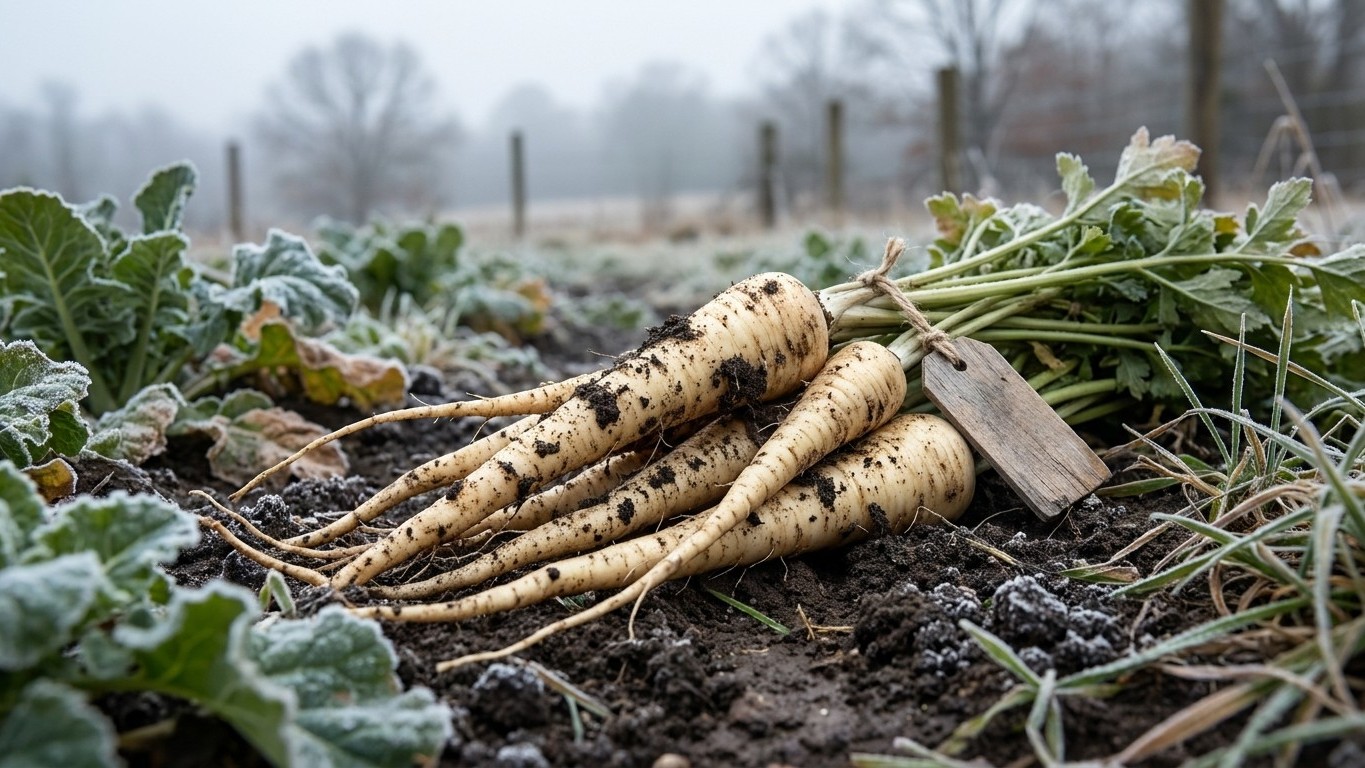

Near the Huntsville reference station, Alabama’s coldest month averages a nightly low of 33.1°F, a hair above freezing, not a sustained plunge below it. That number settles the question for most yards: parsnips here will grow into full-sized roots without trouble, but the sugar-sweetening that gardeners chase depends on repeated hard frost, and a monthly average this close to the freeze line means many nights simply won’t deliver it.
The short answer
Frost exposure and hardiness zone are not the same measurement, and mixing them up is where a lot of garden advice goes wrong. A hardiness zone tells you whether a plant survives winter here at all. It says nothing about how many nights actually dip below freezing, or for how long. The 33.1°F figure is a mean daily minimum for the coldest month, at a station near Huntsville, and it’s built from thirty years of NOAA climate data, not a single hard winter or a single mild one. That’s the number that decides whether parsnips sweeten, because sweetening is a chemical reaction, not a growth stage. Cold temperatures trigger the root to convert stored starch into sugar, and that conversion needs several weeks of frosty exposure, not one overnight dip.
A mean minimum sitting at 33.1°F means roughly half the nights in that coldest month drop below freezing and half don’t. That’s a coin flip on any given night, and it’s a long way from the sustained frosty stretch the crop is built for. In practice, this produces a parsnip that’s fully grown, perfectly edible, and mild rather than the deep, nutty sweetness gardeners in colder climates get used to.
What changes this answer is timing and geography inside the state. In this part of Alabama, the coldest stretch typically falls in January, and a cold snap late in that month, or a run of nights that actually break the 32°F line for a week or two, can still deliver a decent sweetening if the roots are left in the ground through it. Counties at higher elevation, or those farther from the moderating effect of river valleys, will see more nights below freezing than the reference station does. None of that is published in the numbers above, so the honest move is to track your own local lows through the season rather than assume Huntsville’s average applies exactly where you garden. The reference station is a starting point, not a verdict on your particular yard.
Does the season fit?
Parsnips are sown directly in place, never transplanted, and the clock for the whole crop starts the day the seed goes into the ground. Here’s how that timeline lines up against Alabama’s frost calendar, worked out step by step.
- Sowing date: Parsnip seed goes in 2 to 3 weeks before the last spring frost. With the last frost falling between March 19 and April 3 at the reference station, that puts sowing around early to mid-March for most gardens.
- Germination: Parsnip seed is famously slow, taking 14 to 21 days to emerge. A gardener sowing in early March won’t see seedlings until late March at the earliest, and shouldn’t dig up the bed or re-sow just because nothing shows in the first ten days.
- Maturity: Counting 100 to 120 days from that March sowing lands maturity somewhere between early June and mid-July.
- Frost window: The first fall frost at the reference station arrives between November 2 and November 16, months after that June-to-July maturity date.
- The gap: That leaves roughly four to five months between a mature root and the first frost that’s supposed to sweeten it. The days-to-maturity number fits Alabama’s frost-free season with room to spare. The problem isn’t running out of season, it’s the opposite: a long, hot stretch where fully grown roots have to sit in warm ground waiting for cold weather that’s still a season away.
So the arithmetic says the season fits comfortably in terms of raw day count. Where it gets tight is biological, not calendrical: parsnips that mature in June have to survive an Alabama summer in the ground before any frost can touch them, and that’s a different kind of stress than a short growing season.
What goes wrong here
- Forked roots from heavy or stony ground: Parsnips push a single taproot straight down, and any rock, clay clump, or compaction splits it into forks. The remedy is deep, sandy soil worked to at least a foot down; in Alabama’s heavier clay soils, that means double digging the bed before sowing, exactly as Utah State University Extension recommends for any dense ground.
- Forked roots from overwatering: This is a separate cause from soil texture, and it’s easy to confuse the two. Too much water, especially inconsistent heavy watering after dry spells, encourages the root to branch instead of driving straight down. The fix is steady, moderate moisture rather than feast-or-famine watering, particularly through the long summer wait before frost arrives.
- A season that runs out before it should: Sowing late, after the early-to-mid-March window, pushes germination and the following 100-120 days deeper into Alabama’s summer heat. Roots sown too late mature during the hottest weeks of the year, which can toughen them or push them toward bolting. Sow at the front edge of the window rather than the back.
- A winter too mild to sweeten: With the coldest month averaging just 33.1°F, plenty of winters won’t deliver the sustained frosty stretch that converts starch to sugar. The workaround is patience rather than a different technique: leave mature roots in the ground, mulch them against the harshest swings, and harvest after an actual cold snap rather than on a fixed calendar date, since a real frost event does more for sweetness than the calendar month it falls in.
Common questions
Can parsnips survive an Alabama winter left in the ground?
Yes, in most years. A mean minimum of 33.1°F in the coldest month is not a hard freeze deep enough to threaten a root already established in the soil; it’s simply not cold, for long enough, to guarantee sweetening.
Should I harvest parsnips before the first frost in Alabama?
No, if sweetness is the goal. Since the crop matures months before the first fall frost (November 2 to November 16 at the reference station), the better move is to leave roots in the ground and harvest after a cold snap rather than at first maturity.
Why didn’t my parsnips germinate after two weeks?
That’s normal. Germination takes 14 to 21 days, and parsnip seed is notoriously slow and uneven. Digging up the bed or re-sowing before three weeks have passed usually just delays the crop further.
Does soil type matter more than climate for Alabama parsnips?
Both matter, for different failures. Heavy or stony soil causes forked roots regardless of temperature, while the climate, specifically that mild coldest-month average, is what limits sweetening. Deep, sandy, well-drained soil solves the shape problem; only sustained frost solves the sugar problem.