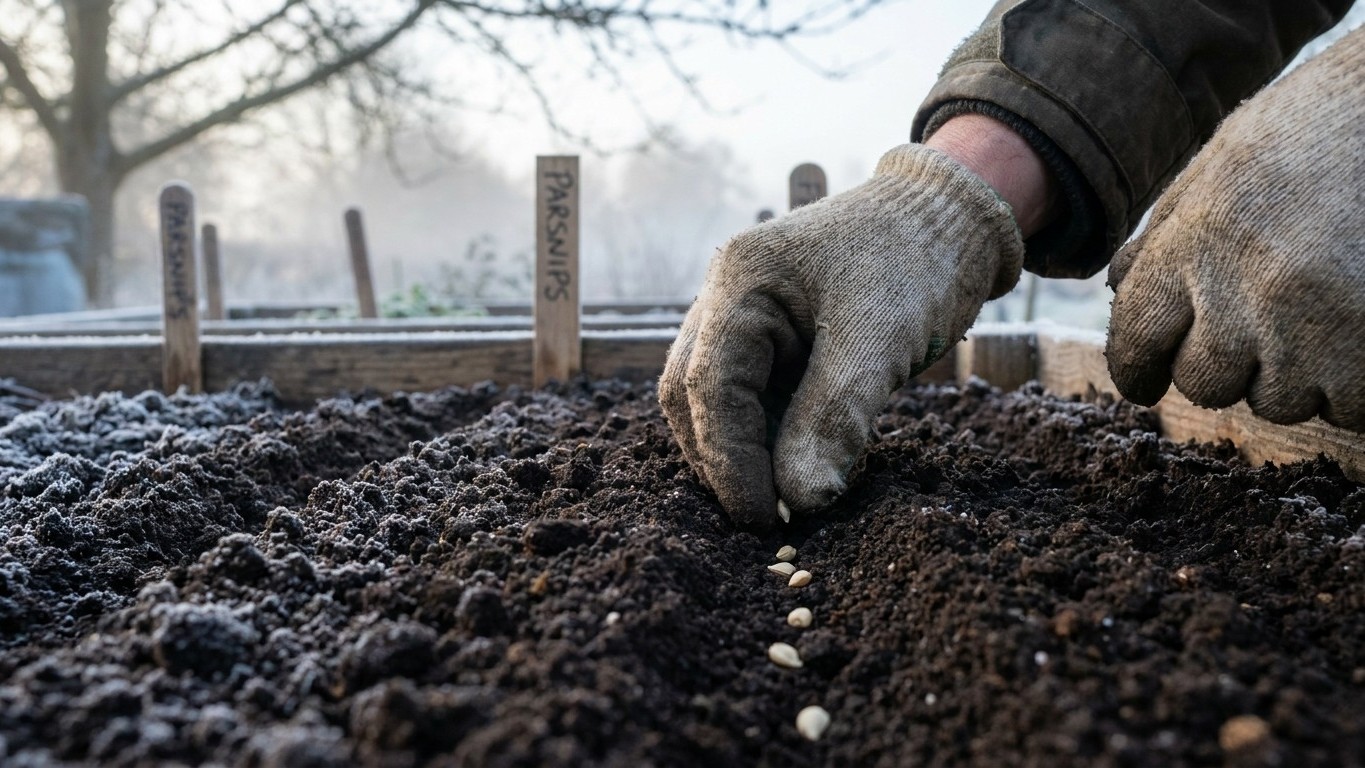

In north Alabama, aim to sow parsnip seed directly in the garden between late February and mid-March, roughly two to three weeks ahead of the last spring frost. Farther south, where frost arrives later and leaves earlier, that window can slide a bit sooner. But the calendar date matters less than what happens after: germination is slow, and the payoff for patience is a root that needs cold to turn sweet.
The short answer
Before picking a sowing date, ask a different question first: does this part of Alabama actually deliver enough sustained cold to make a parsnip worth growing? At the Huntsville reference station, the mean daily minimum temperature during the coldest month sits at 33.1 degrees Fahrenheit, according to NOAA NCEI Climate Normals covering 1991-2020. That figure is not a record low and it’s not a seasonal average. It’s the typical overnight low across the coldest stretch of winter, and it lands right at the edge of freezing.
That number tells a nuanced story. A mean minimum of 33.1 degrees means north Alabama winters routinely dip below freezing on individual nights, sometimes well below, even though the average hovers just above the freeze line. Those recurring cold nights are exactly the kind of frost exposure a parsnip needs, since the crop converts stored starch into sugar only after several weeks of cool, frosty weather. This isn’t about which USDA hardiness zone the garden sits in. A zone rating describes whether perennial roots survive winter underground. Sweetening is a different mechanism entirely: it’s driven by repeated exposure to freezing air temperatures on the leaves and shoulders of the root, and a comfortable zone rating says nothing about whether that exposure actually happens.
For a gardener in the Huntsville area or similarly situated inland counties, the numbers suggest a parsnip grown here will do more than merely grow. It stands a reasonable chance of sweetening, because the region’s winter nights regularly brush up against or drop below freezing for stretches long enough to trigger that starch-to-sugar conversion. The picture shifts closer to the Gulf Coast. Southern Alabama runs milder overall, and while this page’s figures come specifically from the Huntsville station, a coastal or far-south garden should expect fewer nights near freezing and a shorter frosty stretch. In that setting, a parsnip may reach full size just fine but never develop the same depth of sweetness, simply because the frost exposure isn’t there in the same quantity. The practical takeaway: north Alabama gardeners can plan on leaving roots in the ground through several cold snaps with real confidence; those farther south should treat sweetening as a possibility rather than a guarantee, and taste-test a root or two after the first hard cold spell before committing to a full harvest.
Does the season fit?
- Start the clock at seeding, not sprouting. Parsnips are sown directly in place, and the 100 to 120 days to maturity are counted from that seeding date, following two to three weeks before the last spring frost. At the Huntsville station, the last spring frost falls between March 19 and April 3, which puts a typical sowing date somewhere between late February and mid-to-late March, depending on how early or late that frost lands in a given spring.
- Account for slow germination. Parsnip seed is notoriously sluggish, taking 14 to 21 days just to break the surface. A gardener who sows in early March shouldn’t expect to see rows of seedlings until closer to the end of the month, and shouldn’t assume a bare bed means failure and re-sow too soon.
- Run out the 100 to 120 days. Counting from a seeding date in late February through mid-March, maturity lands somewhere between early June and late July. That’s the point at which roots reach usable size, well ahead of any frost at all.
- Compare that against the fall frost window. The first fall frost at the Huntsville station typically arrives between November 2 and November 16. That leaves a gap of roughly four months between a parsnip reaching full size in early summer and the first frost of autumn showing up.
- Read the verdict. The season fits comfortably, with room to spare. Roots finish growing long before any cold weather arrives, which means there’s no pressure to rush a harvest. Instead, the extra months become an asset: leave the mature roots right where they are, undisturbed in the soil, and let the frosty weeks that arrive from October onward do their work converting starch to sugar before digging them up.
Every date here comes from the Huntsville airport weather station. Suburban and rural gardens elsewhere in the state, and especially those in low-lying or inland pockets, often see the last spring frost arrive later and the first fall frost arrive earlier than an airport station records, sometimes by a week or two. Check local frost history for the specific county before locking in a sowing date.
What goes wrong here
- Forked roots from heavy or stony ground. Parsnips push a single taproot straight down, and anything that blocks that path, whether compacted clay, buried rocks, or a hardpan a few inches under the surface, forces the root to split around the obstruction. The remedy is working the bed to a full spade’s depth before sowing, or double digging heavy soil so the root has clear passage. Deep, loose, sandy soil is the crop’s natural preference.
- Forked roots from overwatering. This is a separate cause from soil texture, and it’s easy to mistake for the same problem. Waterlogged soil encourages the root to branch as it searches for oxygen, even in soil that’s otherwise loose enough. Water deeply but less frequently, and let the top inch or two dry between waterings once seedlings are established.
- A season that runs out before maturity. This is rarely the issue in Alabama, given how much daylight separates the last spring frost from the first fall frost. It becomes a risk only if sowing is delayed well past mid-spring, pushing the 100 to 120 day window uncomfortably close to the first fall frost date. Sowing within the standard two to three weeks before the last frost avoids this entirely.
- A winter too mild to sweeten. In the milder stretches of the state, particularly toward the Gulf Coast, a parsnip can reach perfect size and still taste flat, because the frost exposure that converts starch to sugar never arrives in sufficient quantity. There’s no soil fix for this since it’s a climate limitation, not a growing mistake. The workaround is patience: leave roots in the ground as long as possible into winter, harvesting only after the coldest nights of the season have passed through, and taste-testing before assuming the crop is a loss.
Common questions
Can parsnips be transplanted instead of direct-sown?
No. Parsnips develop a long taproot that doesn’t tolerate disturbance well, which is why they’re sown directly in place rather than started indoors and moved later.
Why hasn’t anything sprouted three weeks after sowing?
That’s within the normal range. Parsnip seed takes 14 to 21 days to germinate, noticeably slower than most garden vegetables, so a bare-looking bed at two weeks isn’t a sign of failure.
Should the soil be amended before sowing parsnips?
Deep, loose, sandy soil suits the crop best. Heavy ground should be double dug to loosen it well below where the taproot will travel, since compacted or rocky soil is one of the two main causes of forked roots.
Is it better to sow later so the roots mature closer to frost?
Not necessarily. Following the standard sowing window, two to three weeks before the last spring frost, still leaves months of slack before the first fall frost in most of Alabama. The roots mature early and simply wait in the ground until the frosty weeks of autumn arrive, rather than being timed to finish exactly at frost.