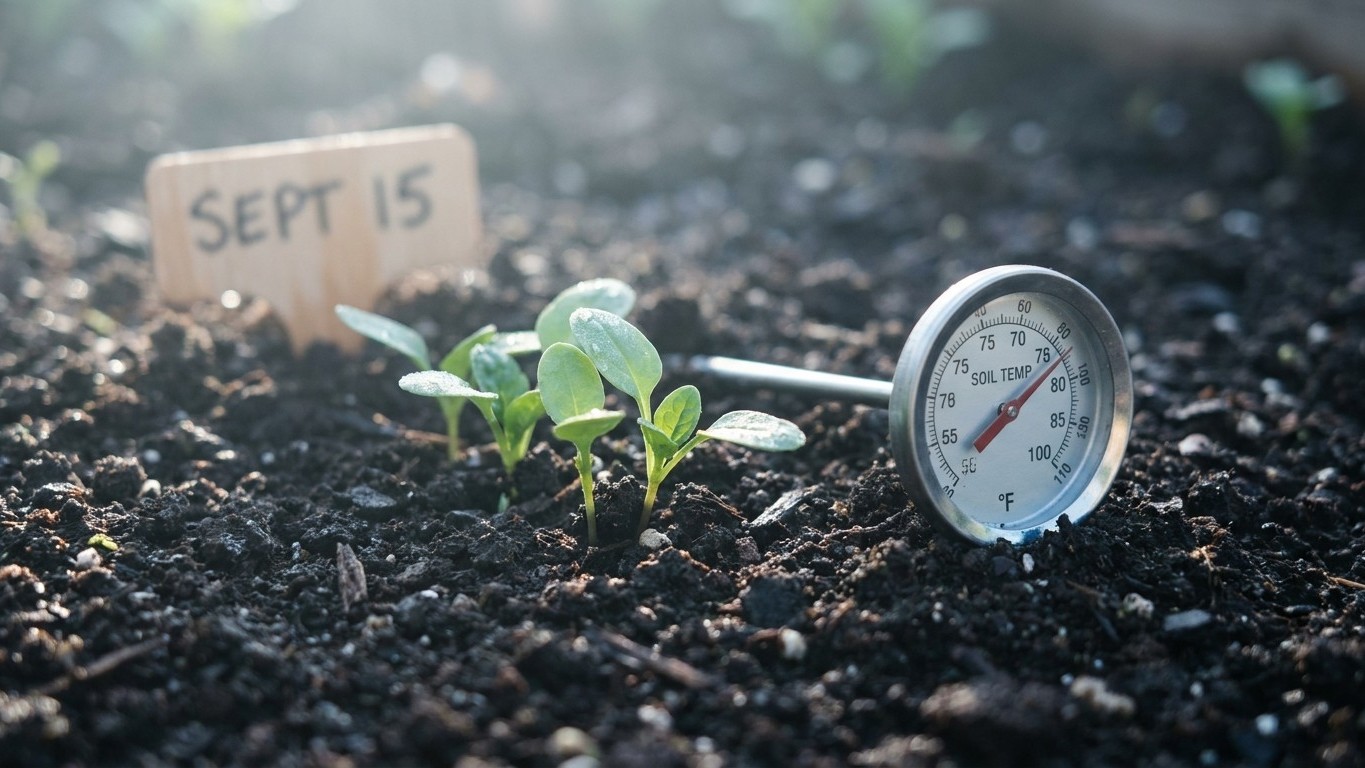

In Anchorage, autumn spinach goes into the ground roughly between July 9 and August 3, counting back 50 to 75 days from a harvest target just ahead of the first fall frost. That frost typically arrives between September 22 and October 1. The bigger surprise: unlike hotter states, Alaska’s cool summers mean the soil rarely gets too warm to sow early, so the real deadline here is frost, not heat.
The short answer
Start with the number that runs the whole calendar here: on the longest day of the year, Anchorage sees 18 hours and 56 minutes of daylight. That’s not a bonus for spinach. Long days trigger bolting in spinach just as reliably as heat does, and a day that stretches almost to 19 hours pushes any spring-sown crop toward flowering fast, regardless of how mild the air feels. A cool Alaska summer does not buy extra weeks of leaf growth when the days themselves are the problem.
That’s the piece worth sitting with. Gardeners in warmer states sometimes assume Alaska’s famously mild summer temperatures should let spinach linger longer before it bolts. It doesn’t work that way. Spinach responds to day length as much as to warmth, and Anchorage’s daylight climbs toward its nearly 19-hour peak faster, in relative terms, than it does at lower latitudes. The plant doesn’t care that the thermometer stayed friendly. It cares that the sun barely set.
Now look at the other side of the equation. Anchorage averages 0.0 days a year at 90 F or above. Zero. There’s essentially no heat load here at all during a typical summer. Spinach grows best below 75 F and starts losing quality, turning bitter, above that mark. In most of the Lower 48, that 75 F ceiling gets blown past for weeks at a stretch every summer. In Anchorage, it barely gets tested.
Put those two facts side by side and the answer to “what limits spinach here” becomes clear: it’s day length, not heat. The spring crop bolts because the days get too long, not because the air gets too hot. The autumn crop, as the next sections show, is limited mainly by the calendar running out before frost, with soil temperature barely entering the picture. That’s a different failure mode than a gardener in Texas or Arizona deals with, where scorching soil and blistering afternoons are the enemy. In Anchorage, the sun itself, simply by staying up so long, does the work that heat does elsewhere.
This matters for how you plan both plantings. Spring spinach in Anchorage has a narrow, daylight-driven window that closes well before the solstice’s peak. Fall spinach avoids that long-day problem entirely, since day length is shrinking through late summer and into fall, but it runs straight into a hard stop: the first freeze.
How long the spring window really is
Working out the usable spring stretch here means lining up three things: the frost date, the sowing rule, and the point where lengthening days start pushing the plant toward flowering.
- Start with the frost date. NOAA’s 1991-2020 climate normals put Anchorage’s last spring freeze between May 3 and May 12, based on station USW00026451.
- Apply the sowing rule. Spinach goes into the ground 2 to 3 weeks before that last frost date, which lands the sowing window in the second half of April, roughly April 12 through April 28, depending on how the season is running and how workable the soil is that year.
- Track the daylight climb. From that April sowing date forward, Anchorage’s daylight lengthens quickly on its way to the June solstice’s 18 hours and 56 minutes. Spinach doesn’t wait for the solstice itself to bolt; the trigger builds as days keep stretching through May and into June.
- Estimate the harvest window. That leaves somewhere around 6 to 8 weeks of good leaf growth between an April sowing and the point where the still-lengthening days push the crop to flower, likely sometime before the solstice’s peak daylight is even reached.
Compare that to what would happen if Anchorage’s summers were also hot: there’d be no relief at either end, heat pushing bitterness from below while long days pushed bolting from above. Instead, with 0.0 days above 90 F on the books, the temperature side of that squeeze barely exists. The spring window here closes because of the sun’s angle, full stop, not because the thermometer climbs.
The autumn crop, and when the soil lets you sow
Fall spinach faces a completely different set of obstacles than the spring planting, and in Anchorage’s case, one of the usual two barely applies.
Soil that’s too warm to germinate
Spinach seed germination drops once soil temperature climbs above 80 F, according to Utah State University Extension. That’s the wall that stalls late-summer sowing across much of the country, where soil holds onto midsummer heat well into August. Anchorage is a different case. With an average of 0.0 days a year reaching 90 F, the soil here has little chance to bank the kind of heat that pushes it past 80 F in the first place. That doesn’t mean the soil is cold enough for ideal germination the moment you want to sow in July, but it does mean this particular barrier, the one that forces gardeners in warmer states to wait for a heat wave to break, is a much smaller factor in Alaska’s growing season.
The frost that ends the season
The frost side of the equation matters far more here. Anchorage’s first fall frost lands between September 22 and October 1, per the same NOAA climate normals. Utah State University Extension’s guidance for fall spinach is to sow 50 to 75 days before the date you want to harvest. Working back from September 22, the earlier and safer end of that frost range, gives a sowing window of roughly July 9 to August 3. Push the harvest target toward the later end of the frost range, October 1, and the window shifts to about July 18 through August 12, though that leaves less margin if frost arrives early.
Four spinach varieties commonly come up in fall-planting discussions: Bloomsdale, Melody, Teton, and Olympia. Utah State University Extension names these but doesn’t publish days-to-maturity figures or other performance data for any of them, so there’s no verified number here to lean on for choosing between them. What the source does confirm is the 50-to-75-day sowing rule that applies regardless of variety chosen.
Common questions
Does Alaska’s mild summer let spinach grow longer before it bolts?
No. Bolting is triggered by long days as much as by heat, and Anchorage’s daylight climbs to 18 hours and 56 minutes at the solstice. That day-length trigger arrives whether or not the air ever gets hot, which is why the spring window closes on schedule even in a cool year.
Why isn’t hot soil a problem for fall sowing in Anchorage?
Germination drops once soil passes 80 F, but Anchorage averages 0.0 days a year at 90 F or hotter. Without that kind of heat load, the soil rarely banks enough warmth to cross the 80 F threshold the way it does in warmer states, so frost timing, not soil heat, is what limits the fall sowing window here.
How many weeks of spring spinach can I realistically expect?
Roughly 6 to 8 weeks, running from an April sowing (2 to 3 weeks ahead of the May 3-12 last frost) to the point where lengthening days push the crop toward flowering, sometime before the June solstice’s daylight peak.
Which spinach variety should I choose for a fall crop in Anchorage?
Utah State University Extension names Bloomsdale, Melody, Teton, and Olympia as options for fall planting but does not publish maturity length or performance data for any of them, so there’s no sourced way to rank them against each other here.