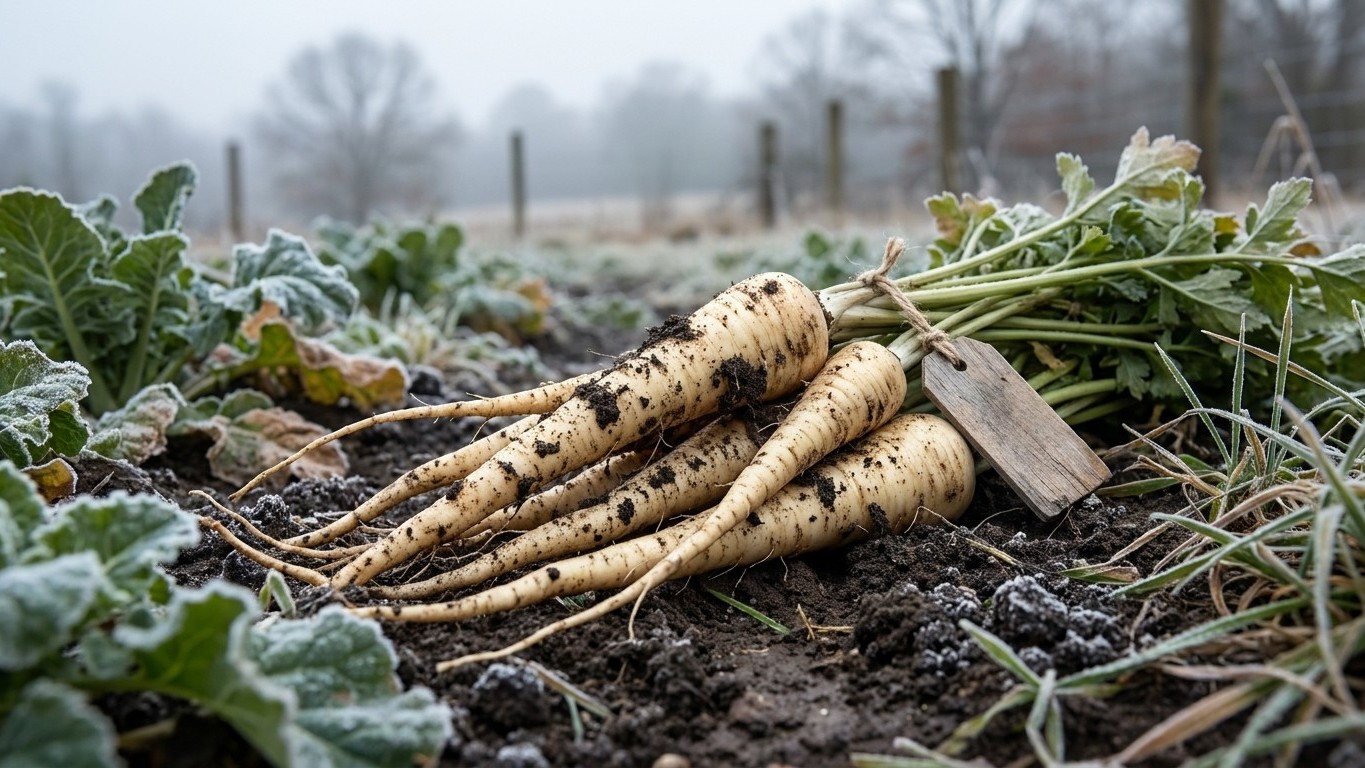

For most of coastal British Columbia, the honest answer leans toward growing rather than sweetening. The reference climate data for this province, drawn from Vancouver International Airport, shows a coldest month that barely dips below freezing on an average night. Parsnips sown here mature comfortably within the region’s long frost-free window. Whether the roots turn genuinely sweet depends on a kind of sustained cold this particular coastal climate rarely delivers with much conviction.
The short answer
What the 33.5°F figure actually measures
Does British Columbia deliver several frosty weeks in the depths of winter? For the coastal station behind Environment and Climate Change Canada’s normals, Vancouver International Airport, the mean daily minimum of the coldest month comes in at 33.5°F. That’s not a record low, and it’s not a monthly average either. It’s the average low every single night sees across the four coldest weeks of the year, and 33.5°F sits barely below freezing.
That number reshapes how a gardener should think about parsnips grown near this station. A mean nightly low that close to 32°F means plenty of nights in the coldest month never touch freezing at all, while others slip just under it. That’s a pattern of frequent light chill, not sustained hard frost. Parsnips don’t need a brutal winter to sweeten, but they do need repeated, genuine cold, the kind that forces the root to turn stored starch into sugar over several consecutive weeks. A coastal winter that hovers around the freezing mark, some nights above and some just under, doesn’t reliably supply that.
Growth is a separate question, and there the outlook improves. Nothing about this climate stops a parsnip from germinating, sending down a long taproot, and reaching full size well ahead of winter, as the season math further down shows. The frost-free window is wide and the crop finishes without trouble. A fine parsnip from coastal British Columbia? Very likely. A candy-sweet one, built on a hard freeze? That’s the harder promise to keep.
Why one station can’t speak for the whole province
British Columbia runs from mild Pacific shoreline all the way to interior valleys and northern plateaus where real winters, sustained hard frost included, show up on schedule every year. A gardener in the Okanagan or in the province’s northern interior is almost certainly working with a colder, more frost-reliable pocket than this coastal figure describes. No mean coldest-month minimum for those interior stations appears in the data behind this article, so nothing further can be said about them here. If your garden sits close to the coast, in the same mild belt as Vancouver, expect a parsnip that grows well and sweetens only marginally. If you’re gardening well inland, your own local frost record, not this coastal number, decides the outcome.
Does the season fit?
The sowing-to-harvest math
Parsnips are sown directly into the ground where they’ll finish growing, never started indoors and transplanted, because a disturbed taproot tends to fork. Here’s how the calendar plays out against this territory’s frost dates.
- Sow directly in place 2 to 3 weeks before the mean last spring frost of March 18, which puts the sowing date somewhere between February 25 and March 4.
- Germination is slow: allow 14 to 21 days before seedlings appear, meaning true leaves won’t show until mid to late March. Resist the urge to dig up the bed and re-sow if nothing seems to be happening.
- From that sowing date, count 100 to 120 days to reach full root size, which lands maturity somewhere between the first week of June and the first week of July.
- The mean first fall frost doesn’t land until November 10, leaving roughly four to five months of open season after the roots are already mature and ready to eat.
- These are mean dates, not guarantees. In half of all years the last spring frost falls later than March 18, and the first fall frost falls later than November 10 as well, so the margin described above should be read as typical, not fixed.
What the mean dates leave out
Put the arithmetic together and this territory’s season fits comfortably, with room to spare. Even a sowing a couple of weeks late, or a germination stretch that runs the full 21 days, still leaves months of frost-free time before the roots need to come out of the ground. That slack matters for a different reason too: it means there’s no rush to harvest the moment the roots reach size in early summer. A gardener can leave parsnips in place well into fall, catching whatever cold the season brings before digging, which is exactly the exposure the crop needs to attempt any sweetening at all.
What goes wrong here
Root and soil failures
- Forked roots from heavy or stony ground: a taproot that hits a rock, a clay lens, or compacted subsoil splits around the obstruction instead of growing straight down. The remedy, per Utah State University Extension, is deep sandy soil where possible, or double digging heavy ground before sowing so the root has nothing to fight against.
- Forked roots from overwatering: this is a separate cause from soil texture, and it’s easy to mix the two up. Soil that swings between soggy and dry pushes the root to branch as it searches for steadier moisture. The remedy is even, moderate watering rather than heavy soakings followed by dry stretches.
Timing and climate failures
- A season that runs out before the roots finish: unlikely given how much slack this territory’s frost window offers, but sowing weeks late, past the 2-to-3-week window before the last frost, erodes that margin fast. The remedy is simple: sow on schedule rather than waiting for soil that “feels” ready.
- A winter too mild to sweeten: given a coastal coldest-month mean minimum of 33.5°F, hovering right at freezing, this is the failure that has nothing to do with technique. The remedy isn’t a fix so much as a management choice: leave roots in the ground through whatever cold the fall and early winter actually bring, and judge harvest by the weather itself rather than the calendar, since sweetening comes from exposure to frost and no amount of soil prep changes that.
Common questions
Can parsnips overwinter in the ground in coastal British Columbia?
The mild coldest-month figure for this territory suggests roots should survive fine physically, since deep freezes aren’t the norm near the coast. Whether the flavor improves the way Utah State University Extension describes, through several weeks of cool, frosty weather converting starch to sugar, depends on cold this coastal climate delivers inconsistently.
What soil works best for parsnips here?
Deep, sandy soil is the ideal starting point, according to Utah State University Extension. Heavy ground isn’t disqualifying, but it needs to be double dug before sowing so the long taproot can grow straight instead of forking around obstructions.
Should I start parsnip seed indoors and transplant it?
No. Parsnips are sown directly where they’ll grow to full size. Transplanting disturbs the developing taproot and tends to produce the same forking problem that heavy soil causes.
How long after the first fall frost should parsnips be harvested?
No specific number of weeks is published for this territory. What is documented is that the crop needs several weeks of cool, frosty conditions for the sweetening process to take effect, so a single light frost right around the November 10 mean date isn’t enough on its own.