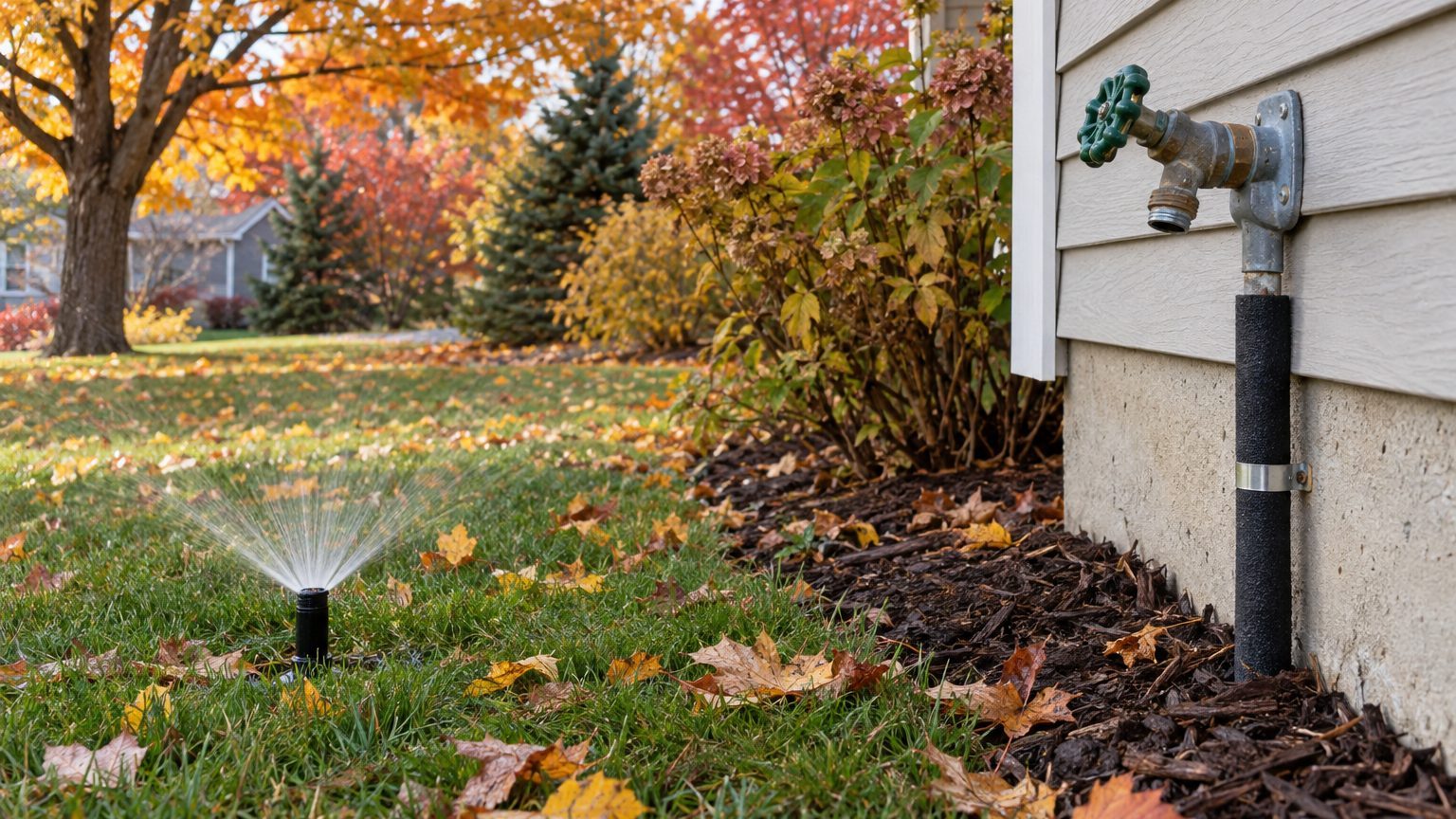

Winterize before the first hard freeze. On the south coast of British Columbia that means the second half of fall, and for many homes a full compressed-air blowout is more than the job needs. A short round of draining, disconnecting and covering does most of the work. Inland, in the north and at higher elevations, frost arrives earlier and the job gets bigger. Below: how to read the calendar, how to handle sprinkler lines, taps and hoses, and which failures this climate makes likely.
When to do it in British Columbia
Plan to winterize between mid-October and early November, before the first hard freeze, not after the first light one. That window sits ahead of November 10, the average first fall frost at the Vancouver International Airport station, according to Environment and Climate Change Canada’s Canadian Climate Normals for 1981 to 2010.
Treat November 10 as the midpoint of a window and never as a safe date. It is an average, so in one year out of two the first frost lands earlier. A light frost that whitens the lawn at dawn rarely hurts anything. A hard freeze, where the air stays below freezing for hours, is what splits exposed pipe and cracks valve bodies. By the time you see the first one, the second may be a few nights away.
Does a mild coastal winter mean you can skip winterizing?
Not entirely, though it shrinks the job. In the same Environment and Climate Change Canada normals, the mean daily minimum of the coldest month at Vancouver is 0.8 °C, just above freezing. The typical coastal night in January stays above the line, so a full blowout is often unnecessary where the ground rarely freezes at the depth of buried lines. Averages hide cold snaps, though, and the parts that sit above ground are the ones that suffer. A few chores earn their keep:
- Disconnect hoses, splitters and timers from every outdoor tap.
- Close the interior shutoff to each outdoor tap and open the outside tap to drain.
- Drain the irrigation system using the method described below.
- Wrap or cover exposed pipe and any above-ground backflow assembly on the irrigation supply.
When the forecast shows overnight lows heading toward freezing, finish the list that same day. Waiting for the second cold night is how a mild-climate household ends up with a burst fitting.
What changes inland, in the north or on higher ground?
A province is not one climate, and the Vancouver station is only one reading. Colder districts, farther north or higher up, run weeks behind it in the other direction: their first fall frost comes earlier, so the whole window moves earlier too. Where the ground freezes through winter, draining or blowing out the system is standard practice, not an optional extra. Your regional district, municipal utility or a local irrigation installer can tell you the usual timing for your valley. Timing for other parts of the province appears in the British Columbia guides.
Natural Resources Canada places Vancouver in Canadian plant hardiness zone 9a, using 1991-2020 normals. That is a Canadian zone, built on seven climate variables, and it does not convert to a USDA zone. It describes the reference city only, so use it as a coastal benchmark and nothing more.
Sprinkler lines: drain or blow out
Water left in pipes, valves and sprinkler heads turns to ice during a hard freeze, and ice takes up more room than water. The expanding ice presses on the walls of the pipe, the threads of fittings and the bodies of valves. Plastic pipe cracks, fittings split and valves fail. You won’t see any of it in winter, because the ice plugs the leak. The damage shows when the system is pressurized in spring.
The worst spots are the low points of each zone, the valve manifold and the backflow assembly. Water settles in the low points and the manifold holds a lot of it. The backflow assembly usually sits above ground, fully exposed to the air.
What is the difference between manual drain, automatic drain and a compressed-air blowout?
All three aim to empty the system. They differ in how much they trust gravity.
| Method | How it works | Best suited to | Watch for |
|---|---|---|---|
| Manual drain | You open drain valves at the low points of the mainline and zones, and gravity empties the pipe. | Systems built with drain valves, on yards with some slope. | Sags in the line that never drain, and valves left in the wrong position. |
| Automatic drain | Valves open on their own when line pressure drops and let water escape. | Mild winters and shallow lines. | Grit that keeps a valve stuck, and heads in low spots that still hold water. |
| Compressed-air blowout | Air is pushed through each zone in turn and forces water out of the heads. | Colder districts, long flat runs and systems without drain valves. | Too much air pressure can damage pipe and heads; stay clear of the heads. |
For the mild south coast, a manual or automatic drain plus protection for the exposed parts is usually enough, since freezing at line depth is uncommon. Colder inland and upland districts call for a blowout. So does any system without drain valves, because a blowout is the only dependable way to empty it. In every case, shut off the water supply to the system first. Drain the system in the mid-October to early November window, and blow it out where winters regularly freeze the ground.
When is a professional the sensible choice?
A blowout needs a compressor with a regulator, and the pressure has to stay within what the pipe and heads can take. The technician also works zone by zone in a set order, so no zone gets air forced against closed valves. Too much pressure can burst a line or send a head flying, which is why a homeowner with a borrowed compressor is taking a real risk.
Call a professional if your system has no drain valves, if you cannot find the shutoff or backflow assembly, or if you are unsure which zones drain by gravity. Backflow devices on irrigation supply lines are often regulated, so check with your water utility before touching one. Once the lines are dry, the rest of the fall yard routine, covered in Winterizing a Lawn, can follow at its own pace.
Outdoor faucets and hoses
The outdoor tap is the simplest job and the one most often skipped. A hose left on holds water against the faucet, and that water freezes first. The steps need nothing beyond turning valves and unscrewing hoses:
- Unscrew every hose, splitter, timer and sprayer from the tap.
- Find the interior shutoff valve that feeds the outdoor tap, often in a basement, crawlspace or utility room, and close it.
- Open the outside tap fully so the line drains, and leave it open for the season.
- Drain each hose, coil it and store it indoors or under cover.
Do all of this in the same window as the sprinklers. For a closer walk through a single tap, see Winterizing Outdoor Faucets Before the First Freeze. Some homes have no interior shutoff for the outdoor tap, and fitting one is a plumber’s job. So is cutting, replacing or re-angling any pipe or tap. Stop at the valves and call a licensed plumber for anything more.
Why does a frost-free faucet still fail with a hose attached?
A frost-free outdoor tap has a long stem. The valve seat sits deep inside the warm side of the wall, and the barrel is meant to drain outward when the tap is shut. That design depends on the barrel emptying through the spout. With a hose or a cap attached, water stays trapped in the barrel, and a cold night freezes it inside the pipe. A split pipe inside a wall may not show until spring, when you open the tap and water sprays into the cavity.
The barrel also needs a slight downward tilt toward the spout to drain. If a tap was installed level or tilted back, water sits in it no matter what you do. You can’t fix that with a wrench and a free afternoon, and it is another job for a plumber. Take the hoses off and close the interior valve in the weeks before early November, even if the tap is the frost-free kind and the forecast looks mild.
What goes wrong here
On the coast, winter damage tends to come from timing and oversight, not from deep cold. The three failures below are the ones this climate makes likely.
What happens when a cold snap arrives before anyone has drained?
Because the first frost lands before November 10 in about half of years, an early cold snap can beat a household that planned to do the work in mid-November. In spring it shows up as a sprinkler head that geysers, a zone that never builds pressure, or a wet patch of lawn over a split line. Prevention is a matter of choosing a date at the start of the window and watching the forecast, with the jobs done in an afternoon.
What does a forgotten hose leave behind?
A hose left on holds water and keeps the tap from draining. The result is a cracked tap or a pipe split inside the wall. It shows when the water comes back on: a spray from the wall, a drip inside the house, or a stain on the ceiling below. Walk the yard with the checklist and put each hose away.
How does a valve box flood or freeze?
Irrigation valve boxes sit below ground, and in a wet coastal fall they collect rain and groundwater. Valves sitting in standing water can crack in a cold snap. Lift the lid on a dry day and look. If there is water, bail it out and clear any debris blocking drainage. Check the valve boxes by early November and keep clear of the wiring and fittings inside. If a pipe does freeze in spite of your efforts, see Frozen Pipes for how to thaw it safely, and call a plumber at the first sign of a leak.
Common questions
Can I wait for the first frost warning before winterizing?
That leaves little margin. The average first fall frost at the Vancouver International Airport station is November 10, which means half of years bring it sooner. Finish the work earlier in the window, between mid-October and early November, and keep an eye on the forecast. Colder districts should start earlier still.
Do I need a compressed-air blowout on the south coast?
Often not. The coldest month’s mean daily minimum there is 0.8 °C, so buried lines rarely freeze. A drain plus protection for exposed parts usually covers it. A blowout makes sense if your system has no drain valves or you live in a colder district.
Do I still need to disconnect hoses if I have a frost-free tap?
Yes. A hose or cap holds water inside the tap’s barrel, and that water can freeze and split the pipe inside the wall. Disconnect every hose, close the interior valve if there is one, and leave the outside tap open.
When can I turn the sprinklers back on in spring?
Wait until nights are reliably above freezing. On the coast that usually comes earlier than inland. In colder valleys and at higher elevations, spring frost lingers later, so start up later there.