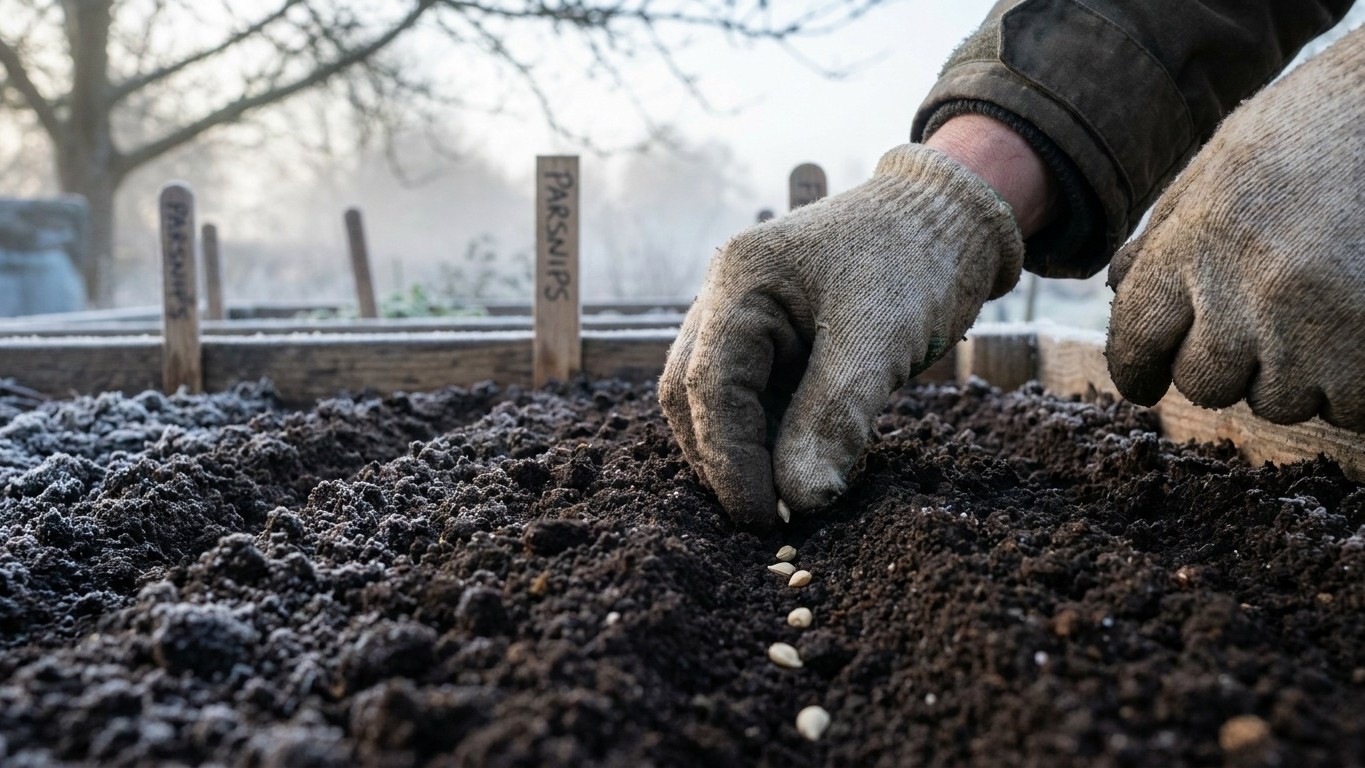

Sow parsnip seed directly outdoors from late February through mid-March, two to three weeks before the region’s average last spring frost of March 18, using the Vancouver climate station as the reference point for coastal British Columbia. The 100- to 120-day season fits with room to spare against a frost-free window that runs to November 10, but the coldest month’s mild average minimum means this crop is far more reliable to grow here than it is to sweeten.
The short answer
Does this stretch of the coast deliver several frosty weeks in a row, the kind a parsnip root needs to turn stored starch into sugar? That’s the real question, and it’s a different one from asking whether the plant will survive here at all. At the Vancouver reference station, the mean daily minimum for the coldest month sits at 33.5°F, according to Environment and Climate Change Canada’s 1981-2010 Canadian Climate Normals. That number sits almost exactly on the freezing line, not well below it.
A coldest-month average that close to 32°F tells you something specific: on a typical night during the deepest part of winter here, the temperature hovers right around freezing rather than dropping into a sustained hard freeze. Frost still happens, and the first fall frost lands around November 10 on average, but the exposure is intermittent and mild rather than the weeks-long cold snap that a colder inland or northern BC valley would deliver. That distinction matters more than any hardiness-zone rating, because zone maps describe whether a plant survives the winter, not whether frost actually reaches the root long enough to convert starch to sugar.
The practical answer for a coastal BC garden: parsnips grown here will size up into a fine, usable root without much trouble. The soil warms early enough, and the frost-free season runs long. But if the goal is that classic sweet, nutty parsnip flavor that shows up after a real cold snap, this climate delivers a lighter version of it. Leaving roots in the ground through several frost events after early November is still worth doing, since some sweetening will occur, but gardeners chasing the most pronounced sugar conversion should know that colder interior pockets of the province, where winter minimums drop well below freezing for extended stretches, will outperform the coast on that one measure even if the coast wins on season length and ease of growing.
Does the season fit?
Lay the numbers side by side and the arithmetic favors the coast, with plenty of margin built in.
- The average last spring frost at the Vancouver reference station falls on March 18. Sowing two to three weeks ahead of that date puts seed in the ground from roughly February 25 to March 4, right into cool, still-recovering soil.
- Parsnip seed germinates slowly, taking 14 to 21 days even under decent conditions, according to Utah State University Extension. Seedlings from an early-sowing won’t break the surface until mid to late March, and there’s no need to panic and re-sow if nothing shows in the first week or two.
- The 100- to 120-day maturity clock starts at seeding, not at germination and not from transplant, because parsnips are grown in place from the start. Counting forward from a late-February sowing puts full maturity somewhere between early June and early July.
- The average first fall frost lands on November 10. Measuring from the March 18 mean last frost to that date gives a frost-free window of roughly 237 days, well over double what a 120-day parsnip crop actually needs.
- That gap means the season doesn’t just fit, it fits with slack to spare. Roots that mature by early summer can simply stay in the ground, doing nothing more than sitting and thickening, until the first frosts of autumn arrive to start the sweetening process described above.
The one caution built into both mean dates: these are averages, not guarantees. In roughly half of all years, the last spring frost arrives later than March 18, and the first fall frost arrives later than November 10 as well. Neither date should be treated as a safe cutoff, only as the midpoint of a window that shifts year to year.
What goes wrong here
- Forked or split roots from heavy, stony coastal soil. Many BC coastal gardens sit on dense clay or compacted, rocky ground left behind by old fill or construction. Parsnip roots need loose, deep soil to grow straight, and forked roots are the classic result when a taproot hits resistance. Utah State University Extension recommends deep, sandy soil for parsnips, and says heavy ground has to be double dug to loosen it before sowing.
- Forked roots from overwatering, a separate and distinct cause from soil texture. Even in decent loam, keeping the bed consistently soggy encourages the root to split or branch. This is not a soil problem at all, it’s a watering habit, and the fix is simply pulling back to steady, moderate moisture rather than frequent heavy soaking.
- A season that runs out, mostly a risk for gardeners who delay sowing. Coastal BC has enormous slack in its frost-free window, but that margin disappears if seed goes in weeks late, especially at higher elevation or in the province’s colder interior valleys where the frost-free period is much shorter. Sowing promptly at the two-to-three-week-before-last-frost mark protects that margin.
- A winter too mild to deliver real sweetness. With a coldest-month average minimum sitting right at freezing, roots left in the ground get frost exposure, but not the sustained, deep cold that produces the most pronounced sugar conversion. The only real remedy within this climate is patience: leave roots in place through as many frost events as the fall and early winter offer, rather than harvesting the moment they reach full size.
Common questions
Do parsnips need to be started indoors in British Columbia?
No. Parsnips are sown directly in the garden bed where they’ll grow, because the long taproot doesn’t transplant well. Starting seed indoors and moving seedlings later typically damages or forks the root before it ever gets going.
How long does it take parsnip seed to germinate in BC’s cool spring soil?
Expect 14 to 21 days, per Utah State University Extension. Cool early-spring soil can push germination toward the slower end of that range, so bare-looking soil after a week or ten days is normal, not a sign of failure.
Should parsnips be harvested before or after the first frost in BC?
After. The sweetening that parsnips are known for comes from exposure to frost, which converts stored starch into sugar. Pulling roots as soon as they reach full size, before any frost has touched them, skips that conversion entirely.
Does this sowing timing apply across all of British Columbia?
Not evenly. These dates and figures come from the Vancouver reference station, and the province is not one climate. Interior valleys, northern districts, and higher elevations run frost dates weeks behind the coast and often see a colder, more sustained winter, which shortens the growing season but can improve the sweetening a colder pocket delivers.