
In coastal Connecticut, aim to have your pumpkin vines flowering by early-to-mid September, and sow seed once your soil has warmed to 65°F, typically well after the last spring frost. Because the first fall frost can arrive as early as October 28 in cooler pockets of the state, working backward from that date is what actually sets your sowing window, not the calendar page.
The short answer
Connecticut’s first fall frost lands somewhere between October 28 and November 10, depending on where you garden. That’s a wide window, and it matters which end of it you plan around. A pumpkin needs 45 to 55 days from the moment its flower opens to reach a ripe, hardened fruit. Not from the day you drop seed in the ground. From flowering. That distinction is the whole calculation.
Run the math from the early end of the frost window first, since that’s the safer assumption for anyone gardening away from the immediate shoreline. If frost hits October 28, a flower needs to open no later than somewhere between September 3 and September 13 to have enough time to finish. Push the frost date to November 10, the mild end of the range, and that flowering deadline slides out to between September 16 and September 26.
So the honest answer isn’t a single date. It’s a window: for most of Connecticut, pumpkin flowers should be opening sometime between the first week of September and the last week of September, depending on how close you are to the Sound and how much frost risk you’re willing to accept. Gardeners near the coast, where the milder end of the frost range applies, get more breathing room. Gardeners inland and in the northwest hills, where cold settles in earlier and lingers longer in spring, should plan around the tighter end of that window and treat late September flowers as a gamble rather than a plan.
This is also why “days to maturity” printed on a seed packet can mislead a Connecticut gardener who reads it as days from sowing. It isn’t. It’s a rough total that assumes typical time to first bloom plus the 45 to 55 days after that bloom opens. In a short growing season, the gap between those two readings of the number is exactly what turns an orange pumpkin into a green one still hanging on the vine when frost shows up.
The practical takeaway: don’t sow late and hope the vine catches up. Sow early enough, and keep the plant healthy enough, that flowering happens with a full 45 to 55 days of buffer before whichever end of the frost window applies to your specific yard.
When to sow here
Soil temperature, not the last frost date, is what should trigger sowing. Connecticut’s last spring frost falls between April 2 and April 12, but 65°F soil, the threshold pumpkins need to germinate reliably, shows up much later than that. Air warms faster than soil in spring, and a patch of ground that feels safe to walk on barefoot in April can still be too cold underneath for pumpkin seed to sprout without rotting. Treat the frost date and the soil-temperature date as two separate milestones, because in this state they can be a month or more apart.
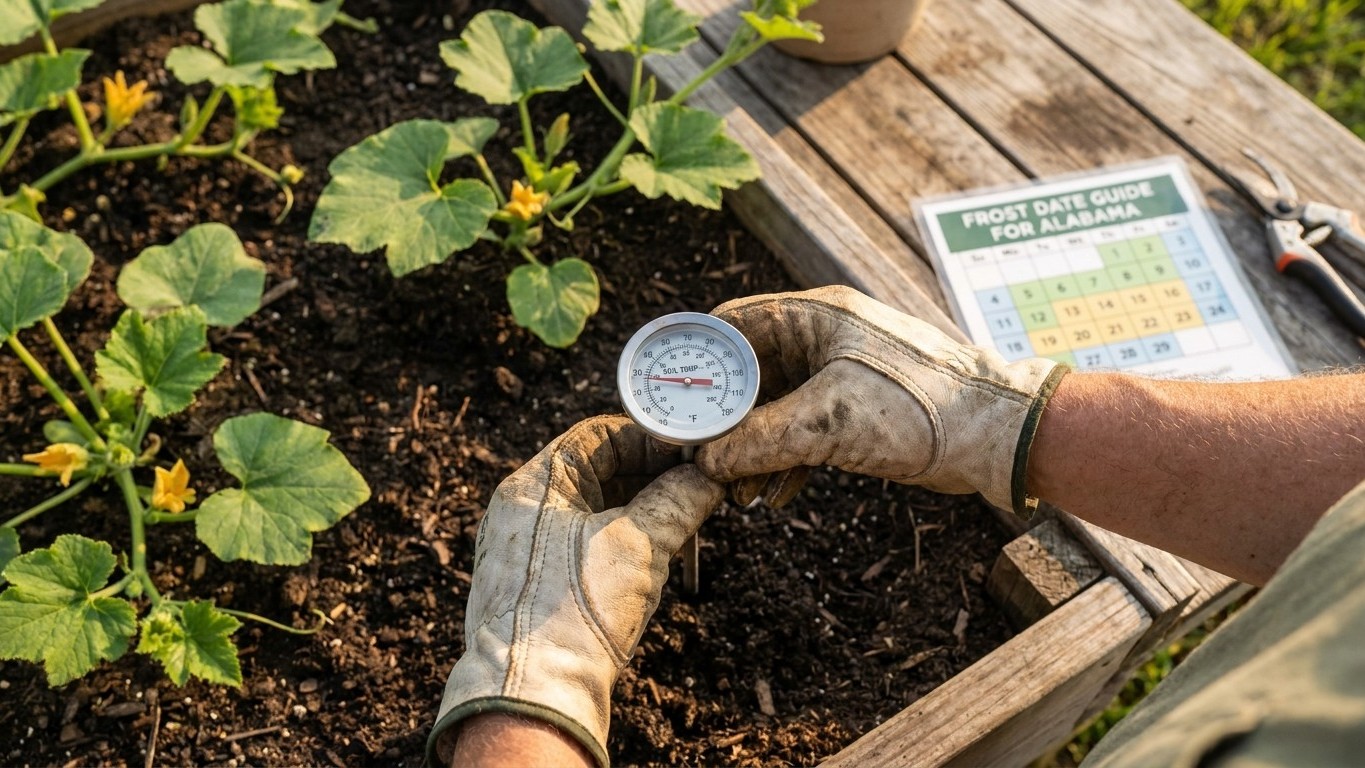
- Track soil temperature directly, not the calendar. A simple soil thermometer pushed a few inches into the bed, checked in the morning before the sun heats the surface, tells you more than any planting chart. Wait for a consistent 65°F reading, not a single warm afternoon spike.
- Use row cover to buy time if you’re pushing the early edge. Row covers laid over the bed can warm the soil faster and let you sow roughly two weeks earlier than bare, exposed ground would allow. That two-week cushion matters most for inland and northwest Connecticut gardens, where the season is already tightest.
- Sow as soon as that 65°F threshold is met, not before. Seed that goes into cold, damp soil sits and rots rather than germinating, which costs more time than waiting an extra week would have.
- Count forward from sowing to your target flowering window. If flowering needs to happen by mid-September at the latest, work backward from that point and treat any sowing date that leaves too thin a margin as a sign to choose a different plan, not a reason to push forward and hope.
- Reassess after a cool, wet spring. Some years, 65°F soil doesn’t arrive until noticeably later than usual. In those seasons, the flowering deadline doesn’t move, so the margin for error shrinks, and it’s worth leaning on row cover or a slightly later target fruit set instead of forcing an early sowing into soil that isn’t ready.
What goes wrong here
- A late flower that never colors up. When sowing gets pushed into June because of a cold, wet spring, flowering can slide past the safe mid-September deadline. The fruit sets, grows, and then runs out of the 45 to 55 days it needs before frost. Remedy: sow the moment soil hits 65°F rather than waiting for a “safer-looking” week, and use row cover early in the season to pull that date forward.
- A fruit caught by frost before it hardens. Connecticut’s frost window opens as early as October 28 in some areas, and a pumpkin that’s still soft-skinned when that first cold night hits will bruise, soften, or rot within days. Remedy: harvest with the stem attached before frost arrives, rather than leaving fruit on the vine to “finish” once the forecast turns risky.
- A vine that dies back before the skin hardens. Powdery mildew, squash vine borer damage, or simple late-season stress can kill foliage weeks before the fruit is ready, leaving pumpkins to ripen without the leaf cover and root support they need. A collapsed vine also leaves fruit more exposed to squash bugs and cucumber beetles looking for an easy target late in the season. Remedy: keep vines as healthy as possible through September, since a vine that collapses in late August effectively shortens the maturation window no matter what the calendar says.
Common questions
Can I still sow pumpkins in Connecticut in July?
It’s a narrow bet. A July sowing pushes flowering toward late August or early September at best, which only works if the fruit then gets a full 45 to 55 days before frost. In a year with an early frost near the October 28 end of the range, a July sowing leaves almost no margin for error.
Does variety choice change the sowing date?
The Utah State University Extension source behind the 45-to-55-day figure and the 65°F sowing threshold doesn’t attach separate day counts to specific varieties, so no reliable variety-by-variety adjustment is published here. Growers choosing among varieties such as Jack O’Lantern, Connecticut Field, Howden, Cinderella, Long Island Cheese, Big Max, Sugar Pie, Baby Pam, or Atlantic Giant should treat the general flowering-to-frost math as the guide, not a specific number tied to any one of those names.
How should I store pumpkins after harvest in Connecticut?
The Utah State University Extension source doesn’t publish a storage temperature, humidity level, or keeping time for pumpkins, only the general guidance to keep harvested fruit somewhere it won’t freeze. Beyond that, no specific figure is available here.
What if my soil never reliably hits 65°F until late in spring?
That’s common in Connecticut’s cooler inland valleys and higher elevations, where the soil lag behind air temperature is more pronounced than near the coast. In that situation, row cover to gain roughly two weeks becomes more valuable, since it narrows the gap between when the soil is actually ready and when the flowering deadline forces a decision.