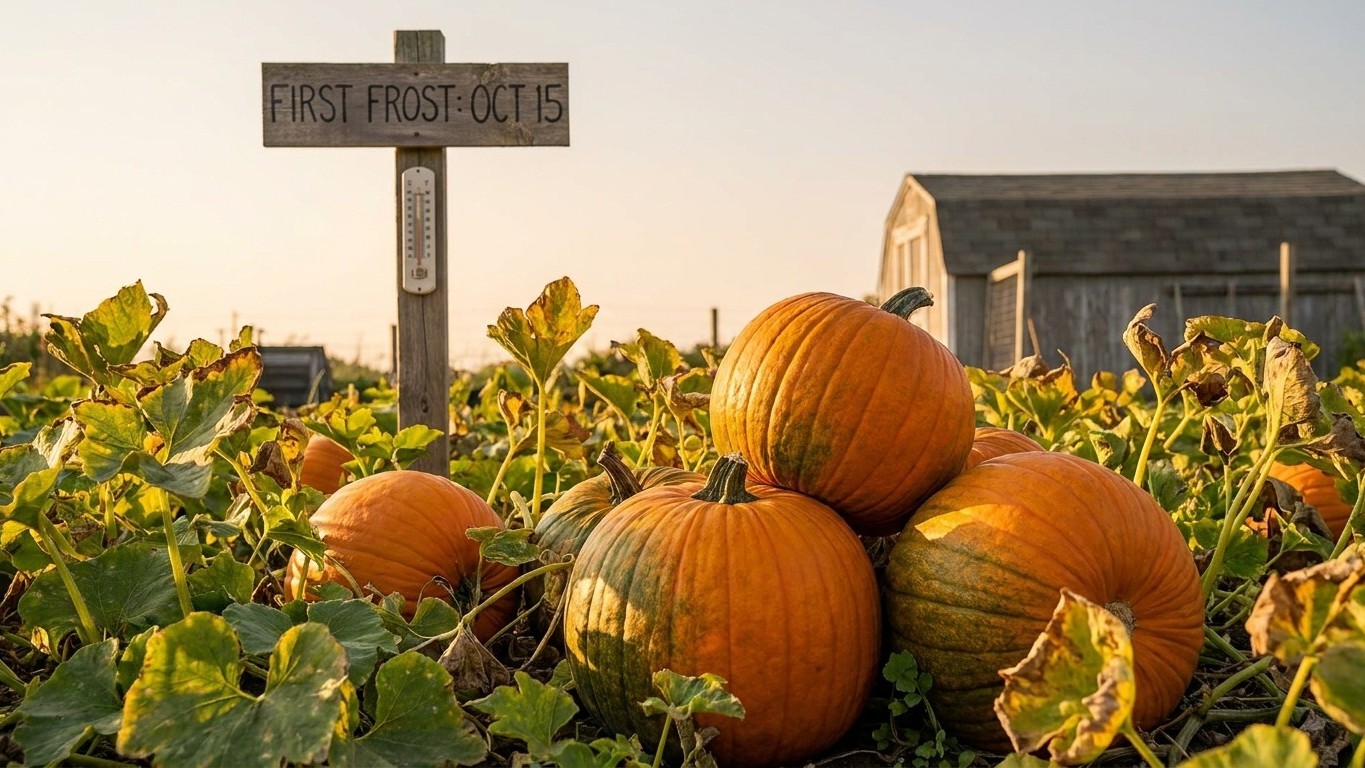

Connecticut’s first fall frost lands somewhere between October 28 and November 10, and a pumpkin needs 45 to 55 days between the moment its flower opens and the moment it’s ripe. Work that backward and you get a real, if narrow, planting deadline. Sow late, or get a cool August that stalls flowering, and the fruit is still green when the frost hits. The clock starts at flowering, not at seeding, and that distinction is the whole game.
The short answer
Start with the frost date, because everything else in this calculation hangs off it. NOAA’s 30-year climate normals for the Bridgeport station put Connecticut’s first fall freeze in a window running from October 28 to November 10. That’s not a single day to circle on the calendar. It’s a spread of nearly two weeks, and which end of it you land on depends heavily on where in the state you garden.
Count backward 45 to 55 days from that window, since that’s how long a pumpkin needs from the day its flower opens to the day it’s ripe, according to Utah State University Extension. Using the earliest frost date (October 28) and the longer end of that maturation range (55 days) gives the most conservative cutoff: around September 3. Using the latest frost date (November 10) with the shorter end of the range (45 days) gives the most generous cutoff: around September 26. So the real answer sits somewhere in that stretch, roughly the first days of September to the last week of the month, depending on your local frost timing and which pumpkin variety you’re growing. For a full breakdown of when to sow pumpkins in Connecticut, and for a deeper look at how these numbers play out across the state, see Will Pumpkins Ripen Before Frost in Connecticut?
That’s the cutoff for flowering, not for planting the seed. A flower that opens after that window closes is racing a fruit that won’t finish coloring before the vine freezes. One that opens comfortably before it has a real shot at a full-orange pumpkin with a hardened rind, ready to pull with the stem intact.
Here’s the part that trips people up: the Bridgeport station sits right on Long Island Sound, which makes it the mildest spot in the state for frost timing. Inland and northwest Connecticut cool off earlier in the fall and warm up later in spring, which means gardeners away from the coast should treat the early end of that frost window, and therefore the early end of the flowering cutoff, as the one to plan around. If you’re gardening in the Litchfield hills rather than along the shoreline, aim for flowers open by early September rather than banking on that back half of the month.
When to sow here
- Anchor your planning to the last spring frost window, not the calendar page. Connecticut’s last spring frost falls between April 2 and April 12, according to the same NOAA climate normals. That date matters less for pumpkins than you’d think, though, because pumpkin seed doesn’t care about air temperature. It cares about soil temperature.
- Wait for the soil to hit 65°F before you drop a seed. Utah State Extension is specific on this: pumpkins are sown once soil temperature reaches 65°F, and that threshold is reached well after the last frost date, not on it. Soil warms slower than air in spring, sometimes lagging by weeks, so treating April 2 to April 12 as your sowing date is a mistake that costs you a cold, slow-germinating seed sitting in wet ground.
- Use row covers if you want to push the date earlier. Floating row covers laid over the bed trap solar warmth in the soil underneath, and gardeners commonly use them to buy roughly two weeks against the calendar, letting the ground beneath reach 65°F sooner than bare soil in the open would. That two-week cushion can be the difference between a flower that opens in early September and one that opens in late September, which, given the cutoff window above, is the difference between orange and green.
- Work backward from your latest safe flowering date, not forward from the last frost. Once you know the soil has reached 65°F and you’ve decided whether row covers are part of your plan, the sowing date falls out of that math rather than off a frost calendar. The safer the margin you build in before that September cutoff, the less a slow, cool summer can hurt you.
What goes wrong here
- A late flower that never colors up. This is the single most common failure tied to Connecticut’s season length. A vine sown too late, or one slowed by a cool, wet stretch in midsummer, pushes its first female flowers past that September cutoff. The fruit sets, grows, but runs out of the 45 to 55 days it needs before frost shuts things down, leaving a pumpkin that’s full-sized but still green or blotchy. The remedy starts the previous spring: sow as soon as soil hits 65°F rather than waiting for a “safe” later date, and track when your first female flowers actually open so you know early whether you’re on pace.
- A fruit caught by frost before harvest. Because Connecticut’s frost window spans nearly two weeks (October 28 to November 10), a pumpkin that would have finished fine in a mild year can get nipped in a year the freeze lands early. Frost damage on the rind speeds rot in storage even if the fruit looked ripe the day before. The fix is straightforward: watch the forecast as that window approaches, and throw a blanket or tarp over exposed fruit on any night frost is predicted, rather than assuming you have until Halloween.
- A vine that dies back before the skin hardens. Vines under stress late in the season, whether from disease, drought, or just running out of gas, can collapse before the rind has fully toughened, leaving a pumpkin with thin, easily bruised skin that won’t keep. Utah State Extension’s guidance here is to harvest with the stem attached and move the fruit somewhere it won’t freeze, rather than leaving it on a dying vine hoping the skin will finish curing in place. A pumpkin cut and moved indoors continues hardening better than one left exposed on a collapsed vine.
Checking this against your own county
Everything above is built on a single coastal weather station, and Connecticut’s frost timing shifts meaningfully once you move away from the Sound. If you garden inland, in the Litchfield hills, or anywhere north of the immediate shoreline, your actual first frost is likely to arrive earlier than the October 28 to November 10 window, and your last spring frost later than April 2 to April 12. That shifts your safe flowering cutoff earlier too.
UConn Extension, the state’s land-grant extension service, is the resource to check against your specific county before you finalize a sowing date. Local extension offices track frost patterns and growing-season length at a finer resolution than a single statewide station can offer, and they can tell you whether your particular corner of Connecticut runs closer to the coastal numbers here or noticeably tighter.
Common questions
Do the 45 to 55 days count from when I plant the seed?
No. That range runs from the day the flower opens, not from sowing or transplanting. Seed-to-flower time isn’t part of the published figure, so track your first female flowers directly rather than counting from planting day.
Is 65°F soil the same as the last frost date?
No, and treating them as the same is the most common timing mistake. Soil temperature lags air temperature by weeks in spring, so a bed can sit well below 65°F for some time after the last frost has already passed.
How should I store pumpkins once they’re harvested?
Utah State Extension’s guidance is limited to keeping harvested fruit “where they will not freeze.” No specific storage temperature, humidity level, or keeping time is published, so beyond avoiding freezing conditions, there’s no further figure to go on here.
What if my flowers are still opening past the cutoff window?
That’s a sign the fruit is unlikely to fully ripen before frost. At that point, checking your specific county’s frost timing through UConn Extension is more useful than guessing, since coastal Connecticut and the inland northwest can differ by a meaningful stretch of days on both ends of the season.