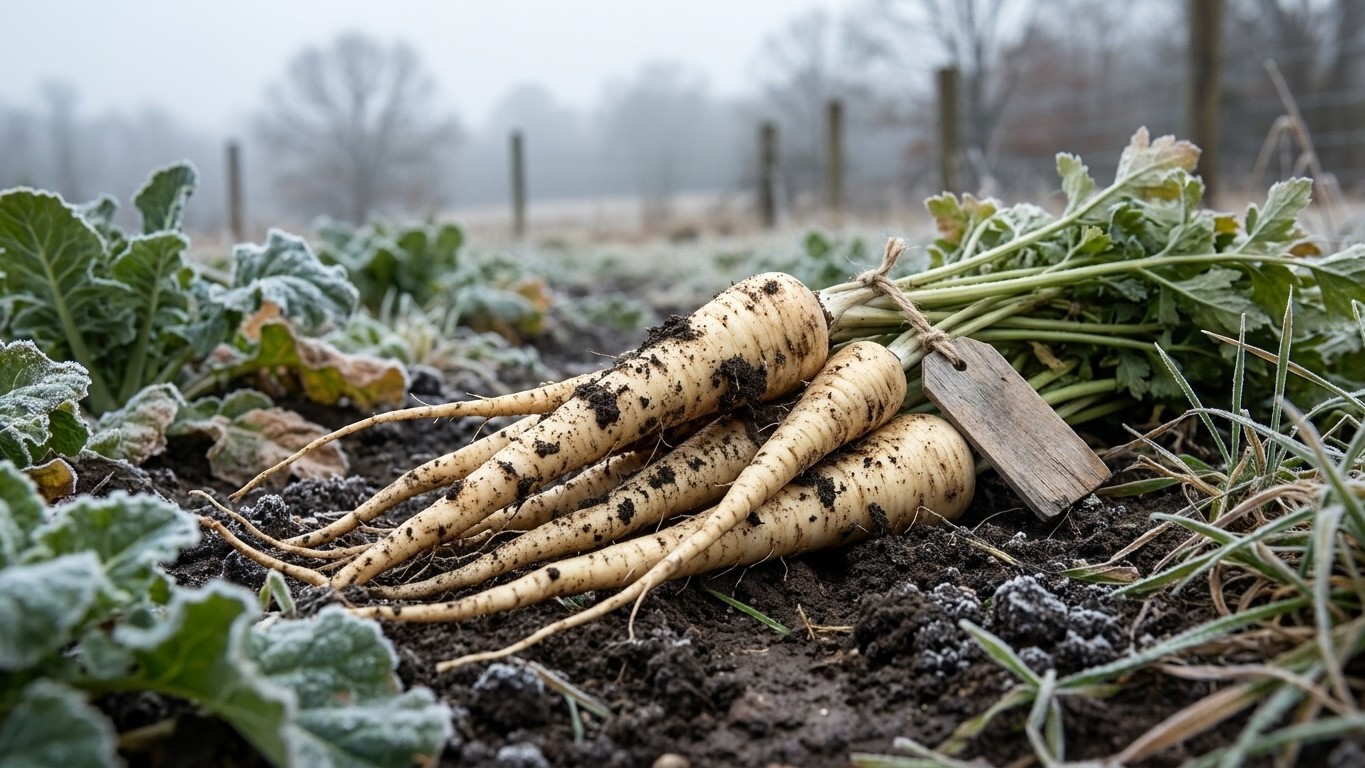

Yes. Massachusetts delivers the frosty weeks parsnips need to turn starch into sugar, and the mean minimum temperature of the coldest month sits at 23.1°F at the Boston reference station, cold enough to sweeten roots left in the ground well past the first freeze. The season length also works, provided you sow early and leave the crop alone until frost has done its job.
The short answer
Start with the number that actually settles this question: does Massachusetts hand a parsnip several weeks of hard cold, or just a light chill that fades fast? At the Boston-area reference station, the mean daily minimum for the coldest month lands at 23.1°F. That’s not a record low and not some rare cold snap. It’s the average low across the coldest stretch of winter, which means freezing nights aren’t an occasional event here, they’re the baseline for weeks at a time.
That figure matters more than any hardiness zone label. A hardiness zone tells you what a perennial plant can survive over winter. It says nothing about whether a root vegetable sitting in the ground gets exposed to enough frost to convert its stored starch into sugar. Those are two different questions, and conflating them is the most common mistake gardeners make when they research parsnips. A state can sit in a mild zone and still deliver plenty of frost exposure, or sit in a harsher zone and still miss the mark if winters arrive late and leave early. Massachusetts doesn’t have that problem. A mean minimum of 23.1°F in the coldest month means the ground is regularly dropping well below freezing, night after night, for an extended stretch.
Parsnips need exactly that kind of repeated cold exposure. According to Utah State University Extension, the roots taste best after several weeks of cool, frosty weather, because that cold converts stored starch into sugar. A single overnight frost won’t do it. A mild winter that dips to freezing once or twice and then rebounds won’t do it either. What works is a sustained cold period, the kind Massachusetts winters reliably produce.
So the answer here isn’t a maybe. A parsnip grown in Massachusetts soil, left in the ground through the fall frosts and into the start of winter, will sweeten. It won’t just grow to size and stop there, the way it might in a warmer coastal climate with a mild, brief winter. The frost exposure is built into the local climate pattern, not something a gardener has to hope for. The remaining question is timing, whether the growing season itself leaves enough runway to get a mature root in the ground before that cold arrives, and that’s a separate calculation from the sweetening question.
Does the season fit?
Parsnips are sown directly in the garden bed, not started indoors and transplanted, and Utah State University Extension puts the timeline at 100 to 120 days from seeding to maturity, with germination itself taking 14 to 21 days before any green even shows. That’s a long runway, and the standard advice is to get seed in the ground 2 to 3 weeks before the last expected spring frost. Here’s how that lines up against Massachusetts’ frost calendar, using the state’s climate normals for spring and fall frost.
- Work backward from the last spring frost. NOAA’s 1991-2020 normals put the last spring frost window at April 1 to April 8 for the Boston-area reference station. Sowing 2 to 3 weeks ahead of that lands seed in the ground between roughly March 11 and March 25.
- Add germination time. Parsnip seed is slow, 14 to 21 days before sprouts appear. A March 11 sowing means seedlings by early April; a March 25 sowing pushes emergence into mid-April.
- Add the 100 to 120 day maturity window, counted from seeding, not from emergence. A March 11 sowing reaches maturity somewhere between June 19 and July 9. A March 25 sowing reaches it between July 3 and July 22.
- Compare that maturity date to the first fall frost. NOAA’s normals put the first fall frost at November 3 to November 14. Even the latest maturity estimate, late July, leaves more than three months of cushion before the ground freezes.
- Use that cushion for sweetening, not for growing. Roots that mature by midsummer simply sit in the ground, sizing up further, until the first fall frost arrives and starts the starch-to-sugar conversion. The extra weeks after that first frost, right through mid-November and beyond, are what push the flavor from decent to genuinely sweet.
That’s a comfortable fit, not a tight one. Even a late sowing, held back by cold, wet March soil, still reaches maturity with months to spare before frost. The margin gives gardeners room to wait for workable soil rather than rushing seed into ground that’s still too cold or too wet to germinate evenly. Inland pockets and the Berkshires see frost arrive earlier and linger later than the Boston-area reference station suggests, which trims the cushion somewhat but rarely erases it entirely.
What goes wrong here
- Forked roots in heavy or stony ground. Much of Massachusetts sits on glacial till, soil left behind by retreating ice sheets, dense, compacted, and often loaded with rocks and stones close to the surface. A parsnip taproot hits an obstruction and splits into two or three legs instead of growing straight down. Utah State University Extension recommends deep sandy soil for this crop, and where that’s not the native condition, double digging the bed to break up compaction and remove stones down to at least a foot deep solves the problem before seed ever goes in.
- Forked roots from overwatering. This is a separate cause from soil texture, and it’s easy to confuse the two. Inconsistent watering, especially heavy soakings after dry stretches, encourages the root to branch rather than push down in a single line. Even, moderate moisture through the growing season keeps the taproot growing straight, regardless of how well the soil itself was prepared.
- A season that runs short in the coolest inland pockets. The Boston-area frost dates are the mildest in the state; the Berkshires and interior valleys see frost earlier in fall and later in spring. A gardener there sowing at the tail end of the recommended window, late March, can find the maturity date pressing closer to an earlier local frost than the statewide normals suggest. Sowing at the earliest safe point in the window, rather than the latest, protects that margin.
- Pulling roots too soon after the first frost. The first fall frost starts the sweetening process, it doesn’t finish it. Harvesting the day after that first freeze gets a root that’s still mostly starch. The flavor payoff comes from leaving roots in the ground through several more weeks of cold, letting the sugar conversion continue rather than cutting it short out of impatience.
Common questions
Can parsnips survive being left in the ground all winter in Massachusetts?
The mean minimum of 23.1°F in the coldest month reflects sustained freezing conditions, and parsnip roots handle that cold well underground, particularly once insulated by soil and any snow cover. Gardeners commonly leave roots in place through multiple frosts specifically to build sweetness, though very hard, prolonged ground freezes can make digging difficult without advance mulching.
Does the variety of parsnip change whether it sweetens?
The sourced guidance here doesn’t name a specific variety, and none should be assumed. The sweetening mechanism, cold converting starch to sugar, is a general trait of the crop tied to frost exposure rather than to any one named cultivar.
What if my soil isn’t sandy like the guidance recommends?
Deep sandy soil is described as a starting point, not a requirement. Heavy soil common across Massachusetts can be double dug to loosen compaction and remove rocks, giving the taproot a clear path down even where sand isn’t the native condition.
Is a hardiness zone rating a reliable way to predict sweetening?
No. A hardiness zone measures whether perennial plants survive winter cold, not whether a root crop gets enough frost exposure to sweeten. The mean minimum temperature of the coldest month, 23.1°F here, is the relevant figure, since it reflects sustained frost rather than a single winter low.