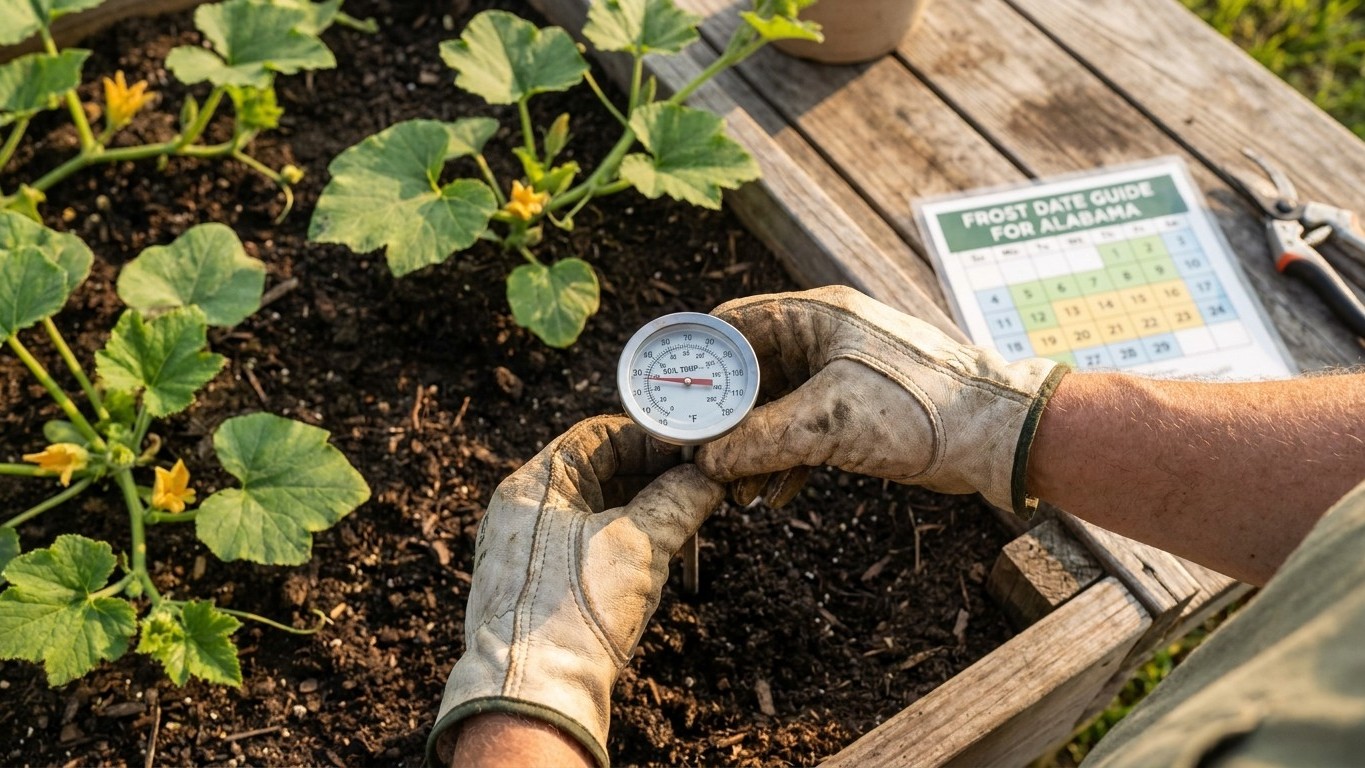

Minnesota gardeners get one real planting signal for pumpkins: soil temperature, not the calendar. Once soil reaches 65°F, seeds can go in the ground. But the sowing date is only half the equation. The other half runs backward from the state’s first fall frost, through a 45-to-55-day flowering-to-harvest clock that Utah State University Extension lays out for pumpkins everywhere. Get that backward math wrong, and you end up with green fruit in October.
The short answer
Minnesota’s first fall frost lands somewhere between October 11 and October 23, according to NOAA’s 1991-2020 Climate Normals for the Twin Cities station. That’s a twelve-day window, not a fixed date, and it matters because it sets the outer edge of the entire pumpkin-growing season here. Everything else in the calendar works backward from it.
Utah State University Extension puts pumpkin maturation at 45 to 55 days after flowering, not after seeding. That distinction is the whole point of this page. A vine can look healthy, be covered in leaves, and still fail if the last flower it opens comes too late to finish that 45-to-55-day countdown before frost arrives.
Run the subtraction both ways. Counting back 45 days from the earliest frost date, October 11, lands on August 27. Counting back the full 55 days from that same date lands on August 17. On the milder end of the frost window, October 23, the same math gives September 8 for the 45-day version and August 29 for the 55-day version.
That gives a flowering deadline somewhere between mid-August and the first week of September, depending on where in Minnesota you garden and how long your particular pumpkin variety takes to ripen after bloom. A flower that opens August 20 has a real shot at a colored, hardened pumpkin. A flower that opens September 15 is racing a frost it probably won’t beat.
This is why the source’s caution matters so much here: cross the 45-to-55-day window against your local frost dates, every time, rather than trusting a single “days to maturity” number printed on a seed packet. The Twin Cities sit at the mild southern edge of the state’s frost timing. Northern Minnesota runs two to three weeks tighter at both ends of the season, which pulls that flowering deadline earlier still, sometimes into the first half of August rather than the last week.
None of this tells you when to put seed in the ground yet. That’s a separate calculation, and it starts with soil, not air.
When to sow here
- Wait for the soil, not the frost date. Minnesota’s last spring frost falls between April 17 and April 30, per the same NOAA Climate Normals data. But pumpkin seed doesn’t care about frost directly. It cares about soil hitting 65°F, and soil warms far slower than the air above it. Bare Minnesota garden soil typically doesn’t reach that mark until several weeks after the last frost date has passed, since the ground has to absorb weeks of sun before it stores enough heat at seed depth.
- Account for the lag before you set a date. If the last frost clears by the end of April in the Twin Cities area, that’s the earliest the air stops freezing, not the day the soil is ready. The gap between “frost is over” and “soil is 65°F” is exactly the trap gardeners fall into when they sow by the frost date alone and then watch seed rot in cold, damp ground.
- Use row covers to close part of that gap. Row covers laid over the planting area typically buy about two weeks of extra soil warmth, according to standard extension guidance on season extension. That means a gardener willing to use covers can sow roughly two weeks earlier than bare soil would otherwise allow, without waiting for the ground to warm entirely on its own.
- Adjust for where in Minnesota you’re planting. Southern Minnesota, including the Twin Cities, has the milder end of both frost windows working in its favor: a later spring frost cutoff isn’t the issue, an earlier fall frost isn’t as early. Northern Minnesota, where the whole frost calendar runs two to three weeks tighter, has less room on both ends, which makes the two-week cushion from row covers considerably more valuable there.
- Work forward from soil temperature, not backward from a fixed date. Because the source data doesn’t publish an exact soil-warming date for Minnesota, the honest answer is to test the soil directly, either with a soil thermometer or by watching how consistently daytime highs have held before sowing, rather than circling a date on the calendar and hoping the ground agrees with it.
The upshot: sowing happens once soil is genuinely warm, which lands later than most gardeners expect relative to the last frost, and the flowering deadline calculated above is what tells you whether that later start still leaves enough runway.
What goes wrong here
- A late flower that never colors. This is the single most common failure tied to Minnesota’s season length. A vine sown too late, or slowed by a cool, wet spring, keeps flowering into September, past the mid-August-to-early-September deadline calculated from the frost window. The fruit sets but never finishes coloring before growth stalls. The remedy is tracking your vine’s actual flowering dates against the local frost window rather than assuming a “days to maturity” number on a seed packet will hold; if flowering is running late, that fruit is unlikely to fully ripen regardless of what happens next.
- A fruit caught by frost before the clock runs out. Even a flower that opens within the deadline still needs its full 45 to 55 days. If frost arrives at the early end of the window, October 11, a fruit that’s only 35 days along is still green inside a hardening shell. The remedy is harvesting with the stem attached before frost hits, even if the fruit is a few days short of full maturity, since a pumpkin left on a frozen vine won’t finish ripening and will start to break down instead.
- A vine that dies back before the skin hardens. Foliage loss, whether from disease pressure or an early cold snap, cuts off the vine’s ability to keep feeding the fruit through the final hardening stage. A pumpkin exposed on a dead vine with soft, thin skin won’t hold up in storage even if it survived to a decent size. Keeping vines healthy through the full flowering-to-harvest window matters as much as the sowing date itself; pressure from squash bugs and cucumber beetles is one of the more common causes of that early dieback in Minnesota gardens, and both pests have their own dedicated pages on this site worth checking if leaves are yellowing or wilting mid-season.
Common questions
Can I sow pumpkins directly from seed in Minnesota, or do I need to start indoors?
The source data used here covers soil temperature and the flowering-to-harvest clock, not indoor-starting guidance specifically. What it does establish is that direct sowing depends entirely on soil reaching 65°F first; if that date lands too close to your local flowering deadline, starting seed indoors ahead of that soil-ready date is the practical way to buy extra time within the season.
Does northern Minnesota really need a different sowing schedule than the Twin Cities?
Yes. Both the spring frost window (April 17 to April 30) and the fall frost window (October 11 to October 23) come from a Twin Cities station, and the source data flags that northern Minnesota runs two to three weeks tighter on both ends. That compresses the entire flowering deadline earlier and makes the two-week cushion from row covers more important there than in the milder south.
What happens if my pumpkin flower opens after the deadline?
Based on the 45-to-55-day maturation window, a flower opening after early September in most of Minnesota is unlikely to produce a fully ripened, hardened pumpkin before the first fall frost arrives. The fruit may set and grow, but it typically stays underdeveloped or green when cold weather cuts the season short.
Is there a published storage temperature for Minnesota-grown pumpkins?
Not in the source used for this page. Utah State University Extension specifies harvesting with the stem attached before frost and storing pumpkins “where they will not freeze,” but does not publish a specific storage temperature, humidity level, or keeping time. Any more precise storage figure would need a different, dedicated source.